Limping since childhood – apparently due to a clubfoot – Napoleon’s foreign minister Charles Maurice de Talleyrand was much less bellicose than his boss.
Yes, during the French Revolution, he supported the war on the Catholic Church, but in the summer of 1807, after the emperor’s great defeats of the Austrian, Prussian, and Russian armies, and after Talleyrand crafted diplomatic pacts that consolidated France’s victories, he warned against attacking Russia. The realistic diplomat was overruled, and he resigned.
It would take five years for him to be vindicated, when Napoleon marched on Russia ahead of some 400,000 troops, most of whom were buried under its snow. In the interim, the newly jobless Talleyrand tried to prevent the fiasco by holding secret talks with the Russian czar and the Austrian foreign minister, in vain.
Talleyrand’s hope to secure a deal that would save the French Revolution’s achievements was the kind of subversive effort that some in today’s Iranian government are seeking as their own revolution faces the consequences of its version of Napoleonic overreach. However, as Russia’s war on Ukraine this month enters its fifth year, the point is not Iran, but Russia, and more specifically, the misunderstanding of Russia, and this time around, not by Napoleon, but by Russia’s own leader.

Putins turbulent rule
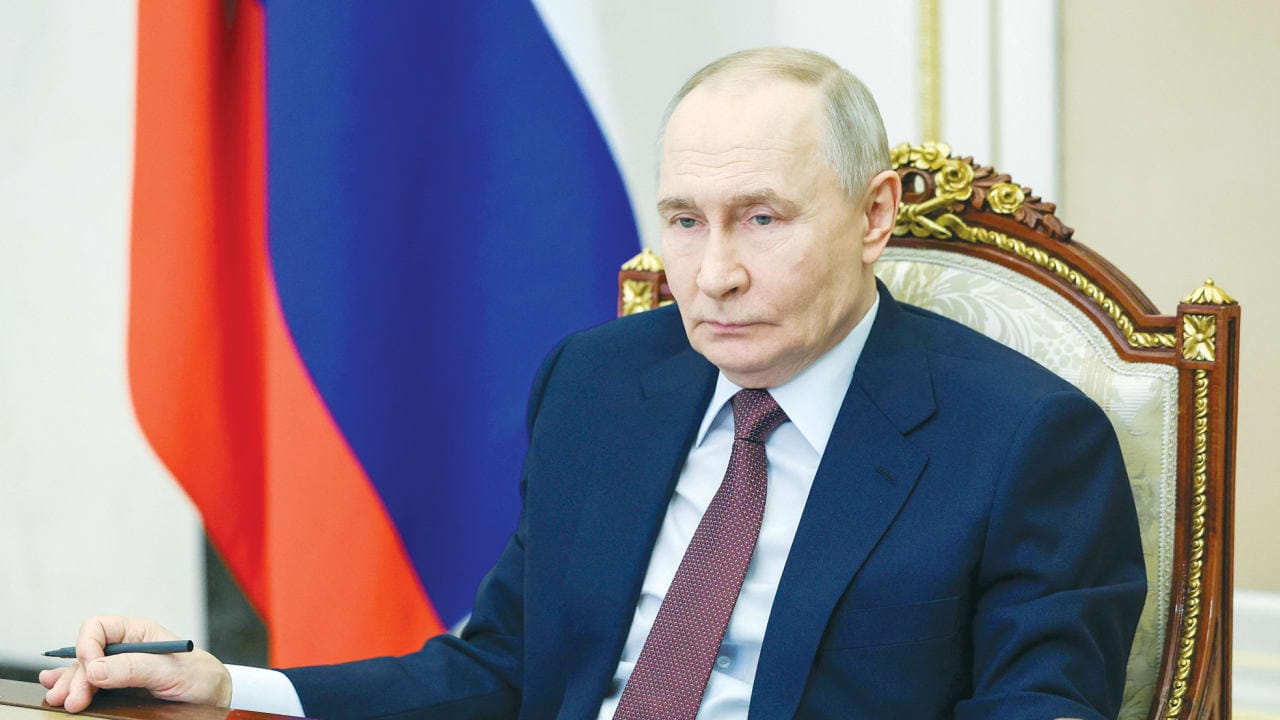
The famous warning sometimes attributed to Talleyrand, that “Russia is never as weak as it seems and never as strong as assumed,” has been vindicated by President Vladimir Putin in both halves of this dictum.
The man who has ruled Russia for the past 26 years initially took it from the turbulence of its first post-communist decade to renewed stability and relative prosperity. Using his country’s bottomless natural resources, Putin both restored a previously insolvent Russia’s status as an industrial power and turned it into a major grain exporter.
That domestic focus lasted some eight years. Then, in the summer of 2008, with Wall Street’s unfolding meltdown apparently tempting him to challenge America, and with resurging oil prices – $147 per barrel – bolstering his confidence, Putin invaded Georgia.
It was the beginning of an ambitious imperial drive, which the following decade veered west, to Crimea, and in this decade became an all-out war on Europe’s largest country, Ukraine. Now, four years and 1.8 million overall casualties later, Putin’s war looms as an exercise in military futility, national delusion, and political self-defeat.
The military plan fell apart in its first days. The idea was to quickly encircle and conquer the Ukrainian capital, remove its elected government, and replace it with a collection of collaborators.
The Ukrainian army, however, did not play by this script. Staging a fight Putin had not expected, it blocked the Russians. The Russian army, which was planned to emerge from its grand invasion as a formidable force the whole world would fear, emerged instead as an undertrained military with dated equipment and subpar command.
Like Napoleon’s cavalry in Russia’s snowfields, Putin’s troops died by the thousands across Ukraine’s wheatfields. Worse, his military commanders displayed an utter lack of professionalism, agility, and inventiveness. Armored platoons failed to maneuver in the face of missile ambushes, and logistical units failed to deliver crucially needed ammunition, gas, and food.
Having so far cost an estimated 1.2 million dead and wounded Russian troops (according to the Washington-based Center for Strategic and International Studies), the invaders failed not only to take Kyiv but also to conquer turf, much less unseat the Ukrainian government. The 20 percent of Ukrainian land that Russia had snatched prior to the 2022 invasion has since grown by hardly 2%.
These fundamentals are not likely to change. Whatever this war’s diplomatic aftermath, Ukraine will remain independent, its government will be Ukrainian, and its land will be mostly intact. And since all these were exactly what the Kremlin’s war was meant to undo, the military result of its gamble is a major-league fiasco. Then again, the military debacle’s political meaning and national price are even worse.
The QUS to undo Ukraine was part of a professional spy’s longing for the vanished superpower that gave him his career. It was the quixotic romanticism of a new leader who set out to restore an old world.
Inspired by yesteryears’ czars, Putin’s foray into Ukraine was but a detail in much grander imperial designs. Still seeing the West as the enemy that it had been for his Soviet masters; and making good use of then-US president Barack Obama’s gullibility – Putin utilized the Syrian civil war to restore some of Moscow’s global reach.
Using his air force, Putin decided the Syrian war’s outcome, while he signed arms deals with Cairo, Riyadh, and Tehran. For a moment, Russia’s lost sway seemed ready to make a grand return, but then came Putin’s Ukrainian misadventure, and destroyed that effort as well.
With Russia’s military energies sapped, it was helpless in the face of its ally Bashar Assad’s downfall. And with Russian arms as poor as they have been exposed in Ukraine, their marketability has been dealt a massive blow.
Worse, the war that was designed to erase Ukraine’s nationhood and use its disappearance as a neo-czarist engine has instead consolidated Ukraine’s place among the nations – and made the rest of Europe rush to its aid.
On top of that, the war exposed Russia as a socially ill nation, one whose corruption resulted in poorly manufactured arms and unevenly conscripted troops, with the political elite’s children conspicuously absent from the trenches while convicted criminals were deployed in their place.
This, in brief, is how Vladimir Putin, after proving that Russia was not as weak as some thought, proceeded to prove it was not as strong as some assumed. Just when he will admit his gambit’s failure is anyone’s guess, but the rest of the world already knows that Mother Russia’s reinventor chose war and got defeat.
www.MiddleIsrael.net
The writer, a Hartman Institute fellow, is author of Ha’Sfar Ha’Yehudi Ha’Aharon (The Last Jewish Frontier, Yediot Sefarrim 2025), a sequel to Theodor Herzl’s The Old New Land.