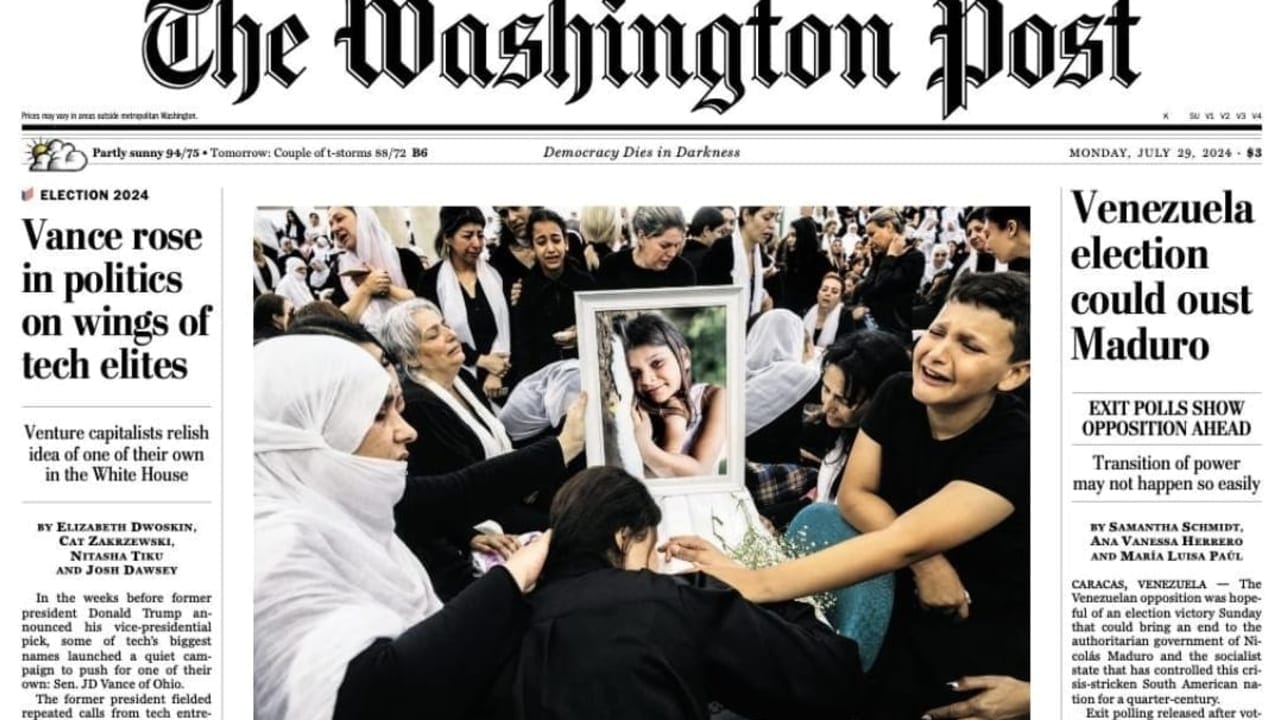
Writing from Jerusalem, where you learn quickly that comfort kills newspapers, let me say this plainly: We’re sorry.
When 300 journalists lose their jobs at a once-great paper (as it announced on Wednesday), democracy gets darker. But The Washington Post (WaPo) died the way it lived: believing moral superiority could substitute for fiscal discipline and that passion makes up for proportion.
The math was simple: Lose $77 million in 2023. Lose $100 million in 2024. Watch organic search traffic drop 50 percent. Bleed 250,000 subscribers when Jeff Bezos blocks your Kamala Harris endorsement. Lose another 75,000 when you shift Right. That’s a suicide note written in quarterly reports.
Here’s the part that stings: Bezos is worth $248 billion. WaPo’s losses round out to zero in his net worth. If he wrote a $100 million check today, he’d go from $248.7 billion to $248.6 billion. You’d need a microscope to see it.
He pulled the plug anyway. Why? Even Bezos couldn’t watch this kind of value destruction forever. Digital revenue fell 14% since 2021. Unique visitors dropped from 1.36 billion to 1.15 billion. The market was screaming something the newsroom refused to hear: You’re done being essential.
Compare that to The New York Times, heading toward 15 million subscriptions and actual profits. WaPo spent years trying to be everything. That’s just another way of being nothing.

When ideology met the income statement
WaPo’s coverage of October 7 tells you everything. It cited casualty figures from the Hamas-run Gaza Health Ministry like it was the Congressional Budget Office. Hamas. The same organization that the US government designates as terrorists. When a mobile billboard circled their headquarters with their logo on a parrot captioned “parroting Hamas lies,” that was the average American speaking.
In November 2023, WaPo ran a Pulitzer winner’s cartoon mocking Hamas for using human shields. The newsroom revolted. Executive Editor Sally Buzbee apologized. Opinion Editor David Shipley called it “divisive.” A major American newspaper couldn’t publish a cartoon criticizing terrorists because it upset the staff.
The numbers tell the story. According to The Intercept in January 2024, in the first six weeks after October 7, it used “massacre” 125 times for Palestinian deaths and only twice for Israelis killed, WaPo. Each Palestinian killed was mentioned eight times on average. Israeli deaths were referenced only once for every two deaths. The word “slaughter” appeared 60 times for Israeli actions and only once for Palestinian killings.
These ratios informed subscribers of the deaths that were significant (at least in their eyes). For the paper’s educated, affluent, often Jewish readers, the message went out: Your concerns don’t count here. They canceled. Thousands of them.
WaPo’s main stories about the Middle East have been corrected multiple times. In hostage swaps, Palestinian prisoners convicted of terrorism were labeled “captives,” drawing condemnation from the Anti-Defamation League (ADL). An erroneous story about Palestinian mothers took over a month to correct; by then, it had long served its purpose.
Jewish voices inside WaPo got drowned out. Internal Slack channels treated “both-sidesism” as a moral failure. When your newsroom thinks that portraying a democracy as the antagonist in its struggle against terrorism is necessary, it has created an environment where dissent leads to dismissal.
Hungry journalists in Jerusalem
At The Jerusalem Post, we’re legacy media too. Founded in 1932. We’ve watched regimes fall and wars end badly. We had our own struggles, our own transformations. The difference? We never had Bezos money. Necessity taught us what WaPo forgot: Size means nothing without substance.
We’re small to medium-sized. That meant making brutal choices about coverage. It meant accepting limits. Most of all, it meant trusting our readers to handle complexity. They’re not children needing protection from uncomfortable facts. They’re adults trying to understand a messy world. The even messier Middle East.
Monday, we’ll defend Israel’s right to self-defense. Tuesday, we’ll question specific military tactics in Gaza. We publish voices across the spectrum because reality is complicated, and following facts beats validating priors. Our readers wake up sometimes confused by our stance. Good. That means we’re doing journalism instead of therapy.
The Washington Post had the luxury of $100 million annual losses. We had to serve readers rather than lecture them. Survival does that. It also keeps you hungry, and hungry journalists will usually be better than stuffed ones.
So what happened in DC? They gutted the metro desk from over 40 reporters to 12. That was their actual barrier, the one thing The New York Times couldn’t replicate. Gone. They eliminated sports entirely, handing that audience to The Athletic. They closed the entire Middle East bureau just as that region exploded in importance.
Meanwhile, they’d spent resources on the “Third Newsroom,” a division chasing Gen Z with “creator-driven content.” Staff called it a money pit. They launched AI podcasts that invented quotes and failed quality checks two-thirds of the time. They held onto Arc XP, their publishing platform, through the pandemic tech boom when they could’ve sold it, then laid off 54 people from the team as it tanked.
This is what happens when you confuse activity with strategy.
The opportunity sitting there
The New York Times owns the luxury progressive market.
The Wall Street Journal has a strong hold on business conservatives. Between them sits the exhausted majority: people tired of both MAGA and the resistance, people who think both parties have lost their minds, and people who want reporting instead of emotional support.
WaPo could’ve owned this. Washington-based. Deep institutional knowledge. Credible reporters. They chose to be the 47th-most-trusted source for progressive orthodoxy instead.
When Bezos finally moved (blocking the Harris endorsement, pivoting opinion toward free markets), subscribers fled in both directions. Progressives felt betrayed. Conservatives remembered a decade of being called deplorables and stayed away. WaPo ended up trusted by nobody, with subscribers who wanted validation and canceled the moment they got disappointed.
Emmanuel Felton, its race and ethnicity reporter, noted management had said race coverage “drives subscriptions.” Six months later, he was laid off. He called it ideological. Maybe. Or maybe they finally realized you can’t build a sustainable business on journalism that alienates half your potential market while making the other half so righteous they’ll bolt over any disappointment.
The Washington Post collapsed because ideological capture met fiscal reality. AI and algorithm changes and print advertising’s death played a role. But the core disease was simpler: They couldn’t tell the truth when it became inconvenient, expensive, or unpopular with staff.
Israel was a test case after October 7. Could you cover a democracy fighting for survival against terrorist organizations without defaulting to the framework where the strong must be wrong? WaPo failed. The United States and Israel, whatever their flaws, are democracies. When you can’t report on terrorists attacking democracies without making the democracies equivalent villains, something is broken in your moral compass.
They have a chance now. Forced by insolvency and Bezos’s refusal to keep subsidizing virtue signaling. They could become a paper covering America and the world as they actually are. That takes intellectual courage. Hiring people who write outside progressive catechism without becoming MAGA trolls. Publishing pieces that make editors uncomfortable. Building readers mature enough to handle disagreement.
It entails reverting to The Washington Post’s former status before moral certainty took the place of moral seriousness. We wish them luck from one Post in a very different capital to another. Democracy needs strong media. Strength comes from telling uncomfortable truths and from understanding that your job is making readers think clearly instead of feel good.
The future belongs to the media that learns this before the money runs out.