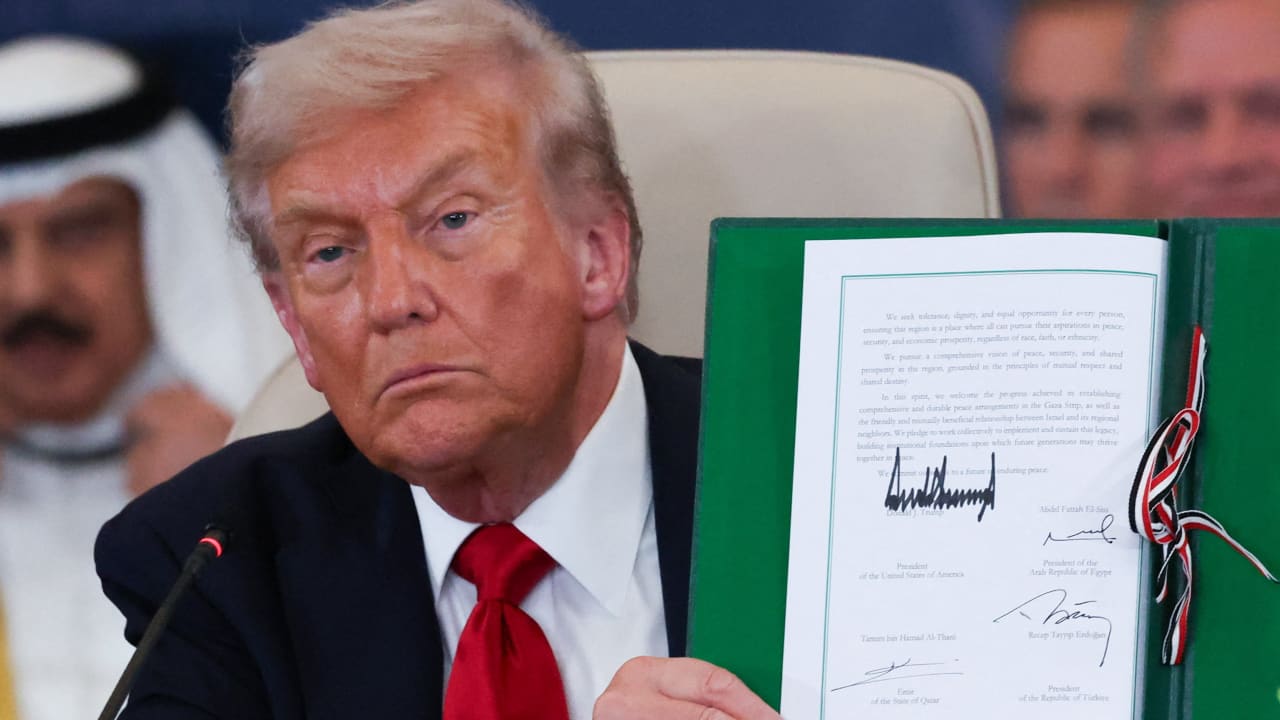
US President Donald Trump continues to import ideas from the business world into international politics, and the Middle East in particular. His latest idea – part of the implementation of his 20-point plan – is the creation of a three-tier governing structure.
At the top is a Peace Council, whose exact number of members has yet to be determined. This is a kind of board of directors under Trump’s leadership, in which he holds veto power. It includes several administration aides, financial figures (such as the president of the World Bank), and leaders willing to join for reasons of prestige – people, who, according to Trump, are all his “friends.”
The middle tier is called the “Executive Council for Gaza.” It functions as a kind of executive committee, composed of figures from various countries, all personally committed to Trump. Among them are Witkoff, Kushner, Tony Blair, and representatives of Turkey, Qatar, the United Arab Emirates and Egypt, as well as a UN representative. There is also an Israeli businessman named Yakir Gabay.
The person tasked with coordinating the council’s work and linking the top tier with the bottom is Nickolay Mladenov, who previously served as the UN envoy to the Middle East peace process and earned wide respect.
The bottom tier is called the “National Committee for the Administration of Gaza.” It is a kind of interim government composed of twelve Palestinian technocrats, at least some of whom are identified with Fatah and the Palestinian Authority. This committee is meant to manage day-to-day life in Gaza. At its head stands Dr. Ali Shaath, who has not previously held a significant political position.

The very establishment of this complex structure can be seen as an achievement, but the real test, as a well-known British saying goes, is in the pudding. In other words, will this structure be able to cope with the multitude of problems awaiting it?
In the absence of a clear answer, it is worth laying out four difficulties facing this new body.
Cooperation among rivals with conflicting interests
At the top tier sit representatives of different states – 24 at the time of writing. As the council expands – it is reported that Trump approached no fewer than 60 individuals – national interests will inevitably come into play. In the meantime, five European leaders have declined their country’s invitation, including France’s Macron and Britain’s Starmer.
The Peace Council is supposed to operate by majority decision, but Trump holds veto power. This means that leaders who have joined are prepared to rubber-stamp Trump’s whims in exchange for membership in what is ostensibly an exclusive club. A larger council would be a personal achievement for Trump, but it would make management of a coherent policy more difficult. Moreover, Gaza will not necessarily be the Peace Council’s main concern, as its mandate is to promote stability in “areas affected by conflict or threatened by it.”
The middle tier is even more complex, because the Executive Council includes from the outset actors with opposing interests – Turkey and Qatar on one side, and the United Arab Emirates, Israel, Egypt, and others on the other. Once the parties confront the core issues, disagreements are likely to emerge that could delay or halt any progress. Notably, Saudi Arabia is not a member of this body, which will give her a disruptive power.
By contrast, the bottom tier of technocrats appears relatively homogeneous – at least in terms of Palestinian identity – though it is reasonable to assume that both the Palestinian Authority and Hamas will exert pressure on each of its members to adopt positions closer to their own.
Demilitarization of the strip and disarmament of Hamas
The most difficult task is the demilitarization of Gaza and the disarmament of Hamas. At the Davos meeting, Jared Kushner presented a master plan for dismantling Hamas, demilitarizing the Strip, and rebuilding it, but it remains unclear who would carry out the first two tasks.
The “international stabilization force” mentioned in Trump’s plan already has an American commander, but it has no army. Countries that committed to sending forces – such as Azerbaijan and Indonesia – have meanwhile backed out. Turkey and Qatar do possess leverage over Hamas regarding both demilitarization and disarmament, but their membership in the Executive Council appears designed to pave the way for the entrenchment of the organization in Gaza. Such an outcome would strengthen their interests in Gaza on the one hand, and bolster Hamas’s “victory” narrative on the other.
A “technocratic government” without a mandate or teeth
The Palestinian committee is composed of individuals chosen not because they represent anyone or anything, but because they do not threaten the important players in the Palestinian arena. Aside from the mandate and consent granted to it, the committee lacks real tools to govern the Strip, and certainly to disarm Hamas and demilitarize Gaza. It can assist in the reconstruction process, but that process is not meant to begin before demilitarization and disarmament are completed. Moreover, the committee is not independent in its decisions or actions, which could undermine the effectiveness of its work on the ground.
Old and new spoilers
Beyond the familiar spoilers – Iran and what remains of its proxies – the composition of the Peace Council could also work against it if important actors remain outside. This is precisely why Trump also approached Putin and others in an attempt to persuade them to join. Russia, China, and even the UN could prove to be forces that complicate reaching understandings and agreements, as they have little interest in serving what currently looks like a one-man show.
To Trump’s credit, the new structure is the product of out-of-the-box thinking. But it is unclear why it was necessary to construct such a complex structure to address Gaza’s well-known fundamental problems. Its very complexity may impede its work.
Israel has effectively been “hobbled” by Trump and cannot act in Gaza entirely as it wishes. If the Peace Council succeeds in achieving peace, Israel will benefit. But the council’s failure – and at present the odds of that seem high – would mean that Hamas entrenches its control over the Strip.
That would, of course, be bad news for Israel, since a renewed war does not appear to be a realistic option, especially given the existence of international involvement in Gaza.
The writer teaches in the Department of Islamic and Middle Eastern Studies at the Hebrew University of Jerusalem and is a member of the executive board of the Mitvim Institute.