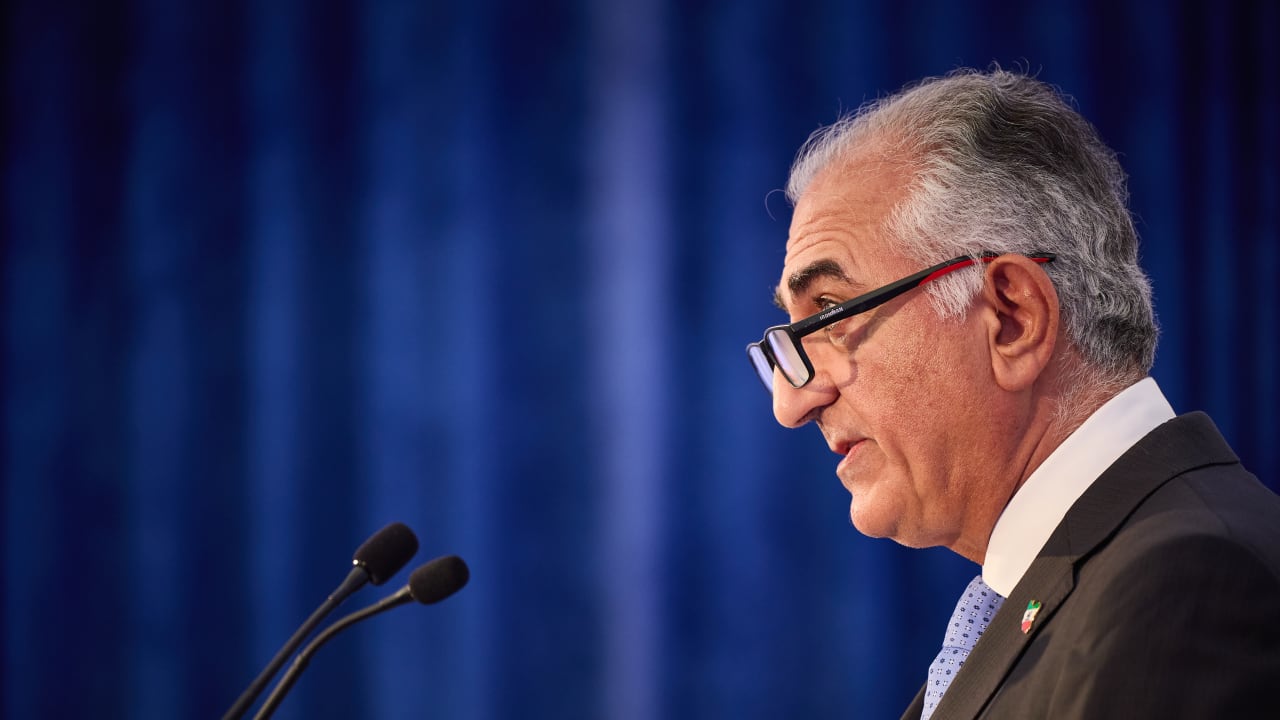
Iran’s cities have seen an uprising of hundreds of thousands – with some reports estimating the nationwide uprising to be multi-million – following Crown Prince Reza Pahlavi’s call to mobilize on January 8 and 9. In city after city, crowds have chanted "Javid Shah" – Long live the King.
Videos circulating online show that cities such as Rasht, Tabriz, and Shahin Shahr are in the hands of protesters and regime forces have fled, with the Lion and Sun flag raised in public squares alongside the crown prince’s photograph.
President Donald Trump has warned the Islamic Republic repeatedly that a crackdown will bring severe consequences. Many witness accounts describe a public mood that this is the decisive moment, the final trench to be taken.
The decisive moment in Iran
If Iranians believe this is the last trench, the Islamic Republic may also treat it as such, and reach for extreme measures to crush it. On January 7, witnesses told the author that the regime was using drones for real-time surveillance, and firing AK-47s and machine guns at protesters in broad daylight, in the province of Fars.
Reports indicate a total communications shutdown and the sound of sustained nonstop gunfire, paired with witnesses recording deployments of biological and chemical weapons to disperse crowds. Any indication of using weapons of mass destruction must be treated as an emergency.

The danger is neither hypothetical nor an exaggeration. Since the Mahsa Amini protests erupted in September 2022, Iran has faced waves of suspected poisonings targeting schoolgirls, with UN experts describing the pattern as “deliberate poisoning.” A major open-source review has also documented the scale and continuity of these incidents across dozens of towns.
The concern is not limited to Iran’s borders. Tehran’s regional strategy has long relied on proxy warfare, and it has stood behind governments accused by international mechanisms of chemical-weapons use, most notably in Syria, where UN- and OPCW-linked findings concluded that the Assad government used toxic chemicals, including chlorine, in documented incidents. Reports suggest that the Islamic Republic is also looking for ways to utilize biological and chemical proxy warfare.
The United States must act
Meanwhile, Washington itself has repeatedly raised chemical-weapons compliance concerns and imposed sanctions tied to Iran’s chemical-weapons research and development, underscoring that the issue is not merely rhetorical.
Just last week, an outlet reporting on Iranian security affairs cited informed sources claiming the IRGC is developing biological and chemical warheads for ballistic missiles, which is a dangerous escalation and should be treated as an urgent trigger for verification and deterrence.
In moments like these, the window for prevention is short. The United States and Israel need to take concrete measures to avoid a mass-atrocity. At this stage, deterrence is not established by threats and press releases. They must establish, immediately and uniformly, that the Islamic Republic will pay a personal and political price for mass repression, and that there is a legitimate alternative center of authority: Crown Prince Reza Pahlavi.
Critics ask why a pro-monarchy stance makes sense in a crisis fueled by public anger. The answer is that Iranian political agency is coherently calling for a restoration. Further, the Pahlavi monarchy offers historical continuity without stagnation. The crown prince can serve as a constitutional bridge, to preserve national identity and institutional stability while allowing a political reset.
A monarchy can function as a stabilizing and unifying symbol above factional conflict, making it hard for the country to fracture into winner-take-all politics. A recognized royal figure can unify security elites who might otherwise cling to the Islamic Republic out of fear of retribution, while also offering protesters an objective-driven pathway that results in regime collapse – as opposed to state collapse.
International recognition of Crown Prince Reza Pahlavi shifts incentives inside the country by signaling to military commanders and bureaucrats that loyalty to the current leadership is a gamble. It also gives foreign governments a partner to coordinate with on urgent national and regional priorities. Recognition creates a recipient for diplomatic pressure and international assistance, in order to claim continuity of the state while rejecting the mass-crimes of the current rulers.
In crises like this, outside powers often hide behind caution until the critical moment is gone. They will say they did not want to “interfere,” even when Iran committed a massacre, and despite mass calls for restoration. If the US and Israel want to prevent a crackdown, they must act before the blackout becomes a bloodstain.
Recognize the crown prince. Isolate the Islamic Republic’s decision-makers. Punish the act of silencing. And make unmistakably clear that biological and chemical coercion and mass repression will end any future the current regime leadership thinks it has. Deterrence works when it is early, specific, and credible. The time for this deterrence is now – while people are still alive to be protected.
The author holds a PhD in International Relations from Queen’s University.