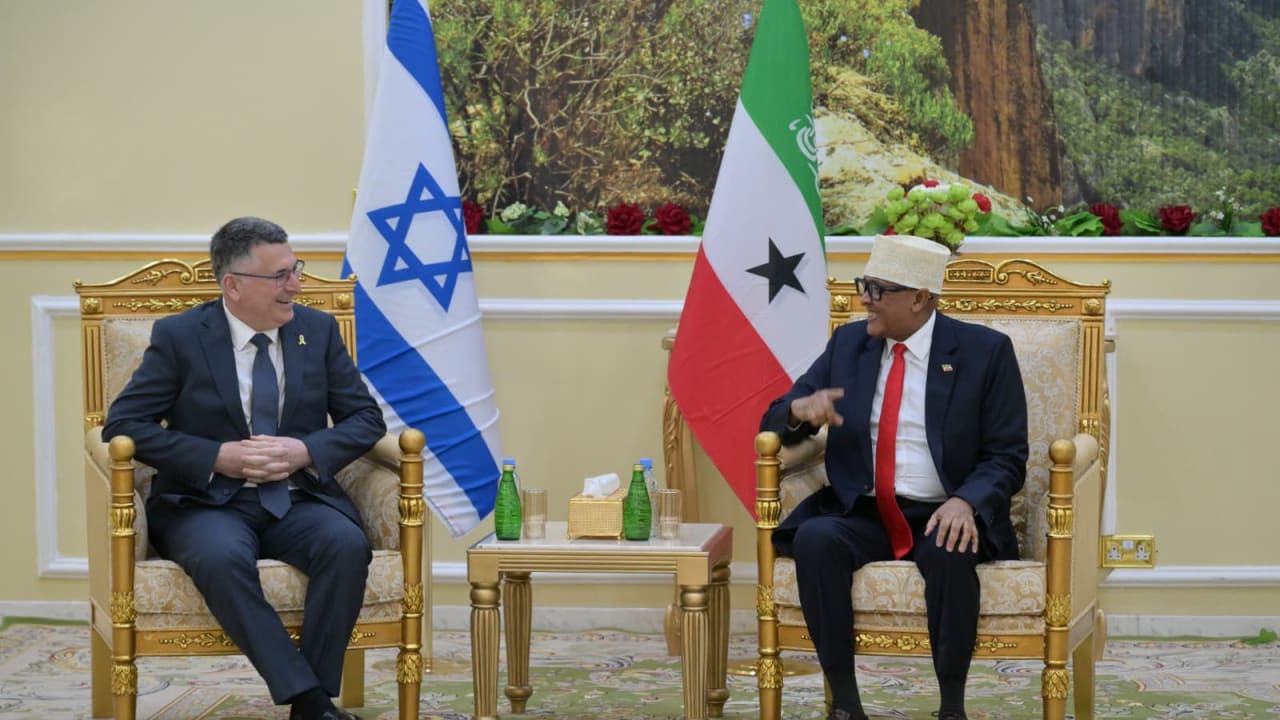
The news that Israel is the first – and for now the only – country to recognize Somaliland as an independent state may, at first glance, seem like yet another anecdote on the margins of Israeli diplomacy. But, in fact, this move exposes one of the most embarrassing paradoxes in the international arena, holding up an unflattering mirror to many countries that in recent years have recognized the “State of Palestine.”
In the world – at least the Western world – which claims international law as its guiding light, the case of Somaliland versus the Palestinian case proves that, in practice, the law is sometimes merely a recommendation, and politics tramples legal reality. If we put aside narratives and slogans for a moment and examine reality through the cold international legal prism, we find that Somaliland is more of a state than “Palestine” has been or will be in the foreseeable future.
The basis for defining a state and recognizing a state in international law is the 1933 Montevideo Convention. This convention, which has become part of customary international law, is binding on all states. It sets four cumulative conditions necessary for an entity to be recognized as a state: a distinct population; a defined territory; an effective government; and the capacity to conduct foreign relations.
An examination of Somaliland, located in the Horn of Africa, reveals that it easily passes at least three of these four tests. It has a distinct population of approximately five million people who have regarded themselves as a separate, cohesive nation for about a century. It has a historically defined territory (which overlapped with British Somaliland before the ill-fated union with the Italian part). And most importantly, it has effective governance.
While neighboring Somalia, from which Somaliland declared independence, is the classic example of a “failed state,” where terror and anarchy reign. Somaliland functions as a fairly democratic, stable, secure, and operational entity. It provides services to its citizens and governs its territory more effectively than many UN-recognized African states.

Now consider the “State of Palestine,” which recently received a broad range of recognition from enlightened European countries. A population? Yes. But that is where any resemblance to a functioning state ends. A defined territory? No. The area is disputed; permanent borders have never been established, and the territory is physically and politically fragmented. Effective governance? This is the most glaring absence. The Palestinians present a governing model that is divided, conflict-ridden, and lacks a monopoly of power. The Palestinian Authority struggles to control West Bank cities without external assistance, and Gaza is run (or not run) under a completely separate government. In dry legal terms, the Palestinian entity is far from meeting even the minimal threshold of a “state” as defined in international law.
The irony is that the Palestinians only excel when it comes to the fourth test: the capacity to conduct foreign relations. They have built a well-oiled diplomatic apparatus that has persuaded the world to recognize an almost virtual entity as a state. By contrast, Somaliland, despite maintaining extensive de facto international ties, has remained outside the international community. Now, with Israeli recognition, it moves up a notch on that front as well.
So why does the world rush to recognize Palestine while it turns its back on Somaliland?
The answer is simple and bleak: international law concerns much of the international community, including enlightened European countries, only when it serves their interests. What drives recognition (or non-recognition) is cynical political calculation. Recognizing the Palestinians is a “bon ton,” a negotiable currency in progressive diplomacy. Recognizing Somaliland carries political risk vis-à-vis the African Union and states that fear setting a precedent for state disintegration.
It must be said honestly: Israel did not recognize Somaliland out of a burst of lofty Jewish morality or concern for the right to self-determination in Africa. Here, too, it is about interests – security, strategic, and economic – in the Red Sea arena. But in this case, Israel’s narrow interest aligns with the legal truth and with historical justice.
The world will likely continue to embrace “Palestine” and ignore the reality in Somaliland. But Israel’s move may prove, in the context of Somaliland, to be a turning point enabling its recognition by other countries, while realizing its right to self-determination on the basis required by international law.
The writer is director-general of JPPI, the Jewish People Policy Institute, and a senior lecturer in public international law at the Peres Academic Center.