
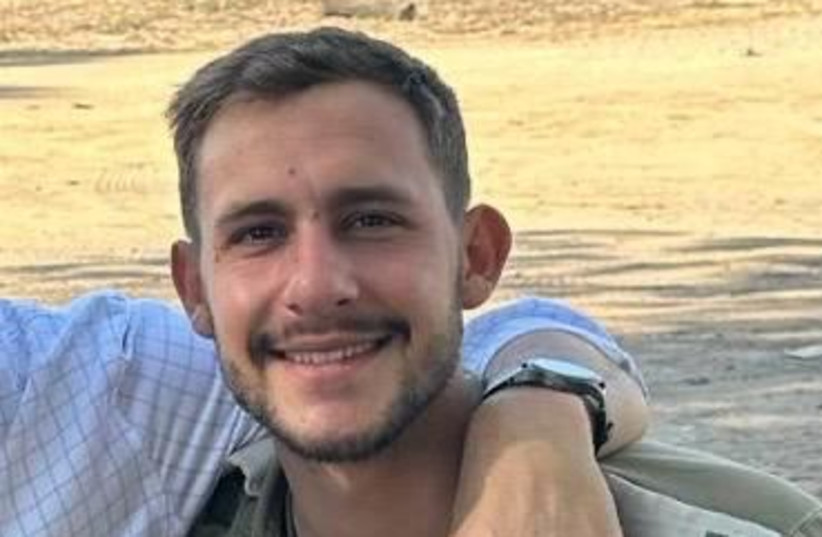
Our family had the privilege of spending a few hours meeting with Matan Angrest, the lone survivor from our son Daniel’s tank crew.
Incredibly, Daniel’s body returned for burial on the same day that Matan returned alive after over two years of captivity. Matan afforded Daniel a great honor by leaving his hospital bed – only two days after his terrible 25-month captivity ended – to attend his commander’s funeral. When my wife Shelley saw him, she felt that a part of Daniel had returned.
He not only surprised us by coming to the funeral – against his doctor’s orders – but also by unexpectedly stepping forward to eulogize his commander in the most loving way. We always knew how much Daniel loved his crew; we had learned from the parents of Matan, Itay Chen z”l, and Tomer Leibovitz z”l how much they loved him too.
The internal tank communications of their two-hour, 16-minute battle also revealed the great love, respect, friendship, professionalism, and camaraderie the four of them shared. Listening to Matan, as our families spent time together, validated just how deep the connection between Daniel and Matan was – and indeed between all members of their team.
The largest family
At Daniel’s open grave, I shared one of the most powerful lines I’d ever heard about what it means to be part of the Jewish people:
“We may indeed be the smallest people on Earth, but we are the largest family.”
This pithy statement explains succinctly, with unusual depth, what is unique about the Jewish people and what perhaps, our greatest secret is.
What binds us together as Jews is not just feelings of religious affiliation, national connection, or patriotic fervor, but rather a deep family bond – we are indeed mishpocha.
This explains, in my humble opinion, why we are prepared to pay seemingly irrational prices to free our hostages. After all, is there any father who would not dive into raging rapids to try and save his drowning child? Is there any brother who would not charge into a fire to save his beloved brother or sister? Is the overriding consideration one of rationality and cost-benefit analysis, or is it a visceral instinct of familial love and affection? It is, of course, the latter.
This seemingly irrational sacrifice for family was taught to us by our founding father, Abraham. I have often wondered why it is that Abraham was prepared to sacrifice his life and entire divinely-mandated mission in order to save his errant nephew, Lot, from captivity. After all, it was Lot who chose to separate from Abraham and to settle in the despicably immoral city of Sodom.
But when Abraham is informed of Lot’s captivity, he immediately springs into action – taking his entire able-bodied household of 318 men to embark on a dangerous military operation against the soldiers of four powerful kings. Why did
Abraham not seek counsel from God? How did he know that this is what God would want him to do? The answer, I believe, is in the text of the Torah itself – “And Abraham heard that his brother had been captured…” (Genesis 14:14).
To Abraham, Lot was not just his sinful, errant nephew – he was his beloved brother. Once Abraham viewed Lot as his brother, he did not need to ask any questions. Any brother would do all they could to save their sibling. It is written in our hearts with bonds of blood and brotherly love!
From the beaches of Goa
This also explains why over 100,000 people returned to Israel in the weeks following the October 7 massacre by Hamas to put their lives on the line and fight for Israel.
On the beaches of Goa in India, three groups found themselves side by side: thousands of Ukrainians, Russians, and Israelis. The Ukrainians and Russians had fled their countries’ war to find safety on India’s tranquil shores. They watched in disbelief as the Israelis did exactly the opposite – abandoning the safety of Goa’s beaches to fly straight back into a war zone. To them, it seemed irrational, even reckless.
They were returning to defend their home, to fight for their family, to protect their brothers. Fellow Jews across the globe rallied together with the same unparalleled camaraderie.
This gives Israel and the Jewish people worldwide an unusual advantage. We are not a country of a few million against an enemy of 300 million. We are a large family with few degrees of separation. Like siblings, we may quarrel among ourselves, but when the chips are down, we stand together with bonds of unconditional love and loyalty that only a family can possess.
As we celebrate Hanukkah, we remember one small family, the Maccabees, who stood up against an empire – challenging the debilitating decrees of the Syrian Greek king who threatened to uproot every last vestige of authentic Jewish life.
They sparked a revolution, built a Jewish sovereign state, and rededicated the Temple in Jerusalem.
They succeeded in not only stemming the tide, but in reinvigorating the Jewish people’s belief in themselves and God, enabling them to survive and push back the military, political, and cultural onslaught of their era’s dominant superpower.
Outnumbered 20 to 1, the brothers and their small group of untrained men defeated the huge and well-trained armies of Antiochus. With a conviction driven by the profoundest bonds of brotherhood, four of the brothers died in battle, survived only by Simeon, who alone would live to tell the tale.
We light Hanukkah candles today, over two millennia later, as a glowing tribute to the Maccabean family’s dual covenants – a covenant of fate and family as well as a covenant of faith and destiny.
The family lights the nations
Perhaps this is the Jewish people’s greatest contribution– to remind the nations of the world that we are first and foremost a family.
Indeed, the book of Genesis traces the history of humanity to one family. Adam and Eve and their children – we are all their descendants. After everyone was wiped out in the flood, save Noah and his wife and children, humanity once again grew from one family.
Although the 70 descendants of Noah were dispersed across the earth into 70 disparate nations, God singled out one family – Abraham and Sarah and their son Isaac – to build a people from this one family. Isaac and Rebecca’s son Jacob would become Israel, and his sons would become the family known as the Children of Israel.
This family of 70 descendants in Egypt did not disperse into 70 disparate nations like Noah’s descendants. Instead, they were forged through the furnaces of Egypt into one people bearing the same name of their original family – the Children of Israel.
Perhaps this is the Jewish light that shines brightest today – the light of familial love and loyalty at the heart of nationhood. Not cruel parochial tribalism but the caring and kindness of kinship. One for all and all for one. We remind all nations how we are prepared to sacrifice for each other. We may be a close family as Jews, but all nations are our extended family. We all descend from the same ancestors, Adam and Noah, and all are created in the image of God.
Perhaps the crucible of family reveals what makes the Jewish people distinct – a light that shines against the darkness of barbaric religious radicalism and nationalist fervor.
We are not the smallest people; we are the largest family.
The author is the chair of World Mizrachi and president of the World Zionist Organization.