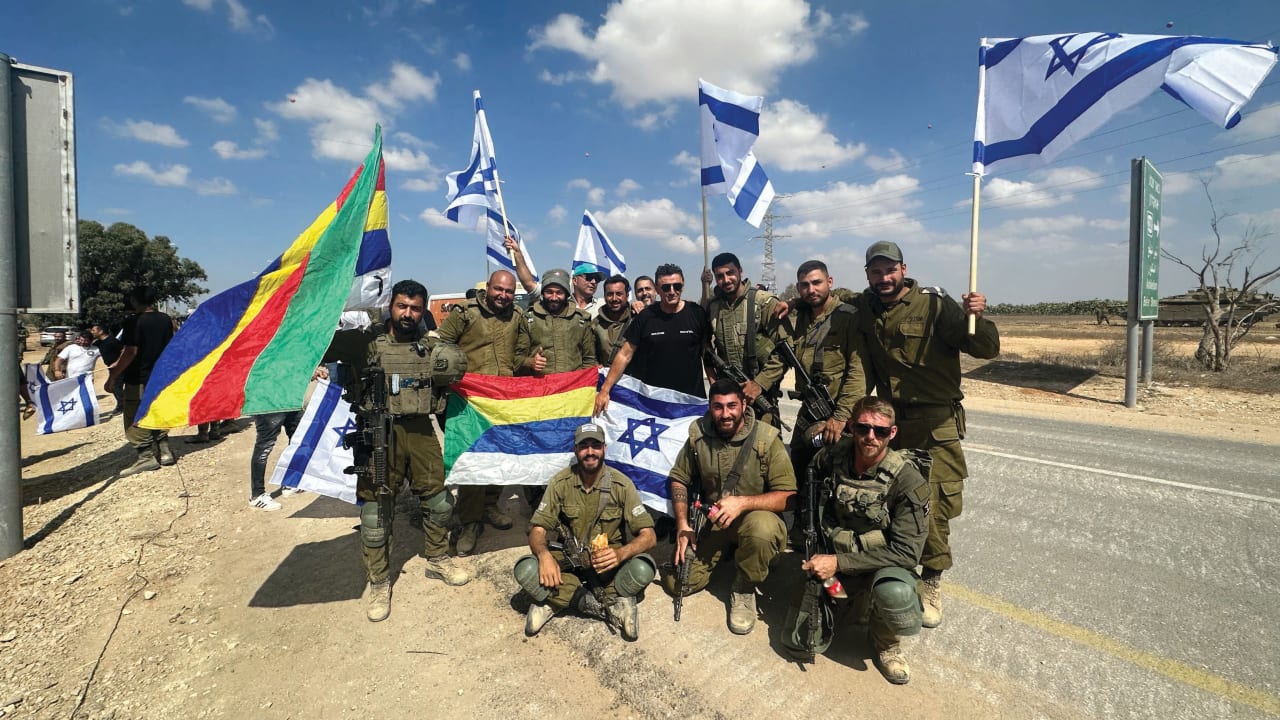
When Col. Safi Ibrahim walks through the Druze villages of the Golan Heights, he sees something that would have been almost unimaginable a decade ago. Young men who once hid their connection to the Jewish state now wear IDF uniforms openly in Majdal Shams, Mas’ade, Buq’ata, and Ein Qiniyye, with enlistment motivation many times higher than before the war.
As Dana Ben-Shimon reported in the latest edition of The Jerusalem Report, the massacre of Druze civilians in southern Syria, the collapse of the regime they once trusted, and the missile that struck a soccer field in Majdal Shams in August 2024, killing 12 children, shattered old certainties.
“The Druze residing in Syria believe there is no one who can help them more than the State of Israel,” Ibrahim said. Brothers across the border and the state whose army he serves have become part of the same story.
This is not just a Druze story. Ibrahim notes that Druze conscription has climbed to around 85% since October 7, with Bedouin service remaining high and Arab Christian enlistment tripling in the past year
A small but growing number of Muslim Arabs from cities such as Nazareth, Ramla, and Sakhnin are also joining the IDF voluntarily. The numbers are still modest, but the direction is clear.

Concurrently, Israel is locked in a bitter argument over ultra-Orthodox conscription, with coalition parties threatening to topple the government over any changes. As the political system spins its wheels, minorities who are often portrayed as outsiders are quietly voting with their feet for a shared Israeli future.
Bringing the country together
This contrast exposes a deeper truth that Israel’s harshest critics prefer to ignore. For years, international forums have branded Israel an apartheid state in which Arabs were barred from full participation. The lived reality, especially since October 7, is more complicated. Coexistence here is not perfect, but it undeniably exists.
You see it clearly in hospitals and campuses. Arab citizens, roughly 21% of the population, now make up about a quarter of doctors and nurses and close to half of pharmacists. Tens of thousands of Arab students study in Israeli institutions, close to their share of the population. This is not the profile of a system trying to push a fifth of its citizens out of public life.
Political representation also reflects this complexity. The current Knesset includes Arab MKs from Arab parties and Arab and Druze lawmakers on Jewish-led lists.
None of this erases the real problems. Arab towns still suffer from underinvestment, high crime, and infrastructure gaps. Arab schools lag behind, and civil society organizations rightly warn about discrimination and missed opportunities, from planning policy to public-sector hiring. The political climate has grown harsher since October 7, and trust between communities has been tested.
Yet it is precisely in wartime that the persistence of coexistence matters most. On October 7, the Hamas terrorists who butchered and kidnapped Israelis did not ask whether their victims were Jews, Bedouin, Christians, or foreign workers. They murder a Bedouin woman in a headscarf just as readily as a kibbutznik in a T-shirt. That cruelty is seen by Arab citizens, too, and it has pushed many to reaffirm where their home is and who they want to live alongside.
Israel must treat this not as a convenient manpower boost, but as a historic opportunity. If Druze from the Golan, Bedouin trackers from the Negev, Arab Christians from Nazareth, and Muslim women from Ramla are all choosing to serve, the state has a responsibility to meet them halfway: fair budgets, serious investment in education and infrastructure, and zero tolerance for racism and incitement in both directions.
Israel can and must be self-critical, and minorities have every right to demand equality in practice, not just on paper. But the crowded hospital corridors staffed by Arab doctors, the lecture halls filled with Arab students, and the IDF bases where minority soldiers now serve are also part of the picture.
In a region where minorities are often persecuted, expelled, or massacred, the fact that so many members of minority communities are choosing Israel and not its enemies is remarkable. It is a quiet vote of confidence in the only Jewish state and in the possibility of a shared future. Our task, as a society, is to justify that confidence.