
(JTA) — This Thanksgiving, I’m thinking about Passover and how the way we choose to remember the past can shape the present and the future.
I grew up in Amherst, Massachusetts, a town known for its leftist politics. But those commitments belie the troubling legacy of its namesake, Lord Jeffrey Amherst. In the postscript to a 1763 letter, Amherst notoriously advocated for biological warfare against the indigenous population in North America, encouraging a military colleague to use smallpox-contaminated blankets “to extirpate this execrable race.” That legacy casts a long shadow, especially around Thanksgiving.
I love my hometown, and my home state of Massachusetts, the place where the early pilgrims who landed at Plymouth Rock sought to build their “shining city on a hill.” I love my country and the ideals toward which it strives. But I struggle to know how to love these things while also confronting the injustices woven into their founding. The two Thanksgiving narratives offer different ways of reconciling history and understanding our national identity.
The first is a familiar and comforting story, the one many of us learned in school: a tale of friendship and generosity between the white European settlers and the Native peoples of America. This story is reenacted in the Thanksgiving feast, which celebrates the abundance of the harvest alongside an abundance of goodwill.
The second tale is darker. It depicts a world of tribalism, exploitation, and racial violence. In this story, there wasn’t enough land for everyone; outsiders were viewed as threats, and destroying them with smallpox blankets was a brilliant military strategy. We embrace the first story at our private tables; we repudiate the second through public acts, such as when Amherst College stopped using “Lord Jeff” as its mascot in 2016.
Both stories reveal important truths about the past and ourselves, but each one also falls short.
Moments of genuine cooperation between pilgrims and indigenous communities were rare, but they happened. Telling that story can inspire us to be better than we are, but it can also risk papering over the harms of the past. The atrocities that took place still demand a moral reckoning. And yet, the ways we tell the bleaker story can let us off the hook. By casting Amherst as a villain, we articulate the values we want our society to embody, but changing a mascot does not repair the lives and cultures he helped to destroy.
This year, we need a new way of telling the Thanksgiving story- one where our memory of the past becomes a vehicle to transform the present. We need a story that invites us to leave the respective corners where we cling tightly to what is ours and begin to rebuild bonds of mutual respect and trust.
Imagine, for a moment, the Thanksgiving table. Pumpkin pies and casseroles are jostled to fill every spare space. Around the table sit the people you love, and some who drive you crazy. The uncle whose politics you can’t stand passes you the mashed potatoes made according to your great-grandmother’s recipe. Sitting next to him is the neighbor you invited at the last minute because she had nowhere else to go. Her kids are crawling around under the table, pretending to be bears. Someone just opened a bottle of wine.
As an American Jew, I cannot help but see echoes of the Passover seder in this scene. There, too, the table is overflowing, this time with matzo ball soup, brisket, and hard-boiled eggs. Family, friends, and the occasional stranger crowd in. The kids are under the table again, pretending to be frogs from the story of the 10 plagues, and someone is pouring another glass of wine. At this table, too, people have come together to wrestle with history and memory, with suffering and liberation, with who we once were and who we want to be.
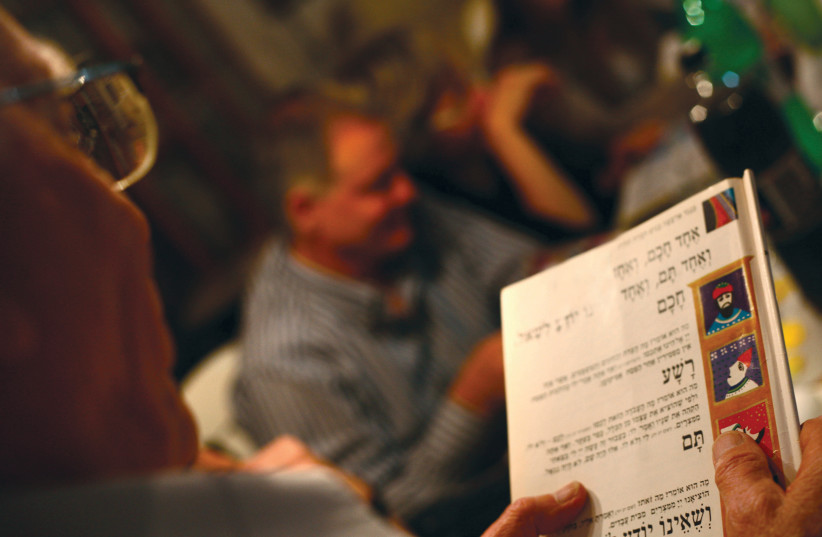
But the Passover story is told differently. The haggadah, the text that guides the seder, whose name literally means “the telling,” blends time, inviting us to remember the past in a way that both acknowledges the present and actively seeks to shape the future. When we prepare to eat matzah, the unleavened bread that symbolizes the holiday, we recite, “This is the bread of affliction. Let all who are hungry come and eat. This year we are still slaves; next year we will be free.”
In this ritual moment, the haggadah does not set us free from the bonds of history. Instead, it frames the memory of suffering as a call to action: because we have known hunger, we must feed the hungry. In so doing, the Haggadah enables the past to shape us in unexpected ways: the memory of affliction does not drive us away from others but instead becomes a prompt for generosity.
This is the power of collective memory. None of us alive today lived through the exodus from Egypt, but for Jews, the haggadah reminds us that this experience is still part of who we are. And it goes one step further: It tells us how to interpret that memory.
The Thanksgiving table can be a place of transformation
This is the kind of story we need at Thanksgiving. None of us alive today lived through the tumult of the founding colonies, but as Americans, that experience is still part of who we are as a nation. We need a way of telling our story that doesn’t paper over the past, wallow in guilt, or simply try to distance ourselves from it- we need a story that prompts us to shape a better future.
The Thanksgiving table, like the seder table, can be a place of transformation. We can tell a Thanksgiving story that acknowledges our shortcomings without allowing them to predetermine what is possible. Remembering scarcity can prompt us to be generous; remembering tribalism can prompt us to invest in strengthening civic ties with those who are different from us.
This Thanksgiving, the words of the haggadah ring in my ears as hunger persists throughout our country. The recent suspension of SNAP benefits during the government shutdown has highlighted the problem of food insecurity with new urgency. Although these benefits have been reinstated, too many Americans continue to struggle to put food on their tables. When some of us sit down to Thanksgiving feasts, parents across America will be going hungry so that they have something to feed their children.
And yet, when I look around my community, I already see us beginning to tell a different story- one that reminds us that the strangers who live down the street are our neighbors and prompts us to turn outwards again.
At school, at synagogue, at the entrance to my local grocery store, baskets collecting goods for the local food pantry are already filled to the brim. In my local “buy nothing” group, people who usually offer to give away outgrown toys and extra gardening supplies are offering to buy each other groceries. These actions acknowledge the ways that we have failed each other and take them as motivation to chart a new path forward.
We cannot ignore the violence and ill will that sits at the heart of our Thanksgiving story. But we should not forget the idealism and vision of mutual care that sits at its heart as well. This Thanksgiving, let us tell a story that motivates us to once again open our doors and our hearts to our fellow Americans.
As we sit down at our tables, let us invoke our own version of the Haggadah: “Last year, we were slaves to fear and distrust; next year, may we be free. This is the feast of our founding. Let all who wish to join us come and eat. We have enough to share.”
The views and opinions expressed in this article are those of the author and do not necessarily reflect the views of JTA or its parent company, 70 Faces Media.