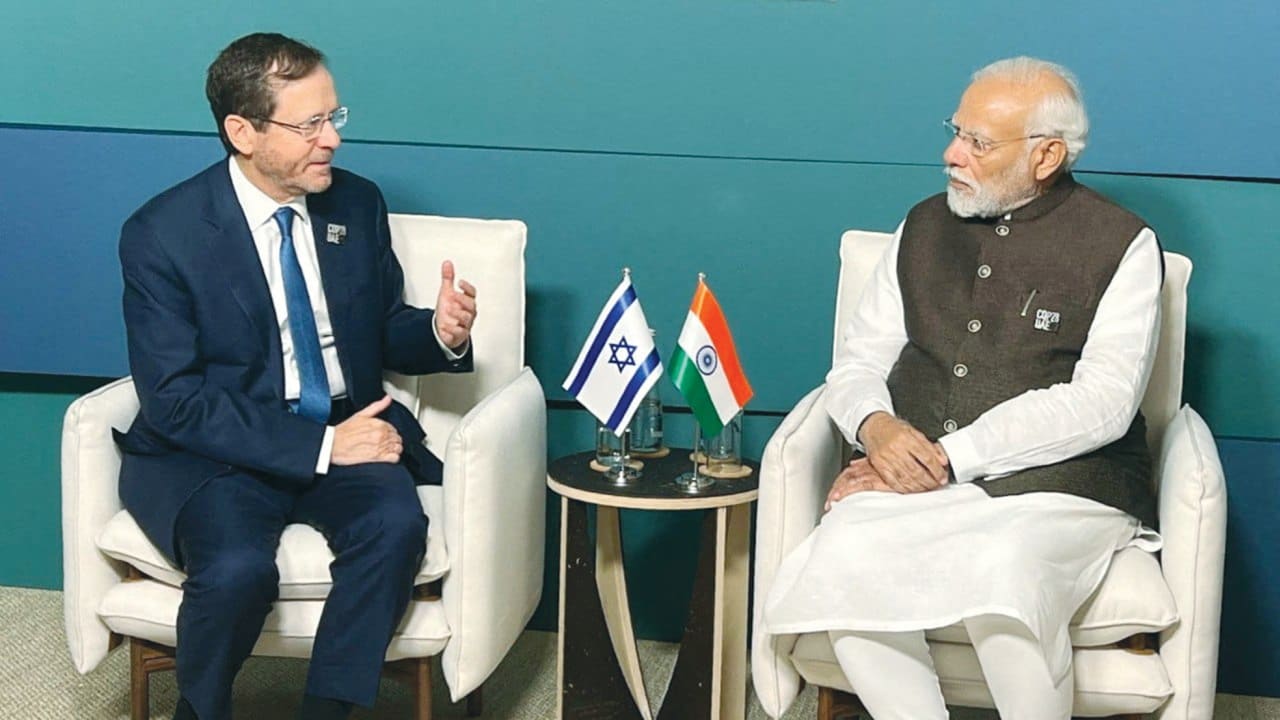
Something is shifting in the quiet spaces between the headlines with a new alliance, already underway, that could turn the entire global order on its head. India and Israel, two civilizations with roots stretching back millennia, are together scripting a playbook for a new era – one defined not by Western dominance or dictated by authoritarian expansion but – driven by resilience, ingenuity, and mutual respect.
Beyond the usual dance of summits and handshakes, this isn’t diplomacy as usual or just the expansion of trade. This is about strategic power in action, a quietly accelerating partnership geared toward technological sovereignty and collective security. If the leaders on both sides have the vision and nerve to make bold moves, the result could be a small, smart, and truly unstoppable axis, and the rest of the world would have no choice but to pay attention.
For decades, the “natural allies” label has followed India and Israel, but that hasn’t come close to capturing what’s happening now. What began as an uncertain handshake in 1992 has grown into something quietly revolutionary.
India and Israel combine strengths
Behind the closed doors of their defense ministries and tech parks, the two nations are stitching together complementary strengths. India brings unmatched scale and deep wells of tech talent, while Israel brings its storied battlefield innovation and intelligence sharpness. No one in this duo is playing second fiddle: both refuse to be proxies, each acting from a tough-minded sense of strategic survival – and their collaboration is speeding up fast. They have mutual trust, shared security interests, and technological convergence.

Historically, Israel has supplied India with some of its most advanced weaponry. That dynamic has changed. Now, India’s manufacturing muscle helps Israeli firms reach global scale, just as Israeli tech makes its way via Indian R&D to new frontiers. Together, they are building a defense ecosystem nimble enough to dodge the lethargy of NATO bureaucracy, unburdened by the hesitations and second-guessing that plague the West.
What comes next? Picture a joint Command for Cyber and Autonomous Systems – one that converges Israel’s battle-tested innovation with India’s burgeoning strengths in artificial intelligence (AI). Within a few short years, this alliance could pioneer swarm drones, anti-drone shields, and quantum-secure communications for democratic partners across Asia and Africa – products of global consequence, not just regional impact.
The ground is shifting.
Western tech powerhouses are encumbered by red tape and regulatory headaches. European capitals dither and debate while the world moves on. Not so in Tel Aviv or Bengaluru, where strategic ambition is backed by speed and scope. Marry the agility and semiconductor know-how of Israel to the engineering firepower and data scale of India, and you get something that could outstrip even Silicon Valley by 2035.
Imagine a tech corridor running from Tel Aviv to Bengaluru, turbocharging advances in AI, quantum computing, and cyber defense – a strategic technology council to steer the process, and ripples stretching from Dubai to Singapore, making both Washington and Beijing uneasy.
Geographically, India and Israel sit on opposite edges of Asia, but they’re mirrors in many ways: both are democratic outliers, both surrounded by suspicion, both learning to convert moral clarity into strategic might. They’re recalibrating their ties with the United States even as they hedge against the turbulence of authoritarian neighbors. As China presses west and America pivots east, the India-Israel partnership quietly forms the backbone of a new security structure. If they double down, a corridor linking Tel Aviv, Abu Dhabi, and New Delhi could become the Indo-Abrahamic anchor of a newly balanced Asia, a structure viewed with worry in Beijing and confusion in European capitals. In this world, agility and self-reliance outshine sheer size or bluster.
Still, there’s an intangible here that’s just as potent as military hardware or code. India and Israel are products of ancient civilizations that have been humbled, tested, and have come back stronger. Their resilience is hard-earned. Each society, forged in adversity, carries a moral weight and a confidence that’s rare in international affairs today. They don’t just tolerate their own existence; they insist upon it. That unshakeable self-possession, rooted in parallel histories of survival and resurgence, forms the moral bedrock of this emerging axis.
To make good on this potential, bold action is needed. This means moving quickly toward a strategic tech council focused on frontier technologies – AI, quantum, and next-gen cybersecurity. It means co-developing hypersonic missile defense and counter-drone weapons; pooling $5 billion into joint innovation funds targeting agritech, green energy, and water security; integrating intelligence across cyber, maritime, and even space; and establishing annual meetings and institutionalized military exercises that bring both countries’ officer corps into step.
Crucially, this is not speculation; it’s a pathway that’s already cleared. The fundamentals of cooperation are established; only political will and vision will determine whether these steps become reality or if incrementalism prevails.
Come 2035, the world may well look to an axis powered by Indian manpower and production and Israeli precision and intelligence – an alliance that gives partners in Asia and Africa what they cannot get elsewhere: real technological sovereignty, free from dependency on either Washington or Beijing.
What India and Israel are building is not just another alliance. It’s a prototype for a new kind of great power: one hardened by history, driven by innovation, and guided by an unapologetic sense of self-worth.
The stakes matter. Hesitation would leave both nations vulnerable and dependent on the whims of others. But if they seize this opportunity, the Indo-Abrahamic axis – small, smart, and nimble – could very well shape the political, military, and technological architecture of the 21st century.
The time when only the West or China shaped the future is drawing to a close. A new chapter, co-authored by India and Israel, is ready to begin.
Dr. Michael J Salamon is a psychologist specializing in trauma and abuse and director of ADC Psychological Services in Netanya and Hewlett, NY. Louis Libin is an expert in military strategies, wireless innovation, emergency communications, and cybersecurity.