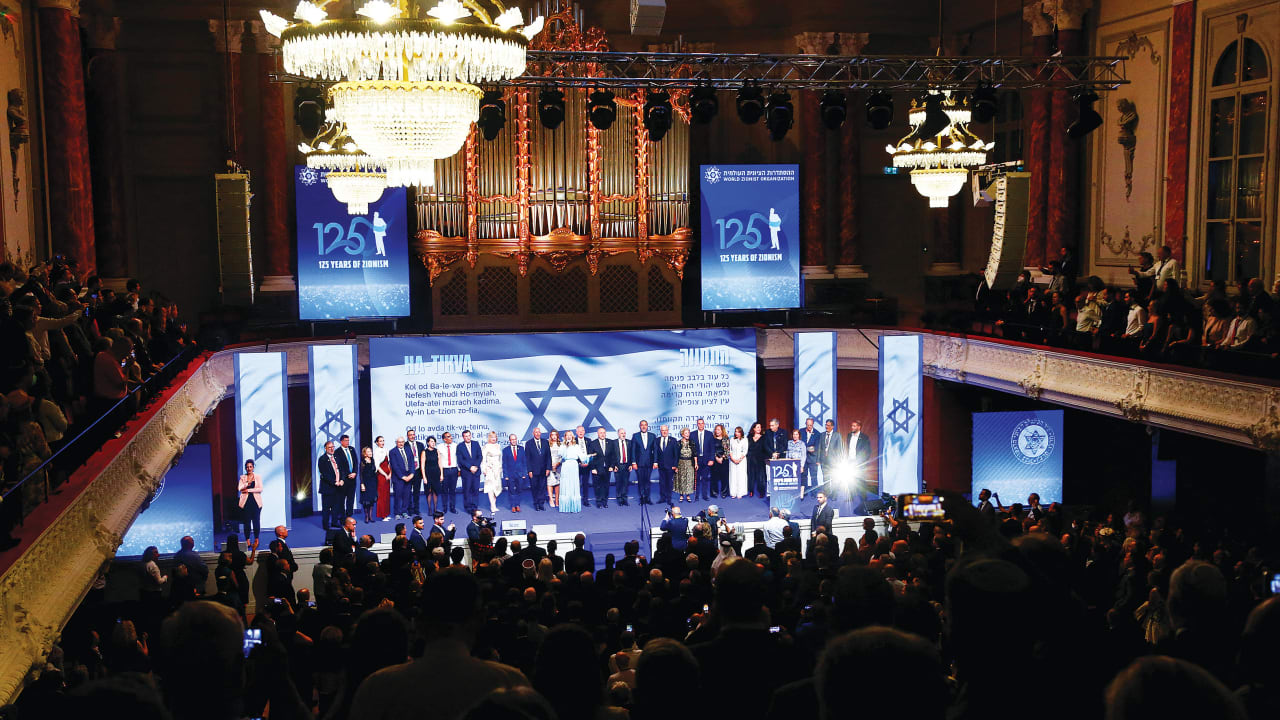
What was supposed to be a three-day World Zionist Congress event to determine the agenda and power-sharing agreements for Israel’s National Institutions has turned into almost two weeks of internal and inter-party squabbling. Although the congress is supposed to host the champions of the Zionist movement, it has demonstrated that it is just another front for the Knesset’s internecine politics.
The appeal for unity was the underlying theme of the 39th WZC, praising soldiers for their sacrifices, praying for the release of hostages, and wishing for healing for the victims of Hamas’s October 7 massacre and the war.
Yet, for all the calls for unity, the result was a fight entirely unrelated to the war that has still not truly come to a close.
The convention ended a day early, seeking to avoid forcing delegates home during haredi (ultra-Orthodox) anti-military draft protests.
A coalition agreement that excluded one Likud faction that was in dispute with others over a failure to hold party elections collapsed at the end of the day after the Culture and Sport Minister, Miki Zohar, proposed the prime minister’s son, Yair Netanyahu, for the position of World Zionist Organization executive.

Many slates decried Netanyahu’s appointment as a red line, a clear example of nepotism and clientelism.
Instead of a vote to officiate the coalition agreement, which would have accepted slate members into key positions in the WZO, Keren Kayemeth LeIsrael-Jewish National Fund, and United Israel Appeal, the WZC delegates instead voted to extend the convention by two weeks.
This was a technicality, as the delegates were still going home and the congress was over, save for the opaque dealings of party leaders over how to divide the Zionist pie.
Several dignitaries and WZO representatives expressed doubt that a full two weeks would be needed to agree, but Wednesday will mark the end of the extended convention, with no end in sight. There may be another time-extension vote, or, more likely, a consensus to ignore the deadline.
A fourth agreement is reportedly on the cusp of finalization – but confidence was also placed in the three other agreements that fell apart.
After Zohar’s faction pushed too far with the Yair Netanyahu proposal, the different factions turned to another Likud caucus, led by WZO chair Yaakov Hagoel, to develop a new understanding. A vote on the second agreement was announced on Sunday, but right-wing factions united in opposing it, demanding a delay.
No source could explain how an agreement was developed under the noses of right-wing factions, but some suggested that the Prime Minister’s Office had pressured them to challenge it.
The vote continued, but a concurrent renegotiation rendered the exercise obsolete. The vote to officiate the agreement was extended from Tuesday morning to the next day to facilitate the renewed backroom dealings. The vote of hundreds of delegates was, in essence, used to legitimize the spirit of agreement between the parties, who would organize the National Institutions among themselves after the fact.
Yet even as the third agreement was all but finalized, Yesh Atid leader Yair Lapid announced that his party was withdrawing from it. The party had been set to secure several important positions within the National Institutions, but Lapid determined that the system was too corrupt, as evidenced by the Yair Netanyahu controversy.

Lapid instead called for the nationalization of the institutions, urging other factions to join him. None did, and negotiations commenced anew without Yesh Atid.
Perhaps come Wednesday, there will be a deal, but the legitimacy of the National Institutions has been harmed, and it is not solely because Lapid railed against their corruption, picked up his toys, and went home.
While ostensibly, the WZC holds a democratic process that is supposed to make its delegates and slates feel as if they were influencing the future of the Zionist movement, the last two weeks have cast aside the pretense for some.
Resolutions were furiously debated in a committee and then in the final plenary. Yet delegates complained that any compromise or personal understanding disappeared as soon as slates issued orders to form up into their political phalanxes.
New delegates stated that, despite all the arguments over the resolutions, they did not believe they would be adhered to or would define the WZO’s future. Like the coalition agreement, deliberated in other rooms and closed to the media and the majority of delegates, the agenda would be decided in the backrooms.
The sense that the delegates were “only new slates” led them to grumble that they were excluded from many of these backroom proceedings, as they were at a disadvantage to the old guard, who knew how to navigate the labyrinth of written and unwritten rules.
The two-week WZC saga is probably not of much interest to the average Israeli or Diaspora Jew, and perhaps it should not be if the National Institutions, the inheritance of Zionist Jews worldwide, did not control billions of shekels in assets.
As frustrated as new delegates were about being left in the dark by WZC’s leadership, it is difficult for the average person to grasp the purpose of the four odd organizations and their relations, or the arcane manner in which they operate, or the way the WZC chooses who wields their assets.
The only time that there is some semblance of interest or comprehension is in the moments when the quarrels breach the opaque surface. The gulf of understanding and interest is bridged by familiarity with the same squabbles that define Israeli politics.
All the most contentious resolutions also touched on the same controversial issues as those that perennially occupied Israeli leaders while the rest of the country fought a war.
As ultra-Orthodox protesters prepared to defy the military draft, the WZC voted to pass a resolution urging the WZO to encourage a more universal draft.
The Knesset still waffles on a state inquiry into Hamas’s October 7 massacre – WZC delegates, meanwhile, have passed a resolution calling for the establishment of such a review. Several resolutions demanding greater egalitarianism in religious sites or in the National Institutions were passed, a nod to the scandals about the conditions of holy sites that rear their head every few months.
Weeks after Noam MK Avi Maoz’s bill to apply sovereignty to the West Bank, the WZO passed resolutions against supporting settlements in Gaza or the E1 area of the West Bank. The E1 resolution did not pass easily, as right-wing delegates left the chamber to attempt to disrupt the quorum needed to legitimize the vote.
Lapid's decision to withdraw was seen as extension of Israeli politics
Lapid’s decision was also seen by many dignitaries as an extension of Israeli politics, evoking an image of a crusader battling corruption and trying to extend a controversy to score political points against Prime Minister Benjamin Netanyahu.
The Netanyahu controversy itself reeks of the never-ending prosecution of the prime minister for corruption. It includes allegations of a quid pro quo: That he was given gifts, such as cigars and champagne, in return for aid to a political ally.
Netanyahu backed Zohar during his feud with Hagoel, and the surprise appointment of the leader’s son could appear as a homage to Zohar’s patron. Showering Yair Netanyahu with the benefits of a cushy job, a paycheck, a car, and a travel budget is at odds with the imagery of the torches of sacrifice wielded during the WZC opening ceremony.
Indeed, the executive suddenly introduced a resolution to expand the ever-growing executive ranks from 14 to 24. Yet, there were no seats for a reservist, or a bereaved mother, or a returned hostage.
Likud’s infighting, Netanyahu’s personal benefits, and Lapid’s tantrum are all artifacts of the same politics that exist in an alternate reality to a nation embroiled in a multifront war. For all the talk of unity and standing by soldiers and the war-ravaged, Jewish Israeli and Diaspora politicians still engage in the luxury of squabbles over tired old issues.
Meanwhile, reservists are sent back for their fourth and fifth tours of duty. “Unity” was nothing more than a euphemism for everyone agreeing with the policies of those who used the word.
As with the WZC resolutions, more broadly, there was never an attempt at actual compromise, nor an attempt to recognize the nation’s actual priorities in turbulent times.
Throughout the war, the Knesset still found time to rehash the same policies from the Judicial reform to the clash with the Attorney-General’s Office.
As for the lack of influence and distance felt by so many WZC delegates and the parallels of political drama between the WZC and the Knesset, these show that Lapid’s diagnosis was wrong. The same symptoms that afflict the WZC afflict other bodies in Israel and Diaspora politics: An insulated elite that is inwardly focused on personal interests.
The problems with the WZC that were demonstrated over the last two weeks are not that it is a corrupt or decayed system that needs to be reformed, but that it is occupied by the same dynasties and organizations that ran the state around in October 2023.