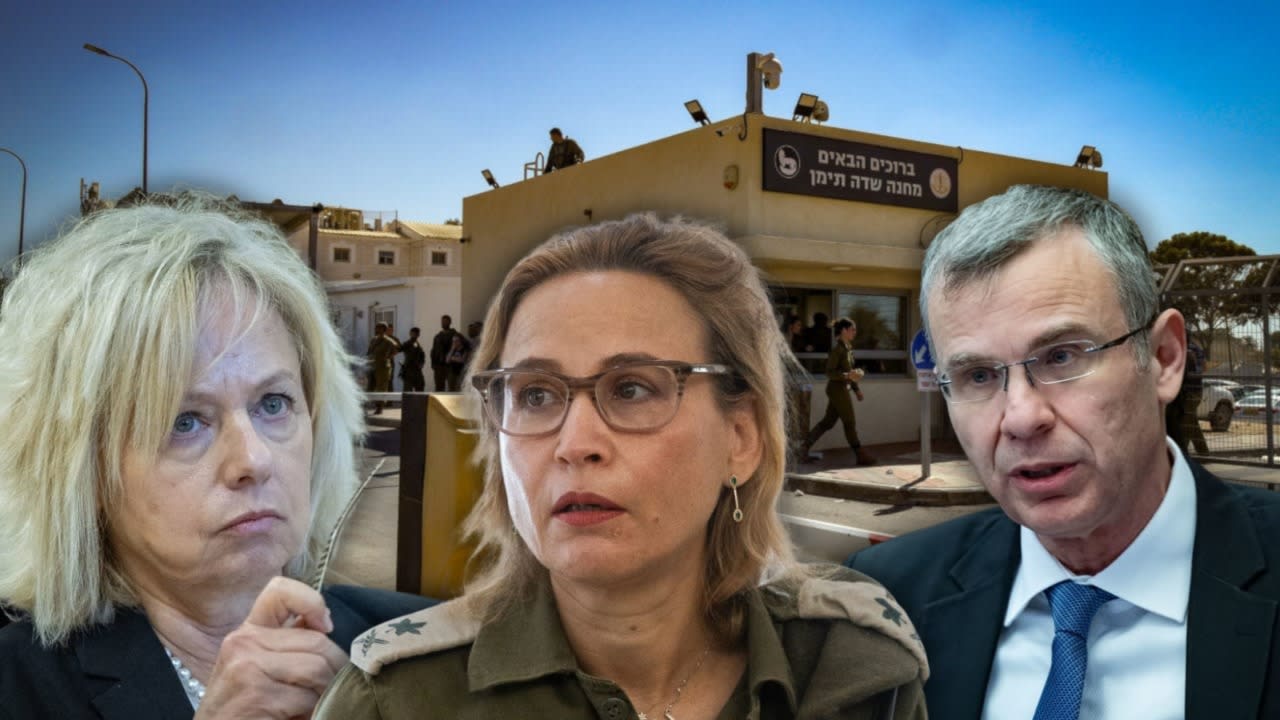
One of the most frustrating aspects of the most recent mega-scandal (or is it a micro-scandal in masquerade?) involving former military advocate-general Yifat Tomer-Yerushalmi is that we are unable, or refuse to agree on what the scandal is all about.
In general, supporters of the coalition argue that Tomer-Yerushalmi deliberately fabricated a video taken by security cameras on July 5, 2024, in Sde Teiman, a military detention camp where the most dangerous Palestinian terrorists are held. The clip allegedly shows a brutal attack on a Palestinian detainee by five reserve fighters of IDF Unit 100, which assists the military police in dealing with extreme situations in military detention camps.
Tomer-Yerushalmi is further accused of being connected to the leaking of the clip to Guy Peleg, the legal commentator of Channel 12, on August 6, 2024, and then denying that she had been involved.
There is a medical report by a Sde Teiman doctor stating that the Palestinian detainee had been beaten severely, had been electrified with a Taser gun, and that a sharp object had been pushed into his rectum, puncturing it.
The examining doctor stated in an interview with Haaretz that “he did not believe an Israeli prison warden was capable of doing such a thing,” and that, according to him, it was apparently revenge by one “Nukhba [terrorist] against another Nukhba.” However, there is no proof that this was more than the doctor’s personal opinion, since one wonders how a Nukhba detainee in Sde Teiman could have gotten hold of a Taser gun.

In his evidence to the military advocacy, the attacked Palestinian detainee had stated, soon after the event, that Israeli reservists had attacked him. However, since he was returned to the Gaza Strip within the framework of the October 2025 agreement on the release of all the hostages, both dead and alive, he could not be cross-examined.
The issues of the coalition and the opposition
The opposition argues that Tomer-Yerushalmi had indeed acted contrary to what was expected of her, had even lied to the court about the leaking of the video clip, and should be punished accordingly. However, it also maintains that the coalition is using the affair to clear the five reservists of any blame, even before they face trial.
They also point out that Tomer-Yerushalmi has even been accused by none other than Defense Minister Israel Katz of being responsible for a “blood libel” against “innocent IDF soldiers” – an accusation that is now resonating abroad. The opposition adds that the coalition is using the affair to attack Attorney-General Gali Baharav-Miara for allegedly being in collusion with the military advocate-general on the whole affair.
No matter how this affair finally ends, the fact that the coalition seems to be refusing to make an honest effort to find out what actually happened in Sde Teiman on July 5, 2024, and punish those responsible, only adds to the difficulty of establishing a real and full record of what has happened since October 7, 2023.
Of course, the blame for this is not only to be placed on the Israeli government.
For example, Hamas, and many Arab leaders – including Mahmoud Abbas, head of the Palestinian Authority for the last 20 years – have refused to acknowledge the fact that on October 7, numerous Hamas Nukhba terrorists, who had invaded Israel, committed acts of rape and sexual abuse against Israeli women, many of whom were also murdered.
This refusal to admit that Hamas had committed horrendous acts on October 7, which subsequently led to Israel’s unrelenting (perhaps even disproportional) reaction, still resonates today.
Among the complaints by over 300 pro-Palestinian writers and commentators against The New York Times two weeks ago was that it had published the article, “Screams without words: how Hamas weaponized sexual violence on Oct. 7,” which – according to them – described these “alleged” crimes without bringing any “concrete evidence.”
Refusing to accept responsibility
There is nothing new about the phenomenon of embattled parties refusing to admit to their own misdeeds and war crimes. For many years after the 1948 War of Independence, we were reluctant to admit that we had been responsible, to a large extent, for the exodus of many local Arabs, who are the forefathers of today’s refugees, from the territory of the State of Israel.
The official Israeli hasbara (public diplomacy) line was that the exodus was the result of instructions from the Arab forces fighting in the war, who told the Palestinians to vacate their homes until after the Arab victory over the Jewish state. Officially, the fact that we had actively encouraged this exodus was denied, or hushed.
Former prime minister Yitzhak Rabin, in his 1979 autobiography The Rabin Memoirs, described the banishment of the Arabs of Lydda and Ramle by the IDF, led by Yigal Allon and himself, and the conquest of the two Arab towns. The section that dealt with the result of the battle over Lydda and Ramle was removed by the censor before the Hebrew edition of the book appeared.
However, the book’s original manuscript was translated into English before the censor brought down his ax, and the section about the Lydda and Ramleh expulsions appeared in the US. I was working with Allon when the book was published, and I still remember how furious he was when he found out what Rabin had written.
I tried to argue with him about his position, as it was 30 years since the end of the War of Independence, and the fact that Israel had played an active role in the local Arab population’s expulsion was well known – but to no avail.
Perhaps I am naive, but I believe that if both we and the Palestinians learn to take full responsibility for our actions, for better or worse, and admit that we have both missed opportunities to improve our own situation as well as that of our neighbors, we would probably find ourselves in a more optimistic reality than we are today.
One precondition for this is to stick to the facts, both among ourselves and between us.
The writer has written journalistic and academic articles, as well as several books, on international relations, Zionism, Israeli politics, and parliamentarism. From 1994-2010, she worked in the Knesset Library and the Knesset Research and Information Center.