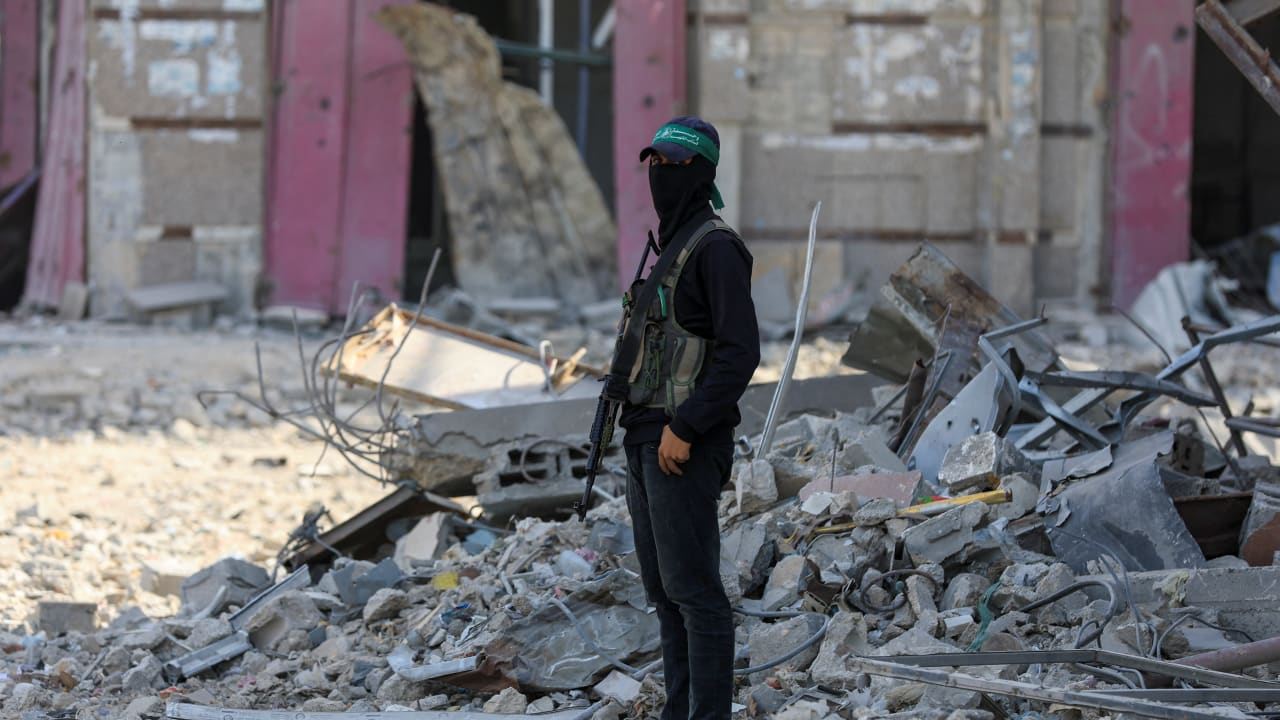
The High Court ruled last week that the government must consider allowing foreign journalists into Gaza, but also granted a one-month extension due to the still-unclear situation in the Strip. Eventually, it will happen, and the IDF must prepare, because when the journalists enter, a final, high-intensity battle will erupt over the narrative of the war. Needless to say, Israel begins that battle from a catastrophic starting point.
There are two possible paths forward. In one, the world continues to believe that Israel bombed people in tent camps to “punish” Palestinians for what Hamas did on October 7, and for the dispiritingly high levels of apparent popular support for that atrocity. In this version, the war will be remembered as a collective punishment marked by daily war crimes. If this narrative takes root in the world’s collective memory, Israel will be judged harshly, and its standing will suffer for generations.
However, there’s another way: the world could understand that Israel faced a truly satanic organization that consciously sought the suffering of its own people to score propaganda victories. That Hamas hid behind civilians, operated from mosques, schools, hospitals, and UN facilities, and left the IDF with a battlefield where every choice came at a terrible cost.
If that second understanding prevails, it will become clear that the Gaza war, despite its bloody toll, was not an act of revenge, and certainly not genocide, but an unavoidable confrontation with a fanatical, demonic, and unrestrained enemy that is also the enemy of the West, and indeed, of the Palestinians themselves.
With sober reflection, it may even be seen that the ratio of civilian to combatant deaths, though horrifying, was among the least bad in the history of counterterror warfare. It all depends on what emerges once the full picture is revealed.

The first path leads to accusations, boycotts, and long-term demonization; the second opens the way to understanding, to rebuilding trust, and to rejoining the moral consensus of the democratic world.
Israel was unwise to block international media
For nearly a year, Israel has consistently blocked the international media from the central drama of our time. This may have been understandable to degree, but it was excessive and unwise. Never before has Israel, or any other modern state, kept foreign journalists away from the critical arena of a major war for so long, especially while facing global criticism over how the war was conducted.
That was a grave failure, not only in communication, but in strategy.
Of course, Israel feared that journalists might be killed and it would be blamed. But it could have allowed earlier entry under conditions, such as requiring reporters to sign waivers releasing Israel from responsibility. That would have been far better than appearing to hide something. Trying to block coverage for too long never ends well.
Moreover, sealing off the Strip gave Hamas full control of the visual battlefield, allowing it to use imagery freely and present its propaganda as legitimate journalism. It was a fundamental public relations blunder that opened the floodgates to endless Hamas-produced material.
Israel left the stage to information coming from the Hamas Health Ministry and the hospitals it controls. Palestinian journalists working for Western outlets are reporting under impossible conditions, under bombardment from one side and Hamas repression from the other. None can speak freely; some are undoubtedly propagandists. Thus, everything the world “knows” about the number of dead comes from a place controlled by Hamas.
And all of it has thoroughly blackened Israel’s image. Anyone who travels abroad cannot fail to notice this. And it cannot all be blamed on antisemitism; that notion, quite popular in Israel, is a pitiful self-delusion.
The irony is that while most Israelis believe the world is against them, in reality, at least at the start of the war, most Western governments and elites supported Israel’s objectives. The United States, Canada, Europe, even the entire European Union (including countries that later recognized a Palestinian state), and the Arab League itself all supported Israel’s stated goals: to destroy Hamas’s military and governing capabilities and to bring home the hostages. Even now, there is near-consensus on disarming Hamas.
Still, there is little understanding of the scale of destruction widely attributed to Israel, that, according to the Hamas Health Ministry, almost 70,000 people have been killed in Gaza, roughly half of them civilians, and whole towns were flattened. This leads to the perception that the war was vengeance, not self-defense. It is turbocharged by every fool who argues that “there are no innocents” in Gaza.
Nor does it help to argue that Gazans “chose” Hamas to lead them. Hamas won only a relative, not absolute, majority in the 2006 Palestinian parliamentary elections, and Fatah continued to rule until the 2007 coup. That whole story has been distorted.
When I was chairman of the Foreign Press Association and head of the AP bureau in Jerusalem during the Second Intifada, the IDF invested serious effort in convincing foreign media that it was striving to avoid civilian casualties. It presented data, testimonies, background briefings, and field tours. It was clear that the information battle was an integral part of the overall campaign. In this war, there’s been almost nothing.
Soon, journalists and photographers will enter Gaza. They will document, interview, and piece the puzzle together. They will find terrible sights. Hence, Israel’s urgent task: to document retrospectively, to finally prepare explanations, to show how targeting decisions were made, what the military objectives were, and what evidence exists that Hamas operated from hospitals, schools, and refugee camps.
If Israel continues to seem indifferent, evasive, or accusatory, it will lose the narrative battle with finality. It’s part of a wider struggle over international legitimacy, and losing that will mean boycotts, lawsuits, exclusion from sports and cultural events, and economic and diplomatic isolation. All these are already on the horizon.
Transparency is advisable.
The writer is a former chief editor of the Associated Press in Europe, Africa, and the Middle East; ex-chairman of the Foreign Press Association in Jerusalem; and author of two books about Israel. Follow his newsletter “Ask Questions Later” at danperry.substack.com.