
After the immense tragedy of October 7, it is challenging in the extreme – even for Israelis, who perpetually ride the emotional roller coaster – to find happiness on Simchat Torah.
The memories of so much cruelty, grief, and death on that awful day threaten to erect a black wall in front of us, as we attempt to dance and sing the night away. It almost seems cruel to celebrate while so many loved ones – many of whom themselves were in the midst of dancing – were savagely slaughtered or carried away.
And yet, we are expressly commanded to rejoice on this day, even if we have to force ourselves. While every festival is referred to as a chag sameach, a happy holiday, Sukkot is considered the happiest of them all. The Torah commands us, “V’hayita ach same’ah,” you shall be only happy, with no ifs, ands or buts. All right; I understand the destination, but how do we get there?
Three ways to be happy on Simchat Torah
I SUGGEST there are three different roads on which we can travel. The first is the road of unity. Everything about Sukkot and Simchat Torah smacks of unity and togetherness.
We can start with the sukkah. While there are countless variations of the sukkah – I even have a friend who keeps his television in there! – they all basically look the same. Unlike lavish houses or apartments that are decorated to the hilt, the uniformity of the sukkah is a great equalizer that puts all of us on the same plane.
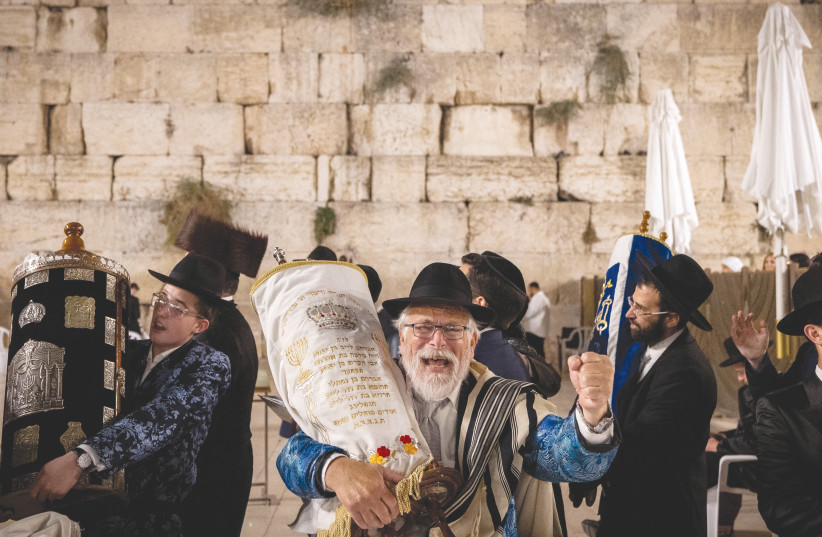
And when we dance on Simchat Torah, we do it in a circular fashion, with the Torah scroll directly in the middle. This guarantees that everyone, at every point in the dance, is equidistant from the Torah. No one is closer to the Torah – or to God, I should add – while we are engaged in expressing our love for the Torah and all that it inspires.
In numbers, there is strength; and in unity and togetherness, both physical and spiritual, there is a feeling of camaraderie and comfort, as we literally hold hands with one another or lean on each other’s shoulder. As we go round and round, we are strengthened and supported in our own journey through the circle of life. In a sense, the dynamic of “if they can do it, so can I” buoys our spirits and frees our inhibitions. And we are happy.
Second, Sukkot is also all about simplicity. This, too, is manifested by the sukkah. Its limited space, its frailty, its position outdoors in the very midst of nature – rather than apart from it – afford us the opportunity to enjoy the simpler things in life and focus on the beauty of the world.
This feeling is echoed in the taking of the Arba Minim or Four Species, the bound-up myrtle-willow-palm branch held together with the etrog. We feel the earth within our hands, hearkening back to a time when we were closer to the land and more in touch with the earth.
Going back to basics grounds us – literally, as well as figuratively – and it soothes us, as we accept the reality that life, like the lulav and its partners, is fragile and fleeting. We come from the earth, and we shall return to it someday – all of us – and we can hardly hope to avoid all the vicissitudes that may confront us. Yes, we must struggle for our safety and our survival, but if the storms do come, we must learn to weather them.
There is a third aspect of Sukkot and Simchat Torah that can strengthen us in our struggle to find happiness. My rabbi, who was a deep, creative thinker, would ask us, “What is the literal translation of the term ‘Simchat Torah’? It means ‘the happiness of the Torah.’ Not the happiness of those who study it, revere it, or practice it, but, rather, of the Torah itself! And what is it that gives the Torah happiness? If you figure that out, then you, too, will be happy.”
The answer, of course, is that when we act in accordance with the Torah, then the Torah and, of course, God, who gave it, rejoice. The Torah – which we relate to as a living thing, a “Torat hayim” – actually feels joy when we behave in a godly manner.
The Torah directs us to “love our neighbor as ourself,” which essentially means to give others some slack, the benefit of the doubt, just as we would want it in return. The Torah commands us to help the stranger, the convert, the disenfranchised; that is precisely what we need when we are feeling disillusioned or despairing of happiness. The Torah preaches, “When you see your brother suffering under a heavy burden, lift him up!” When we do that for others, we can be confident that we, too, will be uplifted when we are down and distraught.
The Torah, in short, celebrates when we internalize and perform the many mitzvot it contains. That happiness is a reflection of how we, too, will come to rejoice, because a better world will enhance our own lives and give us hope for the future.
We have suffered immensely since the Simchat Torah of October 7. But for all the angst and anxiety, there is hope for the future, because we are a nation of eternity. We shall dance again – on Simchat Torah and long into the future.
The writer is director of the Jewish Outreach Center of Ra’anana; rabbistewart@gmail.com.