
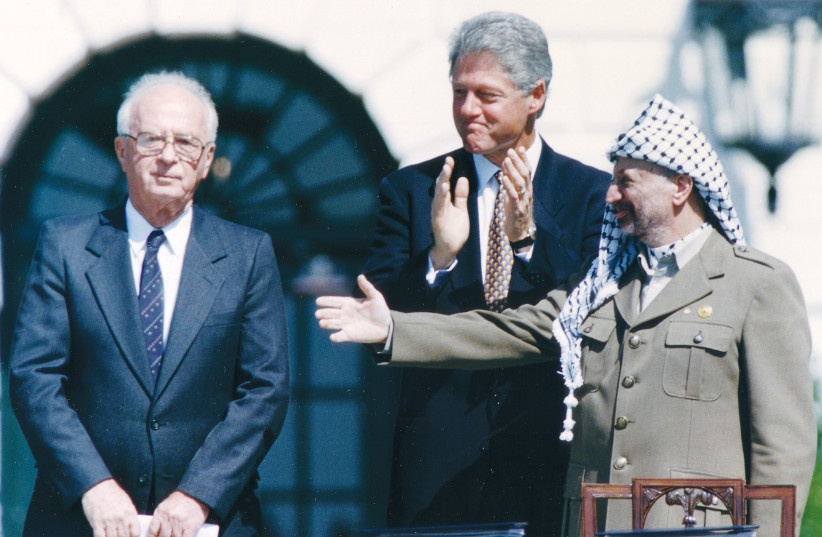
In the one hundred years of conflict imposed by their Arab neighbors, Israelis can be excused for their proclivity to agree to plans and processes full of wishful thinking. In 1993, many of them took that view as Yasser Arafat and Yitzhak Rabin, under the gaze of a smiling US president, signed a peace protocol on the White House lawn that launched the so-called Oslo peace process.
Arafat’s decision was to wage a terror war in 2000 against the state that allowed him to rule in Gaza and parts of Judea and Samaria, leading to the murder of over a thousand Israelis, half of them in suicide bombings in buses, restaurants, and wedding halls, over the next five years. It demonstrated that the Oslo “peace” process was actually a war process that led to spiraling violence.
Now, after two years of war on several fronts, all the more so do many Israelis want to believe that the plan of US President Donald Trump will produce peace, especially since it calls for the immediate release of 20 living hostages and 28 bodies savagely held by Hamas.
Yet compassion must be tamed not only by bitter memories of Oslo but also by the failure of the new plan to assure even the minimum of security for Israelis emanating from the Hamas threat in Gaza that has already cost Israel two thousand deaths in this war, as well as many thousands of Israelis traumatized by the launching of over 20,000 rockets from the Strip over the last quarter of a century.
TRUMP’S GOAL, as it appears in the title of the plan, is to secure a “comprehensive peace.” The same plan calls for the release of 250 prisoners serving life sentences – many of whom, one can presume, will be allowed back to Gaza – along with 1,700 other terrorists (called Gazans) in return for the release of kidnapped hostages.
How will replenishing Hamas’s ranks with 1,700 terrorists, many of whom perpetrated the savage massacre on October 7, 2023, as well as the former terrorists sentenced to life imprisonment, who will no doubt fulfill the depleted military leadership ranks of the organization, promote comprehensive peace?
What if most of those released and the thousands of terrorists in Gaza not yet killed or apprehended do not agree “to commit to peaceful coexistence and to decommission their weapons” or don’t “wish to leave Gaza [and]... be provided safe passage to receiving countries” (Clause 6)?
Will “the supervision of independent monitors” be sufficient to rein them in and ensure that all “military, terror, and offensive infrastructure, including tunnels and weapon production facilities… be destroyed and not rebuilt?” (Clause 13)
Can “independent monitors” possibly achieve what the IDF, using airpower, artillery, tanks, and crack troops only partially achieved in two years of warfare?
Even if “the United States will work with Arab and international partners… [to] develop a temporary International Stabilization Force (ISF) to immediately deploy in Gaza” to train and provide support to vetted Palestinian police forces” there, will this force indeed be “the long-term internal security solution?” (Clause 15)
Little actions against terror organizations
Recall that 30,000 security members of the Palestinian Authority lost to Hamas in 2007 during its takeover of Gaza, that the 12,000-strong international force known as UNIFIL was helpless against Hezbollah in southern Lebanon, and that the PA’s security forces (trained by US military experts) couldn’t even cope with Hamas in Jenin, a relatively small town compared to the major cities in Gaza, in the past two years.
PERHAPS THE fears of most Israelis can be assuaged by a guarantee “provided by regional partners to ensure that Hamas and the factions comply with their obligations and that New Gaza poses no threat to its neighbors or its people” (Clause 14). Presumably, these “regional partners” will include Egypt, Saudi Arabia, Jordan and the UAE, states which have peace accords with Israel.
However, Egypt and Saudi Arabia have done almost nothing against the Houthis in Yemen, despite the blockage of maritime traffic along Saudi Arabia’s 1,500 km. coast and the massive economic losses incurred by Egypt from the loss of this maritime traffic in the Suez Canal. Saudi failure in containing the Houthi maritime threat came in the wake of its failure, along with the UAE, to prevent them from conquering Sanaa, the capital, and most of the inhabited territory of the former Yemeni state. This all begs the question: why should these states be any more successful regarding Gaza?
Worse still, from an Israeli perspective, is that the rebuilding of Gaza will take place while these clearly insufficient security institutions come into being and develop. This means that Hamas and the other terrorist organizations will be able to siphon off concrete and other building material to vastly increase the tunnel infrastructure and relaunch their ballistic capabilities and rudimentary but effective military production. “Taxing” building developers and contractors will provide the funds for recruiting and training new troops for Hamas, just as milking international assistance will provide the means to feed them.
By the time the PA is “reformed,” a feat never achieved by any Arab state, let alone by a 90-year-old leader, Hamas will easily be able to kick out the Palestinian Authority as it did in 2007.
In short, the only option is to finish off Hamas by fighting hard and establishing military rule to prevent its reemergence. These goals can only be “made in Israel,” hopefully with the support of President Trump, whom Prime Minister Benjamin Netanyahu has rightly called Israel’s best friend ever.
Mr. President, it is better to be remembered as a Cyrus rather than as a Nobel laureate. The memory of the Jewish people is infinitely greater than the memory of Nobel Peace Prize winners.
The writer is a senior researcher in the Jerusalem Institute for Strategy and Security.