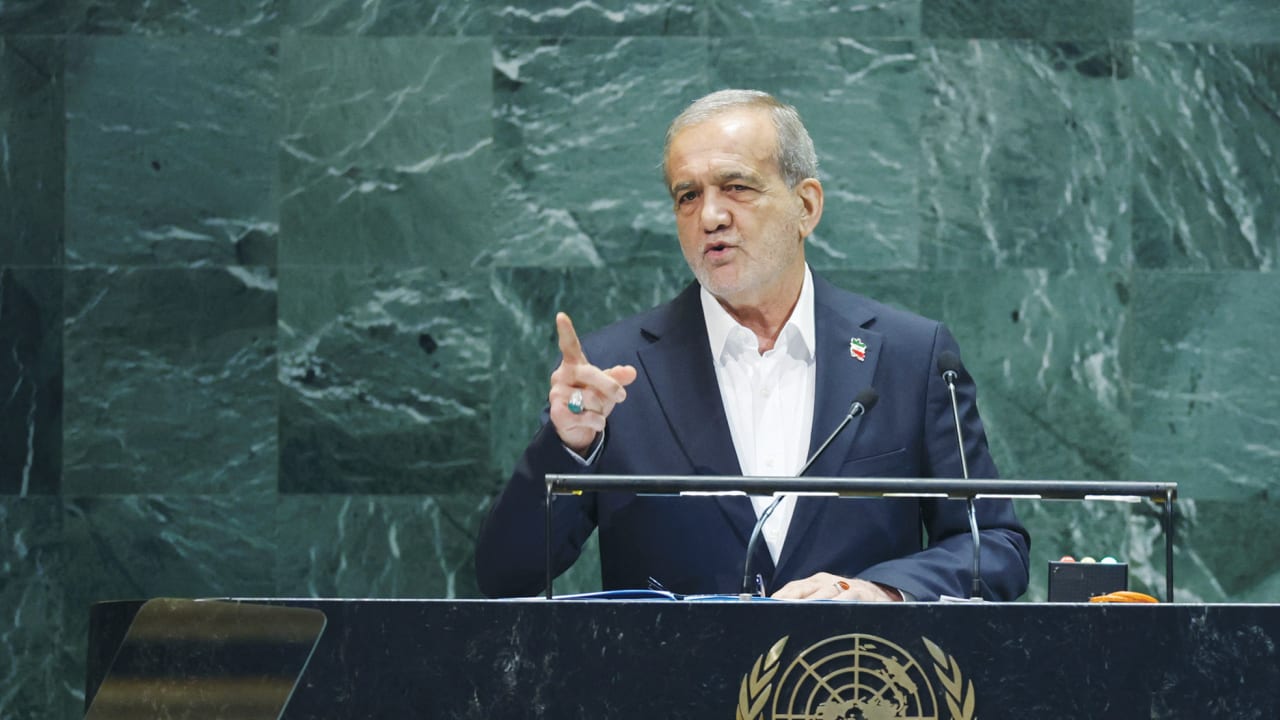
At the United Nations General Assembly in New York on Wednesday, Iranian President Masoud Pezeshkian delivered a fiery 15-minute diatribe. The heart surgeon-turned-statesman targeted, almost exclusively, the familiar pairing of the United States and Israel in his speech, accusing Washington and Jerusalem of destabilizing the region, “brazen aggression,” betraying diplomacy, and “coercion and bullying.”
Faced with the imminent reimposition of Security Council sanctions, which would include the freezing of Iranian assets abroad and the halting of arms deals with Tehran and its destructive ballistic missile program, Pezeshkian vowed never to bow before “aggressors.”
Far more telling in Pezeshkian’s speech was what he did not vow and what he did not even bother to mention.
Not a word about the appalling conditions back at home, where decades of corruption, overextraction, and mismanagement have led to regular blackouts and chronic water, gas, and electricity shortages, pushing the country’s 90 million people to the brink. Tehran’s three major dams, Lar, Mamloo, and Amir Kabir, are at dangerously low levels. In northwestern Tehran, Lake Urmia, once the Middle East’s largest lake and the sixth-largest saltwater lake in the world, has almost vanished.
Pezeshkian said not a word about the suffocating poverty and unemployment that define daily life for the very people he claims to represent. Inflation now sits at 35%. Unemployment among working-age Iranians in some major cities is as high as 60%. The rial has plunged to historic lows, with the country’s GDP per capita sitting at half of what it was in 2012.

Most glaringly of all, Pezeshkian failed to utter a word about an unforgettable anniversary that passed. Last week marked three years since the brutal killing in police custody in Tehran of 22-year-old Kurdish-Iranian woman Mahsa Amini and the subsequent extraordinary “Woman, Life, Freedom” uprising that enveloped almost all of Iran’s 31 provinces and captured the world’s attention.
That uprising represented one of the boldest popular movements the Islamic Republic has ever faced in its 46-year history, and it set off one of the bloodiest crackdowns it has ever unleashed. Hundreds of protesters and bystanders, including scores of children and women, were killed, maimed, arrested arbitrarily, and tortured.
Yet for Pezeshkian, as he stood at the podium in New York this week, that history may as well not exist. The omission was not accidental. It was strategic. By narrowing the world’s attention to external enemies, Pezeshkian sought to deflect scrutiny from the regime’s glaring failures at home. His speech was less a defense of Iran than of the Islamic Republic’s survival.
Iran deserves leadership that will address its reality directly
The Iranian people deserve leadership that will speak their truth on the world stage.
They deserve a leader who will acknowledge that women still risk arrest, or worse, for showing their hair or singing in public. A leader who will fight, not perpetuate, corruption and mismanagement and refrain from pointing to foreign sanctions as the sole reason for Iran’s struggles. A leader who will say out loud what tens of millions of Iranians are saying at home – that they are tired of being hostages to a regime’s obsession with “resistance” abroad and financing expensive terror proxies across the region while life becomes unlivable at home.
Pezeshkian could have used his moment before the world to signal change. Instead, as a powerless figurehead wholly subservient to Supreme Leader Ali Khamenei, he gave the world more of the same: a myopic diatribe against America and Israel, silence on Iran’s domestic crises, and contempt for the courage of his own people.
The contrast is stark. On the streets of Iran, the chants of “zan, zandegi, azadi” – “woman, life, freedom” – still echo. At the United Nations, Iran’s president opts instead to echo only the stale, virulently anti-Western rhetoric of his predecessors.
The writer, Israel’s international spokesperson at the United Nations, is the award-winning author of Unveiled: Inside Iran’s #WomanLifeFreedom Revolt.