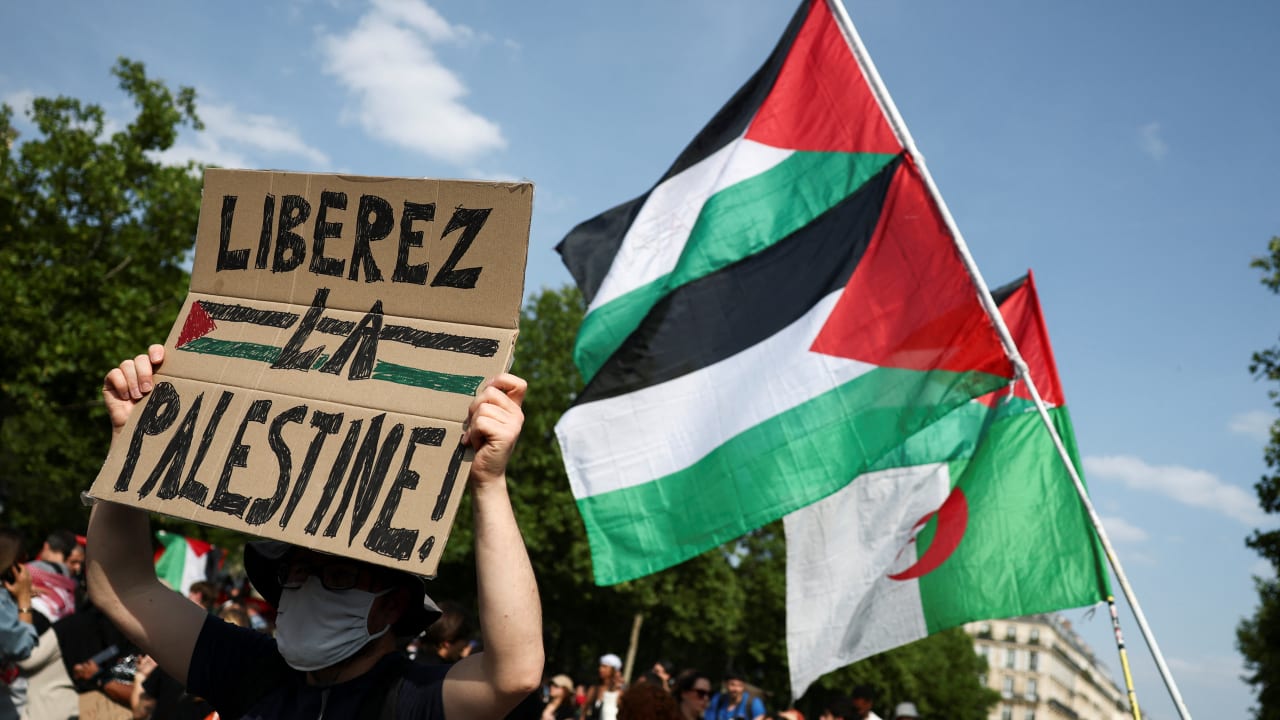
A slew of European governments are itching to help end the catastrophic Gaza war, and the path they have settled on is recognize the non-existent state of Palestine at the upcoming UN General Assembly. Far better would be for Europe – and the Arabs – to table a grand design for peace and reconstruction, in which future recognition can be a carrot.
Recognition alone – currently planned by France, Britain, Belgium, Canada, and others – will not bring peace; it will hand a lifeline to Hamas, which will be seen as having brought it about, and stiffen Israeli resistance, because Israel will take no risks while the savage Hamas is still around. Thus it would actually undermine the goal of a Palestine.
However, a viable strategic plan is desperately needed, and is not forthcoming from either the clueless President Donald Trump nor the obstructionist Prime Minister Benjamin Netanyahu, who runs circles around the clueless Americans. Meanwhile, Israel has proceeded with a ground invasion of Gaza City, which promises new catastrophes and is opposed by the military and most Israelis.
For decades, Europe has been largely irrelevant in Middle East diplomacy. The US dominated, while Europeans offered various support. But Europe is far from irrelevant. Israel’s economy is hugely dependent on exports that Europe, as its largest trading partner, must be willing to buy. The Palestinians, too, need Europe for aid and funding.
The current moment presents a rare opening.

The US has no coherent vision for ending the war and lacks credibility with Palestinians. Israel’s government is focused on military operations only and maintaining the Netanyahu coalition, whose far-right members want occupation, a Palestinian exodus, and Jewish settlement. Into this vacuum could step Europe by sponsoring the only viable plan, together with the Arab League. The annual opening of the General Assembly, to be held from September 23-29, would be a great platform for it.
In New York two months ago, the Arab League, joined by Western states, publicly called on Hamas to disarm. This marked a historic moment: the Arab states including Qatar, historically a patron of Hamas, recognized that these terrorists are the roadblock.
On Friday, September 12, the UN General Assembly made the “New York Declaration” a global consensus, endorsing it with a 142-10 vote. This resolution, spearheaded by France and Saudi Arabia, calls for a Hamas-free Palestinian government and a two-state solution, condemns Hamas’s October 2023 attacks on Israeli civilians, demands the release of hostages, and supports the transfer of authority in Gaza to the Palestinian Authority. The declaration also proposes a temporary UN security mission to ensure peace and assist in state-building efforts in Palestine.
Europe should leverage all this by presenting, together with the Arabs, a detailed and actionable framework to achieve all of this.
It must begin with ending the war and securing the safe return of all hostages, a step that, on the surface, may seem to accept Hamas’s continued hold on power. This initial concession is tactical, setting the stage for a massive choice: Reconstruction of Gaza should then be conditioned on Hamas agreeing to leave power and disarm.
What happens if Hamas refuses?
IF HAMAS refuses, the plan should provide Palestinians with temporary refuge elsewhere – in Egypt under binding guarantees of return once the enclave is stabilized and Hamas has been removed, or perhaps even in the West Bank’s Palestinian autonomous zones. Cairo would require compensation for hosting displaced populations, but the arrangement would make unmistakably clear where the real obstacle lies: with the savage jihadis who expelled the PA from Gaza in a coup in 2007. And it would prevent a humanitarian disaster.
The PA should be restored as Gaza’s governing body, supported internationally in both administrative functions and security oversight. The US should use its leverage over Israel, ensuring it stops demonizing, sabotaging, and blocking the PA. Europe, too, has leverage on Israel as its largest trading partner.
The PA, meanwhile, will be required to amend the textbooks that Israel rightly claims educate young Palestinians to hate Jews. It must also agree to receive security assistance as part of the package, ensuring it can maintain order, prevent armed factions from re-emerging, and rebuild essential institutions.
Arab states – particularly Saudi Arabia, Qatar and the UAE – should commit credibly to lead the reconstruction effort, providing the tens of billions necessary to rebuild homes, schools, hospitals, and infrastructure. This dual approach – removing Hamas from power while rebuilding the strip’s infrastructure and restoring credible governance – creates the conditions for a stable, prosperous Gaza and lays the foundation for eventual recognition of a Palestinian state.
Yet, that recognition should come only after Hamas has been removed and credible governance is in place. In this framework, a clear promise for recognition is a useful incentive to create irresistible pressure on the group.
The Israeli public is likely to embrace it even if the government does not. Over 70% of Israelis oppose the continuation of the war under its current parameters, and it has also been discouraged by senior military leadership, including IDF Chief of Staff Lt.-Gen. Eyal Zamir.
If Israel proceeds in its plan to fully occupy Gaza City, the result will likely be a bloodbath: Hamas has had months to prepare, embedding fighters and explosives among civilians. A prolonged occupation and administration of 2 million Gazans will be a nightmare.
Moreover, an eventual demilitarized Palestinian state separated from Israel is not a favor or a capitulation but a strategic need for Israel – because with the West Bank and Gaza incorporated into it Israel is a nondemocratic and completely binational state. That’s the end of Zionism. An international plan that outlines an attractive endgame and a future partition, but conditioning everything on Hamas disarming, would be a favor to all sides.
America cannot seem to lead it – so Europe should. If the Europeans truly want to see the emergence of a Palestinian state, gaining UN backing for this plank is way better than meaningless recognitions that will strengthen the terrorists who begat the current disaster.
The writer is a former Cairo-based Middle East editor and London-based Europe-Africa editor of the Associated Press, the former chairman of the Foreign Press Association in Jerusalem and the author of two books.