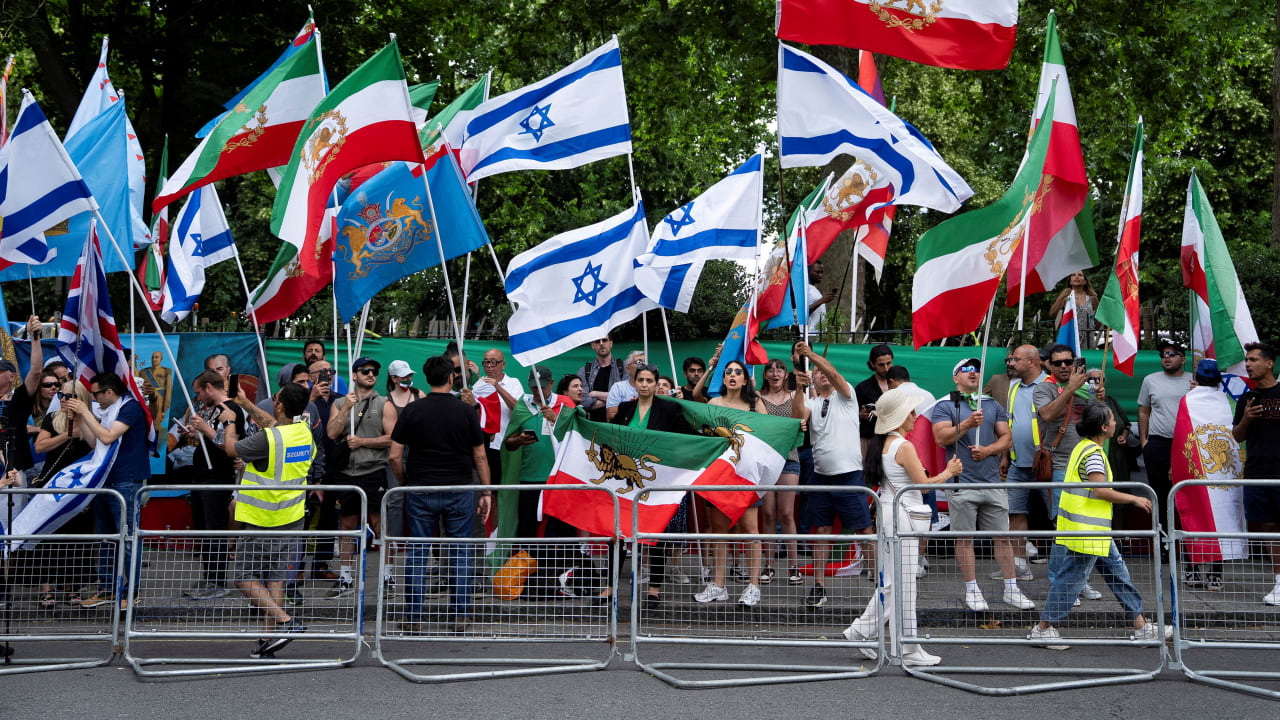
The hostility that currently defines relations between Iran and Israel is not an unchangeable fate. Until the Islamic Revolution and the rise of the Ayatollahs’ regime in 1979, the two countries enjoyed close and friendly ties, grounded in ancient connections between their cultures, a shared and intertwined history, and wide-ranging mutual interests and cooperation — from oil and infrastructure to security.
The Islamic Revolution sought to erase this history by force, choosing to brand Israel as “the little Satan.” Yet beneath the surface of imposed enmity, the peoples still share a memory of closeness and a belief in a different future.
History teaches that sometimes, out of deep crises, unique opportunities arise. Some 2,500 years ago, it was King Cyrus the Great, founder of the Persian Empire, who in his famous edict laid down principles of respect for national identity, freedom of worship and religious belief.
His decree allowed the Jews to return after about 70 years of Babylonian exile to Jerusalem and rebuild the Temple — a move that changed Jewish history and earned Cyrus an honored place in the Hebrew Bible: “Thus said Cyrus king of Persia: All the kingdoms of the earth has the Lord God of heaven given me; and He has charged me to build Him a house in Jerusalem, which is in Judah” (Ezra 1:2).
Today, the two nations whose destinies have long been intertwined stand before a historic opportunity to open a new chapter of cooperation between their nation-states and to create a shared future leading to regional prosperity.

We seek to promote this vision together with our partners, the Iranian people — both those living in Iran and those in forced exile who wish to return once the Ayatollahs’ regime passes. As the Iranian nation longs for a future free of oppression, open to the world, and founded on human liberty and civic prosperity, we extend our hand.
This is the moment for the people dwelling in Zion to repay the noble Persian nation with assistance in rebuilding its country and shaping its future. Naturally, we have chosen to name this vision after King Cyrus the Grinitiative is a joint effort of the State of Israel with those seeking to establish a transitional government that will serve the Iranian people on the day after the Islamic regime falls — an event that may tarry but will come. The initiative to form such a transitional government is led by Crown Prince Reza Cyrus Pahlavi, son of Iran’s last shah, together with his professional team, and is built on hope, pragmatism and mutual recognition.
The Cyrus Accords provide a practical framework for the citizens of Iran to give them hope for a better future if and when the Islamic regime changes. They aim to prepare the ground for a rapid and smooth transition and swift reconstruction of all that will require rebuilding in Iran’s economy when the time comes.
The initiative reflects a sincere desire to re-establish a civil, respectful, professional and efficient relationship, focusing on mutual benefit and concrete solutions to shared challenges.
Core principles of cooperation
Our vision for the Cyrus Accords rests on five key guiding principles:
- Mutual respect and sovereignty. Reciprocal recognition of each country’s right to exist while respecting each side’s national interests.
- Pragmatism and mutual benefit. Concentration on areas where cooperation yields clear economic and technological gains.
- Shared historical heritage. Acknowledgment of the deep historical ties between the Jewish people and the Iranian nation.
- Regional vision. Aiming to integrate bilateral relations into a broader framework of regional cooperation that promotes stability and prosperity in the Middle East.
- Civilian focus. Emphasis on civilian collaboration in economy, trade, technology, energy, agriculture and culture.
A vision for a shared future
The Cyrus Accords outline a framework for cooperation across many civilian sectors, leveraging Israel’s advanced technology and innovation alongside Iran’s rich natural and human resources:
- Water and agriculture. Iran faces a severe water crisis, while Israel has extensive experience in addressing such challenges. We can share expertise in managing a national water economy, desalination and wastewater recycling for agriculture. Advanced Israeli irrigation systems could save water in Iranian farming. Together we can develop drought- and salt-resistant crop varieties. Recently, a delegation of professionals and academics sent by the Crown Prince, whom I hosted in Israel, toured Israel’s Shafdan wastewater treatment plant and the Hebrew University’s Faculty of Agriculture to learn from the Israeli model.
- Energy and natural resources. We can form a strategic partnership combining Iran’s natural resources with Israeli technologies. This includes building joint pipelines for transporting gas and oil, connecting Iran to European markets via the Mediterranean. We will also cooperate on renewable energy projects, especially solar and wind. The Iranian delegation we hosted expressed interest in our smart-grid capabilities and AI applications to help address gas loss, pipeline leaks and air pollution.
- Technology and innovation. The accords propose joint venture capital funds to invest in start-ups and high-tech projects in both countries. We also envision joint innovation parks, student and scientist exchange programs, and cooperation in cybersecurity and artificial intelligence. Another proposed project is the development of shared regional satellite capabilities.
- Tourism, education and culture. The Iranian delegation showed interest in offering Persian-language courses from Israel for Iranian students. To connect our peoples, we plan to launch daily direct flights between Tehran and Tel Aviv and to develop historical tourism routes. We will also establish cultural centers in both countries and work to preserve Jewish heritage sites in Iran.
The Cyrus Accords as a foundation for a broader regional vision – I4U2
Beyond bilateral relations, the Cyrus Accords propose expanding the existing I2U2 framework — currently including India, Israel, the United Arab Emirates, and the United States — to also include Iran and Iraq. This new multilateral framework, which we call I4U2, would tackle larger regional challenges such as water scarcity, food security, and energy security.
Its flagship project would be the creation of a new economic corridor between Iran and Israel, passing through Iraq and Jordan, and serving trade, energy, and fiber-optic communications. This project would re-establish Iran as a global trade hub and bring immense benefits to the region’s economies and millions of its residents. The corridor from Iran to Israel would link with the IMEC plan for a route connecting India to Europe through the Gulf states and Israel, making our region the junction of these two corridors.
The accords are planned in three stages over a decade, from opening embassies and launching initial projects to completing core initiatives and creating a connected economic space. From many conversations with my Iranian partners, I know the Iranian people are eager to see steps that can be taken even now, and naturally, we seek to emphasize progress on what can begin before any change of regime.
The Cyrus Accords represent a historic opportunity to open a new chapter in Israel–Iran relations and to realize the enormous potential of cooperation between the two countries, their peoples, and the entire region. Both nations look forward to the day when we can once again fulfill our shared historic bond and bring peace and tranquility to the Middle East.
The author is a minister from the Likud party and the current Innovation, Science, and Technology Minister of Israel.