History rarely repeats itself exactly, but its rhymes are often unmistakable. Iran, under shah Mohammad Reza Pahlavi, is one such cautionary tale. Though I was not there in those final years, I have studied and witnessed what came after: the wreckage of a society delivered into clerical tyranny by an unholy alliance.
On one side, the mullahs – austere, uncompromising, steeped in the conviction that modernity is a threat to faith. On the other, the Left – intellectuals, Marxists, and radicals, eager to topple monarchy and tradition alike. They had nothing in common but their hatred of the shah.
From alliance to subjugation
For a fleeting moment, their pact worked. The monarchy fell.
However, the dream of progressive triumph was short-lived.
The mullahs seized total control, and the Left that had imagined itself in command was quickly discarded, imprisoned, executed, and exiled. What began as an alliance ended as subjugation.

I did not see the shah fall, but I did see Yemen crumble. I watched as the same slow rot settled in. It began quietly, almost imperceptibly. Sermons grew sharper, more radical, but went unchallenged. Schools, once imperfect but ordinary, became instruments of indoctrination. Institutions weakened. Fear and fatigue bred compromise.
Ordinary people whispered that it would pass, that the storm was temporary.
Yet it was not temporary. It was the beginning of a climate change of the soul.
The mullahs, patient and relentless, worked their way into every crevice of the state until nothing was left but their rule. What was once a fragile, complex country became a hollow husk, governed by men who despised liberty.
Recognizing a pattern
Today, in Britain, I recognize the same pattern. The banners are different, the slogans modernized, but the choreography is painfully familiar.
This island, once the bastion of liberty, is succumbing to its own unholy alliance: a confused and disoriented Left clasping hands with Islamist extremism, both united by their contempt for Israel, for Jews, and – though they may not yet admit it – for the very freedoms for which Britain once stood.
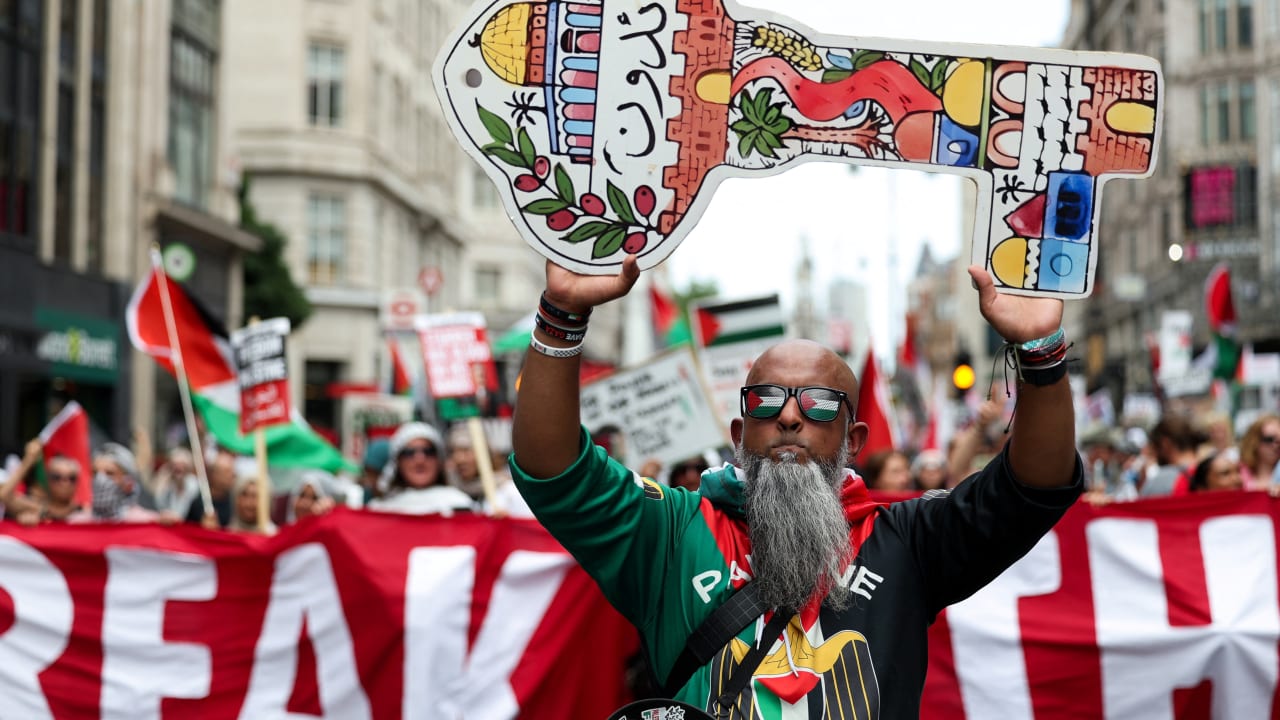
Walk the streets of London and the parallels are glaring. Marches in the capital glorify Hamas, a terrorist organization, as though its pogroms and massacres were noble acts of resistance. Slogans calling for Intifada and jihad are waved like badges of honor, while police hesitate to intervene.
Grotesque pantomime
Universities, those once-proud citadels of inquiry, have turned into stages for a grotesque pantomime where antisemitism is dressed up as “decolonization,” and Jewish students are cast as oppressors for affirming Israel’s right to exist.
Politicians equivocate. Journalists indulge euphemisms. Jewish families – the lifeblood of Britain’s cultural, scientific, and civic life – whisper at their dinner tables whether their future lies elsewhere.
This is Britain’s shah moment. In Iran, it was Marx and the mullahs. In Yemen, it was clerics who stepped through the cracks left by state failure. In Britain, it is the progressive Left and Islamism, cloaked in the flags of “anti-racism,” “intersectionality,” and “human rights.”
Just as in Iran and Yemen, this is a bargain struck with forces that have no interest in sharing power and every intention of devouring their partners.
Feminists who chant “From the river to the sea” alongside Hezbollah sympathizers will be the first ones stripped of rights if the ideology they excuse takes root. LGBT activists marching in solidarity with Hamas apologists would be the first to disappear if Hamas ever ruled here. The pact is temporary. The betrayal is inevitable.
All the while, Britain’s voice of courage falters. This is the country that abolished slavery against the vested interests of its time, that stood alone against Hitler when Europe lay in ruins, that helped draft the very language of universal rights.
It was once the home of Locke, Mill, and Orwell. Today, its institutions cower. Police officers allow calls for jihad but warn those who object not to provoke. Free speech is not dead in Britain – but it is rationed, selectively applied, and Jews too often find themselves excluded from its protection.
A civilizational marker
The lesson of Iran is clear: Once the clerics consolidated power, there was no going back. The lesson of Yemen is clearer still: The rot does not arrive all at once but creeps, spreads, and then consumes everything. Both histories remind us that extremism never pauses where you think it will. It does not compromise. It does not wait. It takes.
Britain is not yet lost. But if Jews leave, it will not be a parochial shift; it will be a civilizational marker. Where Jews cannot live in safety, liberty itself has died. If synagogues must be fortified, if schools resemble barracks, if families must weigh whether to raise their children in Toronto or Jerusalem rather than London or Manchester, then Britain has already betrayed what it once was.
This is not only a Jewish story. It is Britain’s story. When Jews are no longer safe, no one is. The machinery that can slander Jews can slander anyone. The indulgence that excuses pogroms as “resistance” will excuse other barbarities. The society that tolerates antisemitism cannot sustain democracy indefinitely.
The question is whether Britain still has the courage to resist. Will it reclaim its inheritance, the stubborn refusal to appease tyranny, the insistence that liberty is universal and indivisible? Or will it follow the road I saw Yemen take, the road Iran has traveled for 40 years – the road of silence, indulgence, cowardice, and, finally, collapse?
I have seen this before. In Yemen, I lived through it. In Iran, I witnessed what came after. The signs are unmistakable. Britain is not immune. And if the storm is not faced, it will not pass. It will settle. It will spread.
By the time Britain recognizes it, there will be nothing left to defend.
The writer is the executive director of We Believe In Israel.