
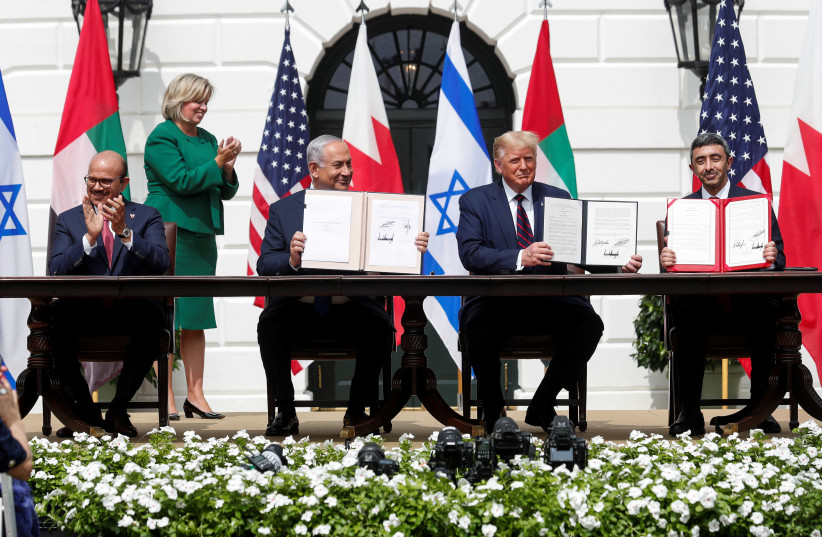
Over the past few weeks, I have attended numerous conferences and briefings commemorating the fifth anniversary of the Abraham Accords, the 2020 agreements that normalized diplomatic relations between Israel and the United Arab Emirates and Bahrain, and later Morocco and Sudan.
From think tanks to regional summits, the rooms buzzed with diplomats, economists, business leaders, and security experts. But one thing was strikingly absent: the voices of educators and faith leaders.
The absence is astonishing. Nearly two years into one of Israel’s most devastating wars – sparked by the brutal attack on October 7, 2023, which was rooted in extremist religious ideology – how can anyone believe that defense pacts and trade deals alone will secure peace?
To be clear, no one doubts that the Abraham Accords are a historic milestone. They opened new channels of communication between Israel and the Arab world. They have led to flourishing economic ties and important breakthroughs in regional defense collaboration. However, alliances based only on shifting interests – however promising – are inherently fragile.
Interests shift. Markets fluctuate. Strategic alliances evolve. What endures is identity – and the narratives we all carry about who belongs, who threatens, and who shares in our story.
That is the soul still missing from the Abraham Accords.
More than tech and trade
So far, the economic deals and diplomatic gains from the accords have largely benefited a narrow slice of society: business elites, security professionals, and political leaders.
For ordinary citizens, little has changed. In the nations that signed the accords, there are, for the most part, still no joint school curricula, no student exchange programs, no coordinated messaging from religious leaders, and almost no meaningful cultural or media programming that reflects the spirit of the accords. That silence leaves the door wide open for extremist voices to fill the vacuum with dangerous distortions.
Meanwhile, propaganda outlets like Al Jazeera flood the region with a different story: that Israel is a foreign, colonial implant – a European project with no legitimate roots in the region. This narrative, amplified across the Arab world, erodes trust and legitimacy at the grassroots level and will eventually jeopardize the accords themselves.
While no country can fully control what others choose to broadcast, people of faith across the region – Jews, Muslims, Christians, and numerous minority groups – can and must speak clearly and confidently about what is true: that Jews are not outsiders in this region, and that all Abrahamic faiths have room here. Christians, Muslims, and Jews are all descendants of Abraham, bound by deep spiritual and historical ties to this land stretching back millennia.
That truth is not a political message – it is a shared foundation on which real peace can be built. Yet for that peace to endure, the Abraham Accords must mature beyond their current scope.
What lasting peace requires
If we hope to mark the accords’ 10th, 20th, or even 50th anniversary with lasting significance, the governments and societies involved must move beyond diplomatic formalities and elite business deals. As they stand now, the accords lack the very Abrahamic spirit for which they were named.
Abraham was not a man of policy or protocol – he was a man of covenant, compassion, and connection. A unifying ancestor for Jews, Christians, and Muslims alike, he embodied the idea that relationships, not transactions, are what bind people together.
To outlast political cycles and withstand the volatility of the region, the next phase of this agreement must focus on people – not just politicians. Real peace is not made in summit rooms alone; it’s built through investing in relationships that shape identity and foster trust. For example, student exchanges funded by the signatory governments can turn strangers into peers instead of threats.
Interfaith diplomacy should bring rabbis, imams, and clergy together across national and community lines, not only for photo ops or panel discussions, but for deep learning in sacred spaces and genuine partnerships that build mutual respect and involve their congregations.
Equally vital are the cultural and educational ties that reach the broader public. Joint educational projects in Israeli, Moroccan, and Emirati schools should bring shared values – compassion, hospitality, justice – off the page and into real-life conversations. Music, art, literature, and media can do what official agreements alone cannot: they can normalize peace from the bottom up, shaping how communities see one another and creating space for empathy.
When people encounter one another in the context of a shared story, they can begin to imagine a future together. This is peace-building at its deepest level – precisely the kind of groundwork required if the Abraham Accords are to live up to their name.
The writer is managing director of the Ohr Torah Interfaith Center.