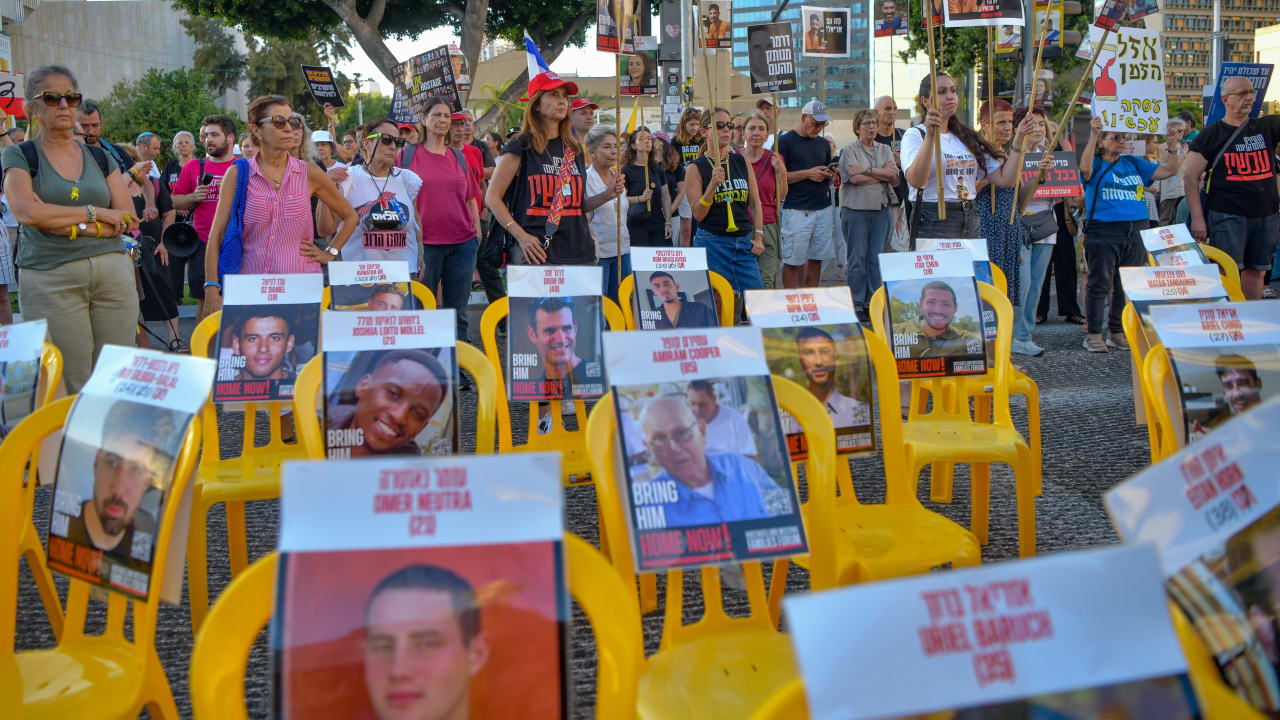
How did such a profoundly human issue as the hostages and the solidarity owed to their anguished families become yet another weapon in Israel’s endless political battles? How did venom and hostility creep into what should be a moment of unity?
The answer, I believe, begins with the way we educate our children. In recent decades, fewer and fewer first graders have entered the state education system. From the very start, we are splintering along value-based lines, denying ourselves a shared moral foundation and the ability to dream together. In the short term, we must summon the wisdom of Solomon. In the long term, we must invest in a shared vision and create far more points of encounter.
Not so long ago, every Israeli child knew who Theodor Herzl was and could recognize David Ben-Gurion. They grew up with biblical stories, figures, and places that anchored them in a common heritage. They even knew that halacha was more than the name of a highway interchange.
Society has fragmented; education is critical
These shared cultural touchstones have steadily eroded. Worse still, what was once consensus has become divisive. We chose to fragment our foundations when we allowed an ever-growing number of elementary schools to operate without a civic core curriculum. We failed to insist on an Israeli framework that could later enable us to dream together or at least understand one another.
Just last week, it was reported that, for the first time, haredi (ultra-Orthodox) children will make up the majority of Jerusalem’s incoming first graders: 8,400 out of roughly 16,000 students. That compares with 4,300 in the state and state-religious systems and 3,500 in the Arab sector, according to the Jerusalem Institute for Policy Research.

The trend is clear. Today, haredim make up about one-fifth of Israel’s first graders. By 2065, they are projected to reach half, according to the National Economic Council in the Prime Minister’s Office. Until just over a decade ago, all haredi elementary schools were privately run by associations.
Core subjects were scarcely taught, particularly to boys, who in secondary school overwhelmingly continue in yeshivot ketanot that teach only religious studies. In 2013, the Education Ministry introduced a new framework called “state-haredi education,” which today includes dozens of schools and thousands of students.
This is not an indictment of the haredim. The secular community, too, has grown more extreme. Arguments over tefillin stands, protests against Bible classes, or campaigns to cancel certain lecturers have become routine.
Each side has retreated into itself, unwilling to hear the other and, by doing so, effectively erasing the other.
If this is the way we raise our children, how can we expect them, in such a painful moment of war, to grasp that even those who think differently also want the hostages home? That even those blocking highways, whatever one thinks of the tactic, love Israel? That not everyone advocating military pressure in Gaza is “abandoning” their brothers but may simply see a different path to safeguarding them?
If we do not create encounters through civic education in the early years, we will not know how to build them later in life. This is a repair we must urgently undertake, though its impact will be seen only in the future. I am not calling for anyone’s way of life to be overturned, nor for canceling a class on AD Gordon or a page of Talmud. I am calling for something more basic: that each day, for one or two or three hours, the state makes sure that we meet one another.
Meanwhile, as the clock ticks, hope wanes, and collective pain deepens, Israeli society seems trapped in an endless argument. Should we strike a deal “at any cost,” or should we hold firm to preserve deterrence and national security? Each side is convinced of its righteousness. Every discussion devolves into emotional fervor and even hostility. In this climate, it is hard not to recall an ancient parable: Solomon’s judgment.
Drawing wisdom from King Solomon
The biblical tale is well known. Two women claim the same infant. There are no witnesses, no lengthy proceedings. Instead, Solomon proposes a shocking solution: cut the baby in two. The horrifying suggestion exposes the truth. The real mother is the one willing to forgo her claim to save her child. Solomon is hailed as the wisest of men not because he had evidence, but because he devised a creative move that broke the deadlock.
At first glance, the analogy is obvious. We too are locked in a dispute where each side has powerful arguments. On one side, the sanctity of life and the moral imperative to bring the hostages home now. On the other, the need to maintain deterrence, deny Hamas a victory, and prepare for the day after. Like the two mothers, each side is certain “the child is theirs” and that their solution is the only one that secures the future.
But here lies the deeper lesson. Solomon’s judgment is not a parable of “an impossible problem.” It is a model of how to find an unexpected solution rooted in deep human understanding. Solomon did not declare who was right. He forced the truth to emerge.
So too must we. If we keep clinging to “I’m right, you’re wrong,” we will remain stuck, and the hostages will remain in captivity. The challenge is to find Solomon’s judgment of our time: a wise, creative, and innovative breakthrough that transcends the stalemate. True wisdom lies not in proclaiming who is right, but in finding a path that saves lives. Even if that path demands concessions, paradigm shifts, or stepping out of our comfort zones, that is the price we must pay.
Because in the end, what is at stake is not only the fate of the hostages but also the character of our society. Can we still prove, to ourselves and to the world, that we possess wisdom, creativity, and moral courage?
The writer is CEO of ANU– Museum of The Jewish People in Tel Aviv.