
Several weeks ago, I joined a tour of Jerusalem and my area by the anti-Jewish development group, Ir Amim. This group advocates preventing Jewish building in certain areas of the Land of Israel. They advocate that the land be developed by the Arabs living in the area instead of the local Jews. Ir Amim is a low-profile group that has a small following among Israelis.
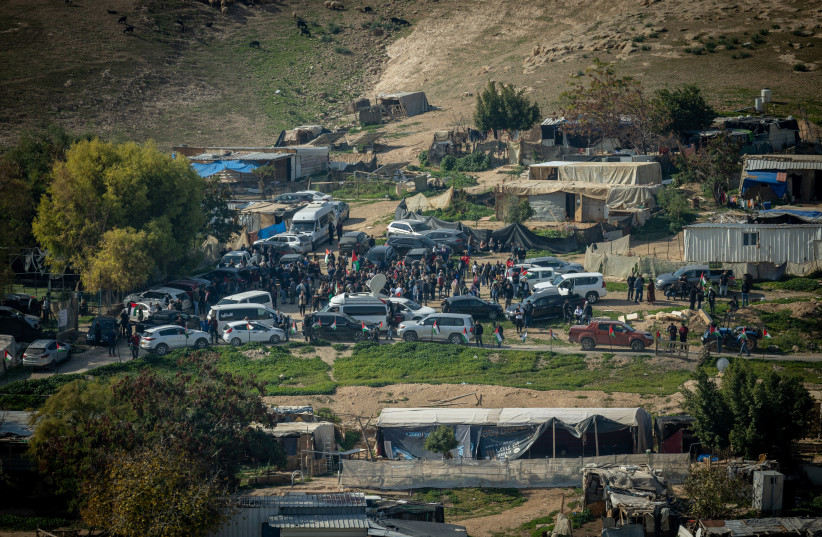
I joined the tour after seeing an Ir Amim social media ad, since the trip would include a visit to the Bedouin outpost near my home, informally named “Khan al-Ahmar.”
This Bedouin encampment isn’t a recognized or legal location. In the 1950s, the residents of a small Bedouin camp in the Negev desert relocated to the Jordanian side of the occupied land, renaming it “The West Bank [of the Jordan River].” When Israel won control of the area from the Jordanians in the 1967 Six Day War, these Bedouin found themselves under Israeli control.
Khan al-Ahmar looks like a tent encampment in the middle of the Judean Desert. There are no buildings, just a series of structures that could generously be called “shacks.” In contrast to Palestinian cities and villages in the area, in the 70 years that the Jahalin tribe of Bedouin has lived on the land, they’ve made no progress in developing the land. This is similar to most of the 30 or so other Bedouin outposts in the area. Ir Amim claims there are 28 families and an estimated 200 residents in Khan Al-Ahmar, although after walking through it and seeing the people, I estimate that to be an exaggerated figure.
Ir Amim partners with another organization called Friends of the Jahalin, which aims to protect the human rights of the Jahalin Bedouin tribe across the Judean Desert. They have been fighting a 2018 Israeli High Court decision, which allowed the demolition and transfer of Khan al-Ahmar’s residents to an area outside of Ma’aleh Adumim.
I have no issue with Jews and Israelis who want to help suffering Arabs. As Jews, we are charged with emulating God and showing compassion and mercy to all those created in God’s image. I admire Jews who see the suffering of humans of other nations, communities, and religions and want to alleviate their pain and misfortune.
Years ago, I joined organizations that helped the residents of Khan al-Ahmar. I visited the Jahalin tribe, listened to their stories, and brought and distributed candy for their children. I saw no reason to move the residents and demolish their tents. I faced resentment and opposition from many of my neighbors who couldn’t understand why I showed kindness to a tribe that didn’t treat our residents kindly or recognize Jewish rights to the land. I never joined Ir Amim and the Friends of Jahalin, but I was sympathetic to their goals.
Eslam Froukh's terrorist attack
A FEW years ago, Eslam Froukh, a Palestinian resident of east Jerusalem affiliated with the ISIS terror group, perpetrated a fatal double bombing attack in Jerusalem. Froukh, 26, set off multiple bombs at two bus stops near entrances to the capital. The attacks killed two people, 16-year-old Aryeh Schupak and 50-year-old Tadese Tashume Ben Ma’ada, and wounded over 20 others.
Froukh had studied mechanical engineering in Israel at an Israeli university and used his knowledge to teach himself how to make the bombs used in the attack. He established a laboratory near Ramallah where he could produce and test the explosives necessary to build a bomb.
After remotely detonating his bombs, Froukh fled, sparking a manhunt throughout the areas surrounding Jerusalem. During the hunt for the terrorist, security forces searched Khan al-Ahmar. According to media reports, the forces suspected that Bedouin residents of the enclave not only failed to report that the terrorist Froukh had fled to their outpost – they had even aided him.
My daughter Naomi was injured, both physically and emotionally, by Froukh’s bombs. She was walking to a bus stop to catch her daily ride to her national service job when shrapnel from the bomb hit her. After sitting for hours with Naomi in the hospital and helping her recuperate in the years after the attack, I looked at Froukh and anyone who helped him with contempt and resentment.
I felt personally betrayed by the Jahalin tribe when members of Israel’s security forces met with me and confirmed media reports that residents of Khan-al-Ahmar aided Froukh evade Israel security forces. I stopped advocating for and helping the Jahalin tribe and opposing the demolition of Khan al-Ahmar.
I COULDN’T bring myself to visit the people who had aided my daughter’s attacker. For years, I imagined marching back into their outpost and confronting them, but I never had the courage. When the advertisement for the Ir Amim tour appeared last month, I knew it was time to confront them, and I registered for it.
When we arrived at the village, we were taken to the tribe’s spokesperson, who delivered a well-rehearsed narrative of the Jahalin tribe as peace-loving people victimized by the Israeli government and Jewish settlers. They claimed rights to the land and complained about not being allowed to build on their land. I patiently waited until he finished his speech, took a few questions, and then I raised my hand.
“Do you remember Eslam Froukh?” I asked him. He claimed not to know who he was. I quickly summarized Froukh’s bombing attacks and the spokesperson immediately remembered who he was and what he had done. I asked him why he had aided and abetted a terrorist who had killed Jews and attacked my daughter. Although intimately familiar with the details of Froukh’s attacks and the manhunt for him, the Jahalin spokesperson claimed that Israeli media reports and an Israeli military statement were false.
I expected the Jahalin members to deny helping him – why would they admit to such a dastardly act and place their narrative as helpless victims at risk? I was shocked that with no knowledge of the case, the Jewish representative from Ir Amim instantly believed the Jahalin and vocally took their side.
While I don’t take issue with Jews helping poor Bedouin, I take issue with Jews who help those who have or want to hurt Jews.
I am challenged in understanding Jews who have taken Hamas’s side after the October 7 attacks and the Ir Amim Jews giving the benefit of the doubt to the Jahalin over their own people.
These people are confused over who the Jewish people’s friends and who their enemies are. They don’t understand who deserves Jewish kindness, mercy, and generosity – and who doesn’t.
I felt frustrated and relieved after my trip to Khan al-Ahmar. As a father of a terror victim, I was relieved that I had confronted those who aided my daughter’s attacker. As an Israeli educator and Zionist, I felt frustrated that I was unable to demonstrate to fellow Jewish Israelis that supporting those who wish to hurt the Jewish people is misguided mercy that will come back to hurt the Jewish people. I can only hope that, upon further reflection, those on the trip with me recognized their error.
The writer is a Zionist educator at institutions around the world. He recently published his book Zionism Today.