Last week the UN-backed Integrated Food Security Phase Classification system declared famine conditions in parts of northern Gaza. The declaration altered normal IPC standards by relying on projections rather than verified evidence such as daily death counts from malnutrition or updated reporting on hunger mortality.
No data was presented on the number of people dying per day from starvation, nor was there acknowledgment that aid deliveries into Gaza have increased significantly over the past two weeks. The announcement generated headlines worldwide but departed from the empirical baseline normally required to label a famine.
Amid this humanitarian debate, Egypt remains absent from serious discussion of solutions. Egypt is a signatory to the 1951 Refugee Convention, the 1967 Protocol which expanded asylum protections worldwide by removing the original convention’s geographic and time limitations, and the 1969 OAU Convention Governing the Specific Aspects of Refugee Problems in Africa. Despite these commitments, Cairo has repeatedly refused to open its border to displaced Gazans.
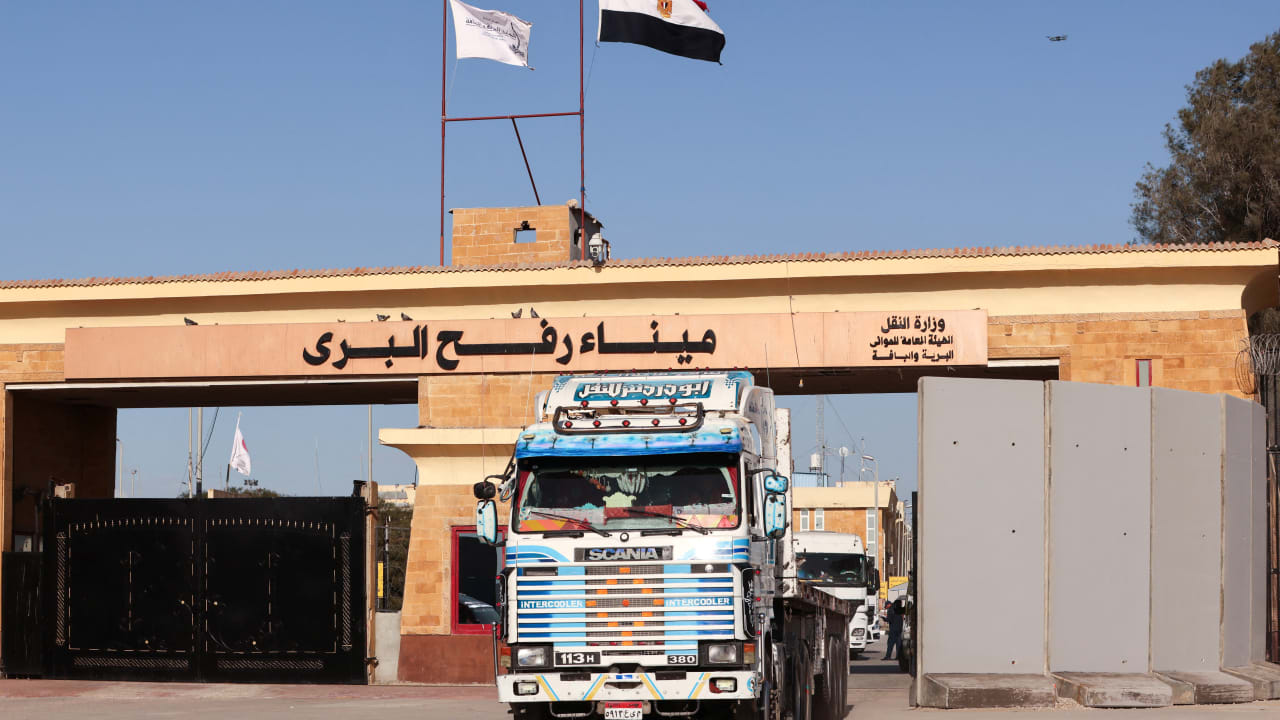
After the October 7 attacks and the outbreak of war, Egypt reinforced its position by deploying an armored brigade and tens of thousands of troops to northern Sinai, erecting new border fortifications, and constructing a massive wall near Rafah to ensure no civilians could escape from the war zone inside Gaza. These measures show that Egypt’s current explanations came after its decision to physically seal the border.
Egypt’s official position is that opening Sinai to large numbers of refugees is a red line. President Abdel Fattah al-Sisi has warned that hosting Gazans would “liquidate the Palestinian cause” by removing them from their land.

Egyptian officials cite security concerns, pointing to the long insurgency in Sinai and the risk that militant groups could use the territory as a staging ground. They argue that Egypt lacks the resources and infrastructure to absorb such an influx. Already home to millions of refugees and asylum seekers, many of whom are not granted formal refugee status, Egypt insists that it cannot handle more.
These arguments may sound pragmatic and rooted in security or political logic, but they do not outweigh humanitarian imperatives, especially in a moment of mass suffering and long-standing regional instability.
The reality is that no single country has ever been able to shoulder an entire population’s displacement alone, nor has any country had the absolute ability to block every escape route.
When Russia invaded Ukraine, over five million Ukrainians fled across multiple borders, with Poland, Romania, and other EU states sharing the burden. No single European state both carried the flow and sealed every exit.
In Syria, over six million people have fled since 2011, mostly into Turkey, Lebanon, and Jordan. Again, responsibility was spread across many countries. In Yemen, millions of displaced people found refuge in multiple neighboring states.
Egypt is unique because it alone controls the only open border of Gaza while Israel remains at war with Hamas. Unlike in Ukraine or Syria, where civilians had options, Gazans are trapped.
Aid perpetually vulnerable to Hamas seizure, exploitation
Because of this, all humanitarian aid is forced directly into Gaza itself, where Hamas continues to control territory, launch attacks, and hold hostages. That creates an environment where supplies are perpetually vulnerable to diversion, seizure, or exploitation by Hamas.
What is occurring today is without precedent. Never in modern history has a nation at war provided such sustained deliveries of food, water, and medicine to a population under the control of its active enemy. It did not happen in World War II, nor in Vietnam, nor in any other major conflict. International law obligates facilitation of humanitarian access, but not at the cost of feeding the very adversary still engaged in combat.
It is possible to envision a different solution. Even without a formal refugee framework in Sinai, the international community could build a fenced humanitarian zone inside Gaza itself, secured by international monitors, where the United Nations and NGOs could provide food, water, and medical care to civilians seeking protection from combat.
Similar humanitarian enclaves have existed in other conflicts and would allow displaced people to find safety without requiring permanent relocation outside their homeland.
Concerns about permanent displacement, which Egypt highlights as justification for its refusal, are not grounded in fact. Senior Israeli officials have publicly stated that Palestinians would be allowed to return to Gaza after Hamas is defeated, and that the United Nations Security Council could pass and enforce such a resolution.
A humanitarian zone or temporary relocation into Sinai would not erase Palestinian identity or rights to return. Rather, it would provide immediate relief to civilians while the war against Hamas continues.
Egypt’s decision to militarize its border, construct new barriers, and block every avenue of escape reflects its national calculations. Yet those calculations should not be accepted uncritically. The lessons of Ukraine, Syria, and Yemen are clear: mass displacement must be managed through regional and international cooperation, not sealed borders.
Egypt may claim to be protecting the Palestinian cause, but in practice it has trapped civilians inside a war zone. The world should stop excusing this ahistorical position and begin demanding concrete humanitarian solutions that save lives without undermining eventual Palestinian return.
With the United Nations General Assembly convening in September, Egypt can no longer be allowed to remain absent from this conversation and certainly not continue to block humanitarian options.
The UN should make it a priority to debate and act on the creation of an internationally monitored humanitarian zone in the Sinai desert so that civilians have a genuine avenue for safety until the war ends.
John Spencer is the Chair of War Studies at the Madison Policy Forum and executive director of the Urban Warfare Institute. He is the coauthor of Understanding Urban Warfare. Learn more at www.johnspenceronline.com.