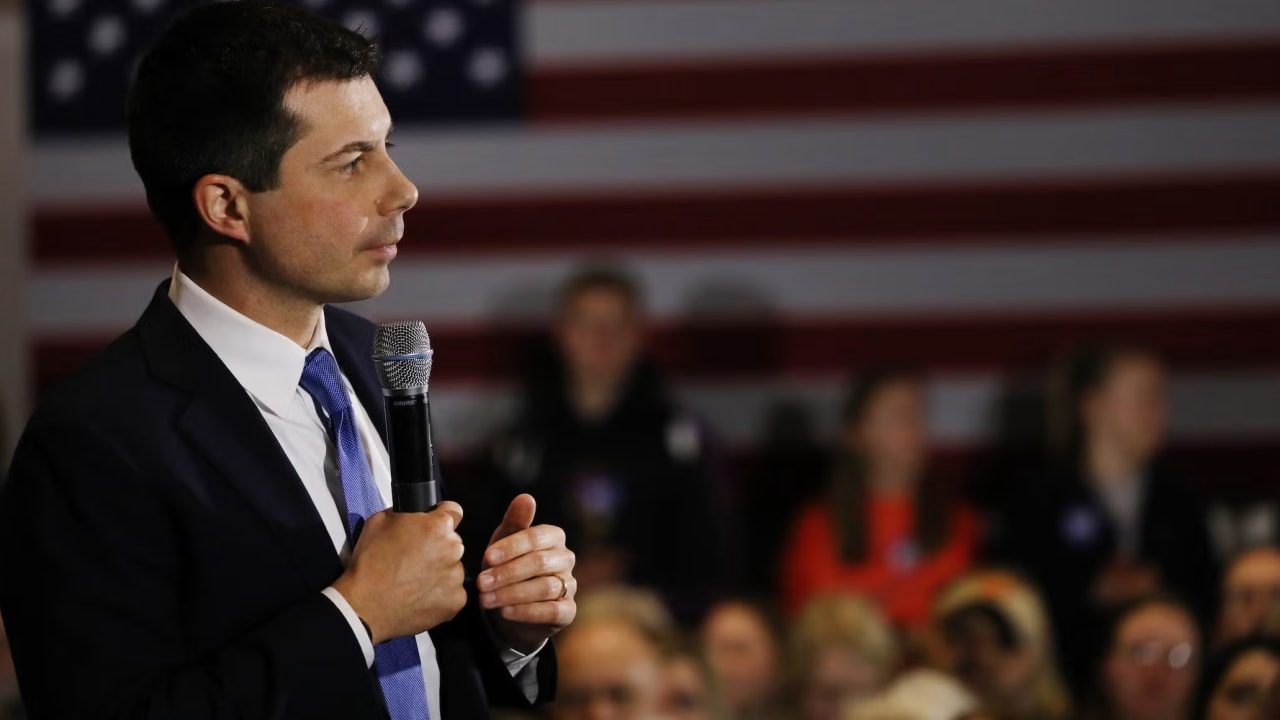
In a political landscape where convictions are increasingly treated as commodities to be traded for popularity, the recent about-face on Israel by former US transportation secretary Pete Buttigieg serves as a troubling reminder of what leadership should not be. True leadership demands consistency and moral courage, not weathervane politics that shift with the prevailing winds of public opinion.
Recently, Buttigieg demonstrated what can only be described as political whiplash. When initially asked about Israel on a podcast, he offered a somewhat supportive stance. Yet, when faced with criticism from the far Left of his party, he quickly pivoted to discussing arms embargoes against Israel.
This rapid reversal wasn’t a thoughtful evolution of views based on new information; it was a calculated political maneuver aimed at appeasing vocal critics.
Who are our allies?
As a Jewish community, we’ve seen this pattern before. We recognize the difference between allies who stand with us through difficult moments and those who retreat at the first sign of political headwinds. We have steadfast friends in the Democratic Party, Sen. John Fetterman and Congressman Ritchie Torres come to mind, both of whom demonstrate unwavering support for Israel regardless of audience or political convenience.

Then there are those who occupy a troubling middle ground: politicians who present themselves as allies until pressure mounts. These fair-weather friends pose a particular danger because their support is conditional, unreliable, and ultimately hollow. When politicians like Buttigieg can so quickly abandon their stated positions on Israel to appease critics, how can Jewish Americans, or any Americans, trust them on matters of existential importance?
I’m reminded of a personal experience years ago when I worked at the Simon Wiesenthal Center. I attended a small gathering where congressman Eliot Engel was speaking on a topic entirely unrelated to Israel. Someone in this non-Jewish, non-pro-Israel audience raised a question about the Middle East. I listened intently, curious how Engel might tailor his message to this different crowd.
What I witnessed was remarkable: Engel delivered exactly the same message he would have given to AIPAC or any pro-Israel audience. He didn’t calculate what would be politically expedient in that moment or try to read the room. He simply stated his genuine position, regardless of whether it would be popular with those present. That is integrity. That is leadership.
King David provides us with a powerful biblical example of principled leadership. When confronted by the prophet Nathan about his grave sin involving Bathsheba, David didn’t deflect or rationalize. He immediately acknowledged his wrongdoing with unflinching honesty. In our tradition, leadership has always been about moral clarity and forthright communication, not about yielding to whatever position might win momentary acclaim.
Politicians who calibrate their moral compass according to the loudest voices in the room cannot be trusted to make difficult decisions in times of crisis. If former secretary Buttigieg can so easily abandon his position on Israel under pressure from the progressive wing of his party, what other principles might he compromise when faced with political headwinds?
Americans must carefully consider which leaders truly deserve our support. We need leaders who stand firm in their convictions, not because they find agreement on every issue, but because they demonstrate the integrity to maintain consistent principles regardless of political convenience.
True leaders may evolve their thinking over time through genuine reflection and new understanding. Yet there’s a profound difference between thoughtful evolution and political expediency. The former happens gradually, with explanation and intellectual honesty. The latter happens overnight, when the political winds shift.
The Democratic Party is now at a crossroads vis-à-vis American support for Israel. Regardless of the outcome, it must elevate and support leaders who demonstrate unwavering integrity, those who plant their feet firmly on principle rather than straddling the fence of political convenience. We should demand leaders who speak the same truth regardless of audience, who stand firm when pressured to abandon their convictions, and who demonstrate the moral courage to stay consistent, even when it’s politically difficult.
Political fashions may change, but America’s need for principled leaders remains constant. In the words of Jewish tradition, “The truth stands, falsehood does not.” Those who stand firmly for their principles, even when unpopular, demonstrate authentic leadership that both the Jewish community and the American people desperately need.
The writer is CEO of Aish and chairman of Aish Ha’am, a new party in the World Zionist Congress. He is also on the Jewish Agency Board of Governors. Prior to Aish, he was eastern director of the Simon Wiesenthal Center, oversaw the Museum of Tolerance in New York City, and contributed to the center’s fight against antisemitism.