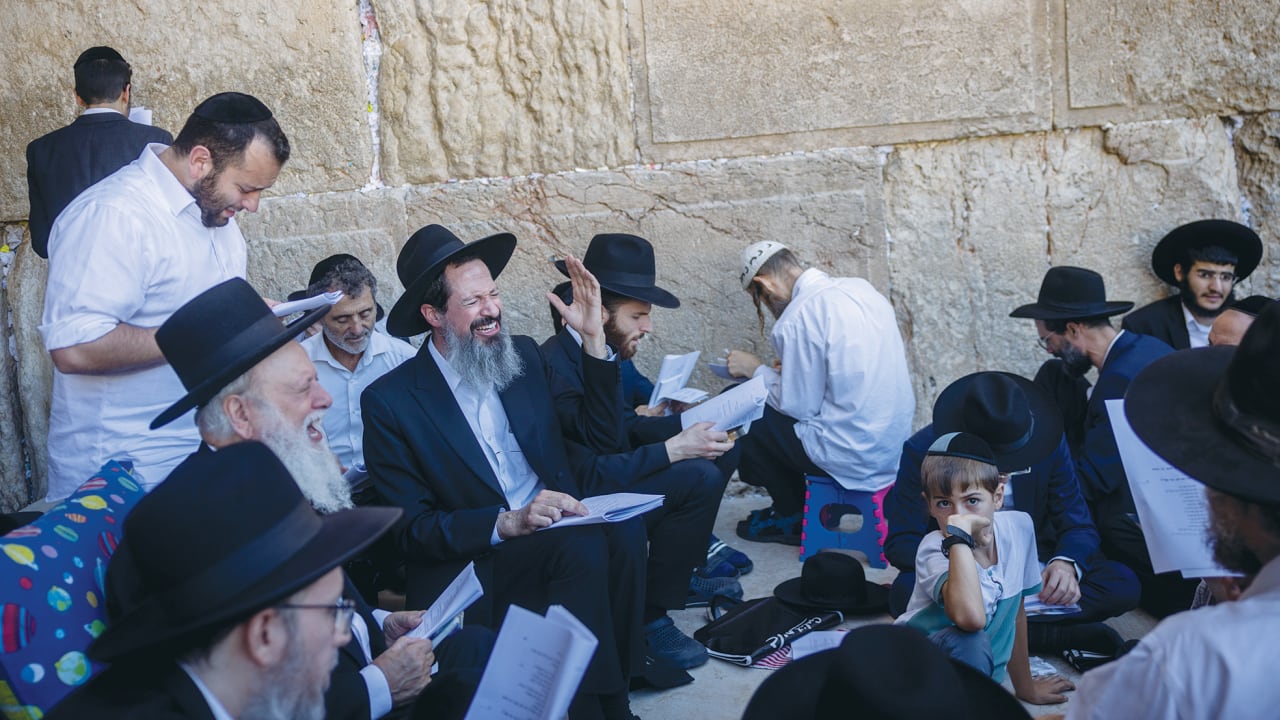
In a wide-ranging discussion on the Inspiration from Zion podcast, two noted leaders in the area of Jewish unity unpacked many issues related to how to achieve what was referenced as the “holy grail” for Jewish peoplehood.
Rabbi David Fine, dean of the Barkai Center for Practical Rabbinics, and JJ Sussman, international director of Gesher, explored persistent challenges of Jewish disunity in Israel and some practical steps to address and overcome it. The goal was not just to talk about how bad disunity is and how much we strive for unity but to propose actionable strategies.
The conversation became an incubator of ideas, rooted in individuals’ personal effort, broader community engagement, and cultural reframing, as well as abandoning stereotypes of people from different backgrounds being the “other.”
Rabbi Fine’s recent article, “If we’re so smart, why are we so divided?” (The Jerusalem Post, June 9), was the catalyst. He questioned why the Jewish people, despite so many intellectual achievements, struggle with unity.
Fine suggests applying the same rigorous effort used to solve complex problems to “crack the code” on Jewish unity through a structured plan. He highlighted that unity does not mean uniformity but rather respectful disagreement with people of different backgrounds, a principle drawn from Talmudic traditions.
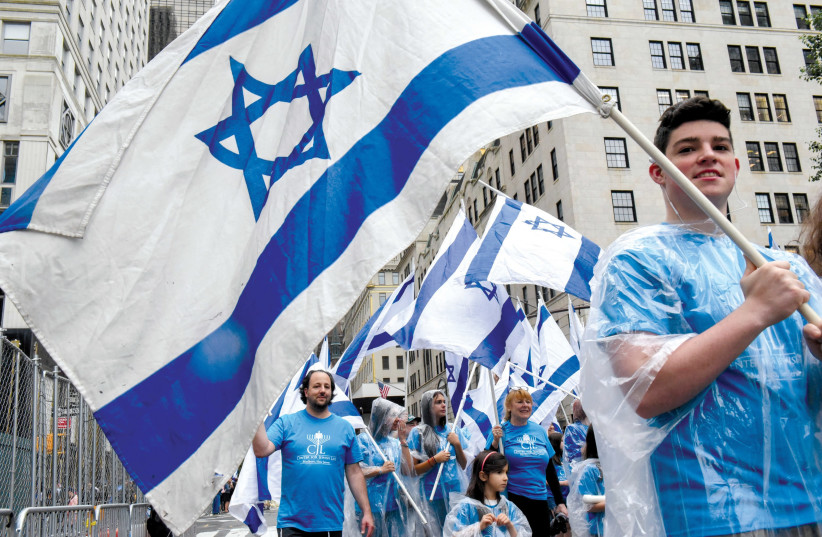
One key is to emulate the Talmudic model of debate between sages like Hillel and Shammai. These scholars argued passionately. From the outside, one might have thought they were severely divided. Yet they maintained respect and love, marrying into each other’s families and praying together.
Fine proposes that studying these rabbinic models can guide modern Jews to disagree respectfully, an essential foundation for unity. He emphasizes that unity is not just utilitarian but a religious imperative, mirroring God’s oneness, as Jews are commanded to imitate divine attributes.
Sussman brings a career of building bridges between Jews of different backgrounds through Gesher. He notes that the key word to remember is that Jews are all mishpacha, family, and advocates employing face-to-face interactions to create understanding and reduce division.
He references Gesher’s “Five Rules for Constructive Dialogue,” which include listening attentively, focusing on issues rather than personal attacks, avoiding cursing or violence, refraining from generalizations (e.g., labeling groups as “haredim” or “left-wingers”), and proactively offering one’s own perspective. Sussman suggests teaching these, especially to youth, to reinforce unity amid disagreement. As a mishpacha, we can differ but remain connected.
Both Fine and Sussman stress the importance of active listening as a critical skill to build unity. At Barkai, Fine teaches rabbis to do so – focusing on understanding rather than planning a retort – arguing that this alone can address much disunity.
Sussman supports this with examples from the Gesher Leadership Institute, where Israeli leaders from diverse sectors are trained first to listen during trips to Jewish communities abroad, breaking down stereotypes by prioritizing understanding over advocacy.
Bringing ultra-Orthodox individuals into classrooms with secular and religious students
A practical intervention to emulate and expand upon, proposed by Sussman, is Gesher’s Israeli Dialogue program, which brings ultra-Orthodox individuals into classrooms with secular and religious-Zionist students. This five-year initiative has successfully reduced “meta-perceptions” (misconceptions about how others view them), decreasing animosity by humanizing the “other.” The program’s success lies in direct interaction, making it harder to harbor intense animosity toward someone one has met in person.
Fine suggests “human connection videos” as another intervention, citing research showing that watching opposing groups form bonds significantly reduces political contempt. He envisions scaling this by sharing such content widely, starting small but aiming big. Similarly, Sussman and Fine propose harnessing social media, identified as a key driving force in disunity, to promote unity through positive content, such as short videos reframing perspectives.
Sussman offers a grassroots action plan: Individuals should meet someone with differing views for coffee, listen to their perspective, take a photo, and share it on social media with #JewishUnity and #Mishpacha to encourage broader participation and awareness. This simple act, he argues, can build bridges across Israel’s diverse populations. Fine complements this with an idea to catalog existing unity initiatives to increase their visibility and involvement.
Fine suggests a business-like approach to unity, proposing that successful strategies from other fields, like venture capital or philanthropy (more prevalent in America than Israel), could be adapted. He acknowledges government limitations but sees potential for financial or structural support once grassroots efforts gain traction.
The two differ respectfully on this, with Sussman cautioning against relying on the government, advocating for a bottom-up effort instead, and citing examples like the high-tech sector’s organic growth.
Reflecting on historical unity, Fine cites the giving of the Torah at Mount Sinai as the only unadulterated moment of Jewish unity. Sussman notes that unity rises during tragedies (e.g., the Holocaust, October 7, the Soviet Jewry movement), and he questions how to sustain it beyond crises.
Both agree that personal action – focusing on what individuals can do themselves – is key, aligning with the upcoming Elul season’s call for self-reflection leading into Rosh Hashanah and Yom Kippur.
Referencing the Jewish understanding that baseless hatred (sinat hinam) was the cause of the Temples’ destruction and underscoring how our enemies can only defeat us when we are disunited, Fine pushes for its opposite, unconditional love. He redefines love as an action, not an emotion, per Jewish tradition, arguing that doing for others fosters emotional connection.
He cites ultra-Orthodox support for soldiers during the war as an example, expressing optimism for improved intergroup relations. Sussman adds that watching diverse media (e.g., Channel 14 and Ynet) to understand opposing views can create understanding and reveal shared goals, enhancing unity.
Connecting to Tisha B’Av, Fine related the biblical 10 spies’ needless crying as the fast day’s origin, urging optimism and gratitude to God and others to prepare for Rosh Hashanah. Sussman emphasizes that internal divisions, not external threats, historically destroyed the Temples, making unity the greatest current challenge. Fine notes the Messiah’s birth on Tisha B’Av as a symbol of salvation from tragedy, reinforcing the need for effort.
Practical seasonal suggestions emerge as next steps. Fine proposes a 10-day social media break during the High Holy Days season (Rosh Hashanah to Yom Kippur), encouraged by rabbinic calls, to reduce polarization. Sussman highlights Gesher’s phone-free summer camp, where religious and secular youth interact together, suggesting individuals actively and purposefully replicate this disconnection to foster real-life connections.
Wrapping up a conversation that could go on for hours, Fine reiterates Sussman’s emphasis on seeing people as individuals, not labels, rooted in the shared Sinai experience. Sussman echoes the Mishna’s call to love and bring others closer to Torah, starting with loving fellow Jews. Rather than a silver bullet that will fix everything at once, these closing remarks underscore one’s personal responsibility and love as foundational to unity efforts.
View the entire conversation and share your own ideas about, and strategies for, Jewish unity at InspirationfromZion@gmail.com.
The writer is the president of the Genesis 123 Foundation, which builds bridges among Christians in support of Israel; the host of the Inspiration from Zion podcast; and the publisher of Israel the Miracle.