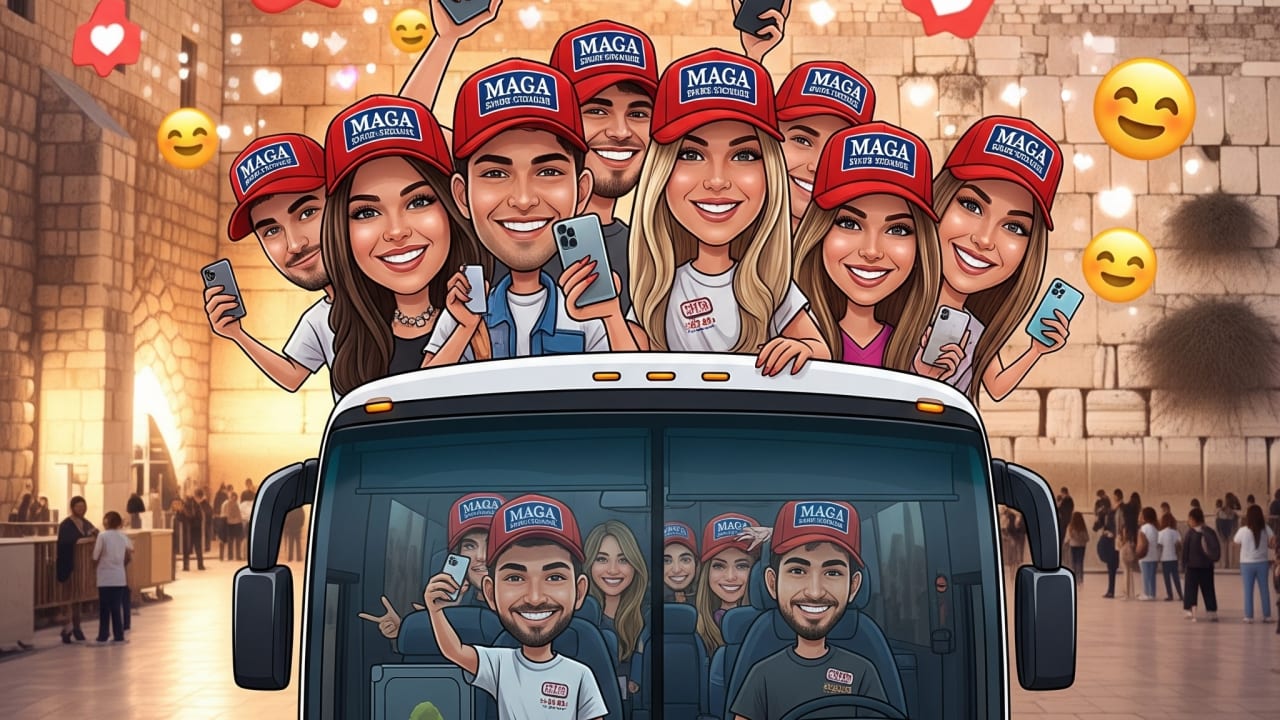
Imagine a convoy of tour buses winding through the Judean hills at sunrise. On board sit 16 young American influencers, baseball caps emblazoned with “USA” and “Make America Great Again,” eagerly live-streaming their journey.
As the buses crest a hill, the golden stones of Jerusalem come into view. The group spills out onto the Western Wall plaza, a mix of awe and frenzied content creation. They press prayer notes into the ancient cracks, pose for selfies draped in Israeli and American flags, and record enthusiastic monologues about fulfilling biblical prophecy.
Later, they’ll visit an Israeli military base on the Gaza periphery, donning IDF hats for group photos with soldiers, before an exclusive dinner with officials who extol Israel’s fight for “Western civilization” against tyranny.
Every stop, whether overlooking the Galilee or touring a West Bank heritage site, becomes a backdrop for hashtagged posts that beam a pro-Israel narrative to millions of followers back home.
This MAGA influencer tour, sponsored by an Israeli organization called Israel365, feels like a surreal blend of biblical pilgrimage and political boot camp for social media stars.

That scene is not totally a satirical fantasy, but an imminent reality. Israel’s Foreign Ministry is funding a week-long visit for 16 prominent young influencers aligned with Donald Trump’s MAGA and America First movements, part of an ambitious campaign to reshape Israel’s image among American youth.
The logic is straightforward: these online personalities command audiences of hundreds of thousands, even millions, predominantly in the conservative heartland. As one Foreign Ministry official put it, Israel wants to “leverage the massive followings of young social media influencers to bolster Israel’s standing in the US.”
The tour is explicitly designed to counter a decline in pro-Israel sentiment among younger Americans, a trend that Israeli diplomats note with alarm. “With the rise of the America First movement and MAGA in American politics, it’s essential for Israel that the movement adopt a pro-Israel position,” an internal document, signed by Yacov Livne, a senior public diplomacy official, said about justifying the project.
To execute this vision, the ministry turned to Israel365, a group positioned at the intersection of Israeli hard-right politics and Evangelical Christian fervor.
Israel365, the tour’s organizer, was awarded a NIS 290,000 ($86,000) contract without a public tender, a decision defended by officials on the grounds that the organization has “experience and know-how in creating awareness, engagement, and mobilization of Christian audiences” in support of Israel.
In other words, Israel365 speaks the language of the tour’s target demographic. The group, founded by Orthodox Jewish activists, unapologetically courts Bible-believing Christians and conservative patriots.
Its website proclaims Israel’s “God-given right to the entire Land of Israel” and dismisses the two-state solution as a “delusion,” casting its mission as defending “Western civilization against threats from both Progressive Left extremism and global jihad.”
These strident themes, once on the fringe, now resonate deeply with segments of the American right, and the Israeli government is keen to harness that energy.
THE MAGA INFLUENCER tour is just one plank in a broader, if quiet, reorientation of Israeli public diplomacy. In recent weeks, two other Foreign Ministry contracts, similarly exempt from the usual tender process, reveal a strategic bet on Evangelical Christian networks and grassroots outreach as new instruments of Israeli soft power.
In mid-July, the ministry quietly approved a NIS 1,000,000 deal with Sar-El Media & Productions, an Israeli production company that specializes in content for the Christian world. The goal: to create polished Israel-focused programming for Trinity Broadcasting Network (TBN), the globe’s largest Evangelical television network.
This no-bid contract, which had flown under the radar until now, effectively outsources a piece of Israel’s image-crafting to a private studio fluent in the tastes of American churchgoing audiences.
Based in Jerusalem, Sar-El Media has produced a TBN series called Insights: Israel & the Middle East, showcasing the country’s innovations in technology and faith side by side.
Traditional diplomacy cannot compete with emotive storytelling
The Foreign Ministry’s investment in such content emphasizes a recognition that traditional diplomacy, press releases, and embassy briefings cannot compete with the emotive pull of storytelling on a platform like TBN.
As with the influencer tour, the underlying assumption is that bypassing conventional channels and speaking directly to the conservative Christian base will yield more enthusiastic allies. The Sar-El Media contract, not previously reported in the press, shows Israel’s public diplomacy apparatus eagerly courting the tens of millions of TBN viewers for whom support for Israel is often a religious conviction as much as a political stance.
A third tender exemption highlights yet another facet of this outreach strategy: humanitarian goodwill missions branded with Israeli (and even military) pride. The Foreign Ministry has allocated NIS 360,000 for seven volunteer delegations to be dispatched via the NGO “Warriors Without Borders,” an organization of IDF veterans that carries out humanitarian projects abroad.
In practice, these delegations of young ex-soldiers will travel to developing countries, bringing aid and elbow grease to local and Jewish communities in need. They might build schools in remote villages, renovate community centers, or teach Hebrew and English to disadvantaged youth.
Such work is inherently charitable, but it’s also implicitly diplomatic: each smiling photo of Israeli volunteers covered in dust and sweat, helping impoverished communities, serves to humanize the Israeli soldier and counter the country’s critics.
If traditional Israeli foreign aid (through agencies like MASHAV) projects Israel’s state power, Warriors Without Borders projects its people power. This warm, informal outreach can touch hearts where formal diplomats cannot.
Notably, this initiative was also arranged off-tender and with little fanfare. It represents a sociological shift in Israeli diplomacy, blurring the lines between soldier and civilian ambassador. Here are young Israelis, fresh off military service, effectively becoming roving emissaries of goodwill – a very different archetype from the career diplomat in a suit.
The fact that the Foreign Ministry is backing Warriors Without Borders in an official capacity signals how the Netanyahu government is reshaping Israel’s national image in its ideological mold. Today’s ruling coalition, a mix of hard-right nationalists and religious conservatives, often celebrates the IDF’s dual role as protector and moral beacon.
Sending “warriors” to plant gardens in Africa or assist after natural disasters embodies a narrative that the Israeli Right has long promoted domestically: that strength and compassion go hand in hand, and that those who bore arms for Israel can also be agents of healing.
THIS REALIGNMENT has been years in the making, but never has it been so unabashedly embraced with government imprimatur.
Previous Israeli administrations certainly valued Evangelical support; one recalls the close friendship between Prime Minister Benjamin Netanyahu and figures like Pastor John Hagee, as well as Israel’s long-standing welcome of Christian Zionist tour groups.
But there was always a balance: Israel also cultivated ties with liberal Jewish communities, bipartisan lawmakers, and secular Western elites. What we are witnessing now is a tilt, if not a turn, toward particularistic outreach. By targeting MAGA influencers, Israel is nodding to America’s Trumpist right wing that “we hear you and need you.”
There are concrete geopolitical calculations here. Netanyahu and his aides have watched surveys showing waning support for Israel among young Americans, including young Evangelical Christians who, unlike their parents, are somewhat less automatically pro-Israel.
The Foreign Ministry’s justification for the influencer tour bluntly noted that “positive perspectives towards Israel are falling across all younger age groups” in the US. At the same time, Israel’s traditional bipartisan support in the United States has been fraying; the Jewish state has become a contentious topic in America’s polarized political climate.
However, this approach is not without risks and trade-offs. By embracing American conservative Christianity so tightly, Israel could be seen as further entangling itself in the US culture wars. The sight of social media personalities who traffic in MAGA rhetoric touring Israel may boost Israel’s appeal to one segment of Americans while alienating another.
Already, critics note that casting Israel as a champion of the “Western Christian” cause feeds a perception of Israel as a partisan project rather than a universal one. It could deepen the estrangement between Israel and liberal American Jews, many of whom recoil at the merger of Israeli policy with the Evangelical Right’s agenda.
Diplomatically, too, a policy that hinges on Evangelical solidarity might unnerve secular allies in Europe or invite cynicism in the Global South, where such alliances can be painted as neo-colonial or Crusader-like.
Israel’s identity on the world stage has long been multifaceted, at once a Jewish homeland, a democracy, a Start-Up Nation, a refuge after the Holocaust.
The new initiatives highlight an identity increasingly framed in civilizational terms: Israel as the front line of a Judeo-Christian alliance defending traditional values against radical Islam and the “progressive” Left. It’s a narrative that plays well in certain circles, but it is also inherently polarizing.
And yet, for all the concerns, one cannot dismiss the potential impact of this strategy. American Evangelicals remain one of the largest and most politically mobilized blocs of pro-Israel support.
Their influence was instrumental in the Trump administration’s policies (from moving the US Embassy to Jerusalem to recognizing Israeli sovereignty on the Golan Heights), and their fervor has hardly diminished in the Biden era; if anything, it has grown more determined as they feel their values under siege at home.
Cultivating the next generation of that constituency, whether through Instagram influencers who espouse Christian nationalism or through heart-tugging programming on Christian TV, could secure Israel a devoted advocacy army for decades to come.
Likewise, presenting Israel’s young veterans as humanitarian angels could win hearts in places where talk of high politics falls flat. Soft power can build reservoirs of goodwill that outlast any particular government in Jerusalem or Washington.