
Content warning: The article includes disturbing descriptions.
Nearly 22 months have passed since Hamas invaded Israel on October 7, 2023. While it may feel as though much has happened since then, and many Israelis have emotionally compartmentalized the trauma, more and more horrifying details continue to emerge about the depravity and brutality of that day.
A powerful new report compiled by The Dinah Project over the past year and a half offers some of the clearest, most undeniable evidence yet that Hamas systematically used sexual violence as a weapon of war. The details are deeply disturbing.
The report draws on testimonies from survivors of the Nova music festival, released hostages, and others who lived through the massacre. It presents evidence that rape, sexual humiliation, and genital mutilation were not random or isolated acts, they were coordinated and deliberate tactics of terror.
Twenty-seven first responders, along with morgue attendants at the IDF’s Shura base, testified to finding bodies with unmistakable signs of rape, mutilation, and what they called “sexual staging,” supported by forensic photographs and documentation. Perhaps most chilling are the videos, intercepted communications, and recovered photos that show victims being sexually violated, some while still alive. This evidence was collected with legal standards in mind, ensuring it could be admissible in court, even when victims cannot speak for themselves.
Women were found tied to trees and poles, partially or fully naked, raped, mutilated, and executed. One woman was discovered with her underwear stuffed in her mouth and a gunshot wound to the head. Others, including children, were publicly violated and paraded, their bodies weaponized to inflict psychological terror. In one documented case, the corpse of a woman was raped in front of other hostages. The abuse continued even after captives were dragged into Gaza.
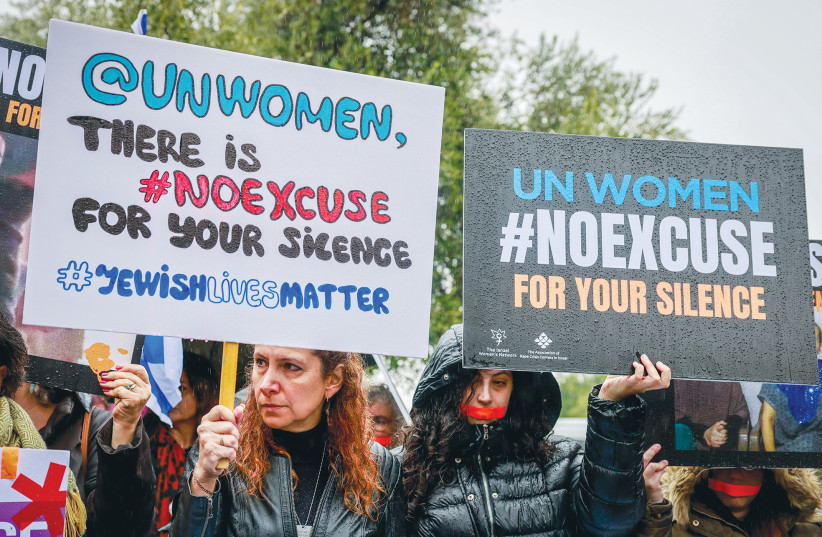
The report includes testimonies from 15 released hostages. Nearly all of them (including men) described forced nudity, sexual harassment, verbal abuse, and threats of forced marriage. The cases span six locations, including the Nova festival grounds, Route 232, Kibbutz Re’im, Nir Oz, and Kfar Aza.
The international community chose inaction
Negotiating with terrorists is never a good idea: it rewards and incentivizes their brutality. But Israel faces a terrible moral dilemma: to bring our loved ones home, we must engage with those who committed these atrocities. The international community, however, had a choice. And it chose inaction.
The Gaza hostage crisis, and the use of mass sexual violence, must serve as a precedent-setting moment for how the world responds to such crimes. The victims of October 7 included citizens from 35 different countries; hostages were taken from 25 of them. At the very least, nations whose citizens were taken captive should have acted as if those people had been abducted on their own soil.
It is no longer enough to issue condemnations. The international system must evolve to meet the scale of these crimes, especially when they are ongoing.
More than 300 international legal experts have classified Hamas’s actions as war crimes, crimes against humanity, and potentially even genocide. The legal basis is clear: hostage taking, the murder of civilians, torture, and the use of rape as a weapon of war are explicitly prohibited under international law. These are not acts of war gone awry; they are systematic crimes, prosecutable under the principle of universal jurisdiction. States have both the right and the duty to act, even when such crimes occur outside their borders.
So why, with dozens of their citizens taken captive, did France, Thailand, Argentina, the US, and Germany do very little to force Hamas’s hand?
New standards are needed
It is time to invoke the Responsibility to Protect (R2P), not as an academic principle, but as a binding moral and legal obligation. Under R2P, when a governing body fails to protect civilians from mass atrocities (or worse, perpetrates them) the international community must take “timely and decisive” action.
Though Hamas is not a state, it is a de facto governing body with effective control over a population and territory from which these crimes were launched. There is no legal or moral reason R2P should not apply.
In addition, countries that harbor or fund Hamas, such as Qatar, which hosts its leaders, or Iran, which arms and bankrolls it, bear international responsibility. If the world fails to hold these state actors accountable, it sets a devastating precedent: that mass rape, torture, and hostage taking can be outsourced to proxies without consequence.
To prevent future atrocities, the international community must establish new standards, including:
• Automatic multilateral investigations into mass hostage taking and sexual violence in conflict, with legal and diplomatic consequences for obstruction.
• Concrete consequences for state sponsors of terror, including sanctions, suspensions from international bodies, and prosecution in international courts.
• A binding international protocol for hostage recovery when multiple countries’ citizens are involved.
• An expanded R2P mandate that includes non-state actors with territorial control, like Hamas.
This is not about Israel. This is not about Palestine. It is about what the world does when civilians are burned alive, when children are kidnapped, and when rape is used as a weapon of mass terror. It is a test of whether international law has force, or whether it collapses when politically inconvenient.
Legal experts are already calling for a stronger international response: a UN-led working group on hostage taking, a special envoy for hostage affairs, updates to global treaties, and an annual summit of world leaders to build a long-term strategy for preventing and responding to such crimes.
Terror organizations across the world are watching. They’re not only studying what Hamas did, they’re watching to see what the world lets them get away with.
This is not just about protecting Israeli or Jewish lives – it’s about setting a universal standard that no human being, anywhere, can be used as leverage for terror. If the world fails to act, October 7 won’t just be a tragedy: It will be a blueprint.
The writer is the co-founder and CEO of Social Lite Creative, a digital marketing firm that specializes in geopolitics.