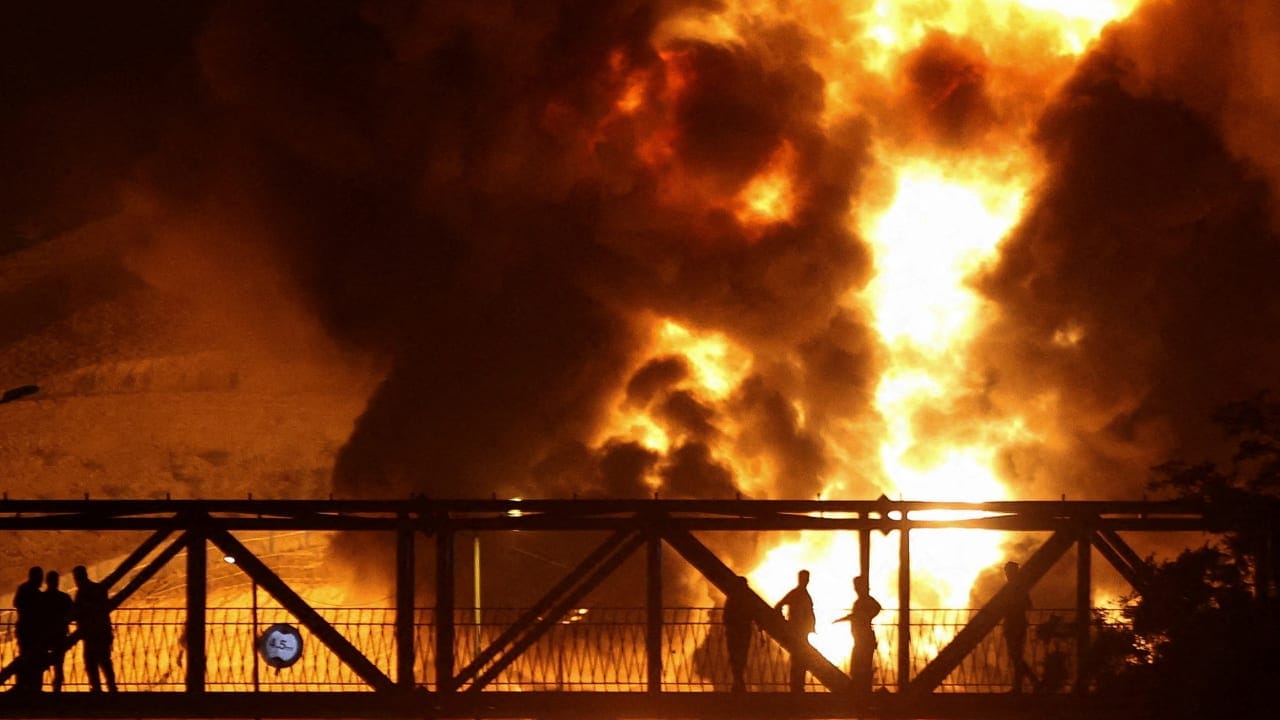
In 2010, the US and Israel conducted a brilliant cyberattack against Iran’s uranium enrichment plant at Natanz. The nuclear program was set back about a year by this first-ever cyberattack that caused physical damage. Of greater long-term consequence, Iran’s deep national trauma at the time led it to rapidly ramp up its only nascent cyber capabilities. Within a few years, Iran had become one of the world’s more active offensive cyber actors, especially against the US and Israel.
The conflict with Iran last month raises several critical questions.
What conclusions does Iran draw from this far more devastating attack? That three decades of international tensions, and hundreds of billions of dollars in both direct costs and lost economic opportunities, were not worth the price, and that what it viewed as its ultimate security guarantee – a nuclear weapon – has become a direct threat to its security? Or, conversely, that nukes truly are the only security guarantee and that it must race to a bomb, when circumstances permit?
What is the location of Iran’s prewar stash of 400 kg. of highly enriched uranium, which may be buried under the rubble of the bombed nuclear sites, or transferred elsewhere? If still extant, and if Iran has secret enrichment and conversion facilities, this stash could provide the basis for a rapid “sneak out” to a bomb. If not, the nuclear program will have truly been set back for a considerable period.
Given Iran’s deep penetration by Israeli and US intelligence, it is questionable whether such facilities exist and whether it could complete weaponization without risking further attacks.

What was the actual damage to the nuclear program?
Skeptics and opponents of the US and Israeli attacks immediately seized on an intelligence report indicating that only a few months had been gained. If ever there was a case of premature and misunderstood intelligence assessments, this was it.
It was made less than a day after the fighting ended, before significant damage assessments had been conducted, and had only “low confidence” in its own findings.
It is far more likely that later assessments will conclude that considerable damage was done. Whether this translates into an end to the nuclear program is ultimately up to Iran – and future US-Israeli responses.
How close was Iran to developing a bomb? Skeptics cast doubt on the need for the US and Israeli attacks to begin with, arguing that Iran did not pose an immediate nuclear threat. In fact, there was broad agreement between America, the UK, France, and Germany, based on intelligence estimates, that Iran already was a threshold nuclear state, and that it could have completed the weaponization process between six-24 months. In other words, tomorrow. Uncharacteristically, perhaps, France took a particularly hard-line position.
Implications of strikes on nuclear deal
Is the fighting really over?
Israel will wish to maintain the air corridor door to Iran that it opened last fall and which it has now further expanded. This will lead to ongoing friction with Iran and possibly to a significant escalation.
Iran is at the outer limits of Israel’s military capabilities and it is questionable how long Israel can sustain this. Doing so may also cause regional tensions and lead to American pressure to desist. The US, with far greater security margins and more advanced weaponry, can take a more tempered approach.
How likely is a new nuclear deal now? Given the damage caused by the airstrikes, US President Donald Trump has cast doubt on the need for a deal. It is unclear whether he believes that Iran’s program has been so degraded that a deal is unnecessary, or fears that negotiations will fail and hurt his reputation as the consummate deal-maker.
He may also believe that Iran needs a deal so badly, to preserve at least part of its nuclear program and stave off further attacks, that he can extract important concessions.
Whatever the case, a long-term nuclear deal (30 years?), with a particularly intrusive inspections regime that also imposes limits on Iran’s missile arsenal and regional role, would be the most effective means of ensuring that Islamic Republic does not resume its malign activities.
Impact of war on US-Israel relations
What is the war’s impact on US-Israel relations? On one level, primarily in regard to the Palestinian issue, bilateral relations are tension-fraught. But rarely has Israel had the opportunity to demonstrate its strategic value to the US.
Ever since last fall, Israel has defeated Iran’s Axis of Resistance. Hezbollah has been decimated and even chose to stay out of the very fight for which Iran established it: its primary means of responding to an attack on the nuclear program.
The Houthis essentially sat this one out, and Hamas’s power has been severely downgraded. Iran’s ambitions to become a nuclear power and regional hegemon also have been dashed. Israel severely degraded Iran’s capabilities on its own and cleared the air corridor that allowed American bombers to complete the job unchallenged.
The payback that Trump – always transactional – will likely expect from Israel, will start with an end to the war in Gaza. He may also demand concessions on the broader Palestinian issue, designed to facilitate expansion of the Abraham Accords to additional Arab and Muslim states, and further institutionalization of the US-led regional axis to contain Iran.
Regarding the war’s impact on Israeli politics: Will a triumphant Prime Minister Benjamin Netanyahu now feel sufficiently free of his coalition constraints to make the agonizing decisions that would cement his place as the leader who not only delivered Israel from the Iranian threat, but also tried to make the peace? Initial polls do not indicate a significant change in his electoral fortunes, but it is too early to tell. If past behavior is any indication, Netanyahu will favor political longevity over diplomatic derring-do.
What is the war’s impact on the US global posture? Ever since president Barack Obama first declared a “pivot” to the Far East, the Middle East has come to be viewed as a distraction from US efforts to contain its only “near-peer competitor,” China, and, secondarily, Russia.
In practice, US involvement in the recent Iran-Israel conflict has only strengthened its global posture. The inability of both China and Russia to offer Iran any assistance stands in sharp relief to American support for Israel and undermines their regional standing.
The heretofore fearsome Authoritarian Axis – China, Russia, North Korea, and Iran – has been dealt a resounding blow. Moreover, this successful demonstration of American might and determination may force China to think twice about threatening Taiwan.
Only one thing is certain. The Middle East will continue to pose challenges to US policy. Maybe now, somewhat less so.
The writer, a former deputy national security adviser in Israel, is an adjunct professor at Columbia and Tel Aviv universities. His books include Israeli National Security: A New Strategy for an Era of Change.