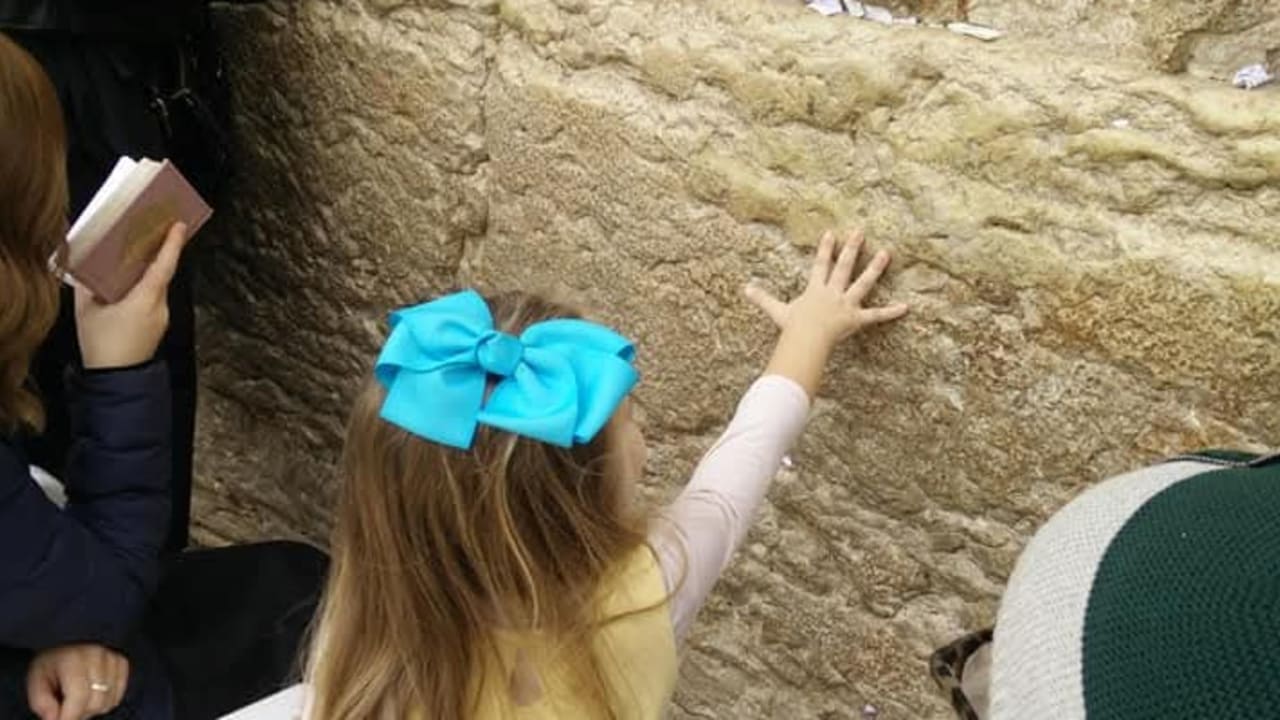
In the hush between sirens, as war with Iran broke out earlier this month, I became more acutely attuned to the two spiritual languages being spoken in my home.
One is intuitive and reflexive, the product of growing up in a land where the sacred is a lived experience. The other is mindful, deliberate, and shaped by choices and values my husband and I consciously transmit.
My children are being raised in Israel, where the soil itself seems to nourish faith, but they are also being raised by parents who believe that even the most fertile ground requires cultivation.
I grew up differently. My path to God was circuitous, intellectual, full of questions and slow revelations, and shaped by inquiry more than instinct. It unfolded gradually, through reflection and study.
This is why I am still taken aback when I observe my Israeli children encountering God as a real presence.
Here, where theological abstraction is constantly interrupted by existential immediacy, children grow up in a spiritual atmosphere that is less about instruction and more about immersion.

God is not an idea invoked in rarefied spaces but a force encountered in real time through love, fear, and especially the lived proximity to life and death that marks so much of Israeli childhood.
Iran strikes Israel
Last Shabbat, as the first wave of attacks from Iran sent the country into lockdown, we gathered in our mamad, where the fear was real, but so was the sense of faith.
As we began to recite Tehillim, I was struck by how instinctive it seemed for my youngest daughter, the only one of my children born in Israel, whose roots were planted here rather than in the Diaspora.
There was no hesitation or sense of performance, just a seamless turn to the language of supplication, a spiritual muscle already well-formed.
Earlier that evening, with shuls (synagogues) shuttered and sirens still anticipated, my family prayed Kabbalat Shabbat together at home. The sincerity of my children’s prayer was unmistakable.
The words were sung with intensity, punctuated by quiet entreaties and personal whispers to God. It was not the solemnity of rote practice but a kind of raw, experiential faith that flowed not from obligation but from inner orientation.
Even the child among them who has wrestled with belief, openly challenged God, and raised hard theological questions stepped into prayer that night easily and intuitively.
For our family, this has been one of the quiet truths of raising children in Israel: that spiritual formation often occurs not through formal education alone, but repeated exposure to existential reality.
Sirens, shelters, losses, and recoveries form part of the atmosphere, as do moments of wonder, connection, and casual holiness.
Rav Kook (in Ma’amar Hador) invokes the rabbinic phrase “Or va-hoshekh mishtamshim be-irbuvya” (“Light and darkness are entangled”) to describe the spiritual reality of Jewish life in modern Israel and the intermingling of the mundane and holy, which he views as the crucible in which national and spiritual redemption will be forged.
For me, this intermingling is observed on a macro level as the calendar orients around the Jewish life cycle, and the very language we speak is suffused with biblical and talmudic idioms.
On a micro level, I experience this when I spot a soldier bent over a Gemara at a bus stop between shifts or when watching my youngest child and her friends pick lemons in our yard to make a lemonade stand and suddenly pause to make sure terumot (offerings) and maasrot (tithes) are properly taken.
These are not grand gestures or curated moments but the background texture of life – the steady shaping of souls by the rhythms of a people and a land. In all of them, God ceases to be a proposition and becomes instead a presence – inevitable, integral, and accessible.
In his essay “Majesty and Humility,” Rav Soloveitchik famously describes his need to encounter God during his most acute moment of crisis, as his wife lay on her deathbed.
As he explains, his confrontation with mortality stripped away theological distance, and in that clarity, the Divine became palpable “as a humble, close friend, brother, father...”
What was for the Rav a singular, searing moment is experienced by Israeli children in increments. Raised where God is not theoretical, their lives are punctuated by such moments – of fear, waiting, and deep awareness – that are often filled by the turn toward God.
At the same time, my husband, Uri, often reminds me that immersion alone doesn’t build ownership and that atmosphere is not the same as agency. So as parents, we have tried to model and carve out space for conscious religious decision-making.
To point to one concrete example: Kashrut is nearly effortless here. Restaurants are labeled, and communal norms are aligned. And yet, we’ve retained a few underlying stringencies so that within our and our children’s organic Jewish experience, Halacha is kept alive as a language of values, boundaries, and intentionality.
Our hope is that by making routine practices slightly more deliberate, our children won’t simply inherit their faith but will approach it mindfully and with purpose. The organic becomes the framework, but within it, we try to empower our children to become thoughtful architects of their own religious lives.
A transformative visit to the mikveh
I recently experienced the tension between the organic and deliberate models of spirituality during a visit to the mikveh (ritual bath), when a siren sent us women rushing, mid-preparation, into the bomb shelter.
Later, when I was about to emerge from the water, the attendant gently asked if I wanted to take a moment to pray. I was startled not by the question itself, but by the fact that it hadn’t occurred to me.
Having been raised within the intellectual and religious framework of what Rav Soloveitchik famously calls “halachic man,” I have approached religious life through the prism of halachic structure.
For me, God is encountered within the boundaries of the halachic system, in the act done properly. Immersion in the mikveh has never needed bells and whistles, added emotion, or external expression; it is meaningful simply because it fulfills a Divine command with intention and precision.
But in that moment, the mikveh lady (balanit) introduced a different paradigm, where the immersion was not the endpoint but the threshold. Her reflex to pause represented a posture closer to the Rav’s conceptualization of “homo religiosus,” as one who longs for communion instinctively seeks a relationship with God through emotion, spontaneity, and prayer.
My balanit’s invitation to speak to God represented an ontological association of ritual with presence, an entry point into a moment thick with possibility, intimacy, and nearness to the Divine.
That moment made me realize how natural that kind of religious reflex is to those raised in a culture suffused with God consciousness, where Halacha and theology are not separate strata but part of the same lived response.
This kind of immediate, unselfconscious religiosity has become native to my children. However, it is not the only spiritual language they are learning.
Alongside this intuitive faith, they are also being exposed, in our home, to a mode of deliberation and reflection, to pausing, questioning, and thinking about how and why we behave as we do. This, too, is part of what we are trying to cultivate.
As a parent, my hope for my children is that they continue to grow within both of these spiritual frameworks: the instinctive awareness born of immersion and the thoughtful commitment shaped by reflection.
I hope they draw deeply from the wellspring of holiness that surrounds them while also bringing to it clarity, curiosity, and intentionality. May they be equally fluent in both spiritual languages: rooted in the organic rhythms of life in Israel while always engaging profoundly and critically.
Living within this inherited structure, may they rise within it, choosing, shaping, and personalizing their faith with thoughtfulness and care.
The writer has spent over two decades teaching Torah and Jewish thought in universities, high schools, and communities across the US and Israel.