I came to Israel for an academic project and to push back against the BDS movement in my country, where I am a member of parliament in Geneva. The early days were full of life: long coffees, intense lectures, vibrant conversations, and an ambitious stack of books to devour. Then, two weeks in, everything changed.
Of course, I knew that the conflict with the Islamic Republic of Iran had been building for years. Iran’s nuclear ambitions, its regional proxy network of terrorist groups, its missile program and its naked and assumed hostility had long been a source of tension. Little did I expect that it would blow up so completely during the exact days of my stay.
So I found myself stuck in Tel Aviv, in an apartment. I know Tel Aviv brands itself as “the city that never sleeps” – but usually, it’s in a different way. Now sleep is interrupted by sirens.
This war will end, whether in the next few days or perhaps after a longer time, but either way I resolved to not romanticize the experience. And yet it has made me feel closer to Israel than ever before: a kind of affinity that attaches to collective stress, I suppose.
Like my new neighbors, I’m glued to the smartphone, scanning for alerts. Notifications tell you when to stay near a shelter, when you have 90 seconds – or sometimes less – to reach safety. If your app crashes, your heart rate spikes. Time flattens; you become alert at all hours, but especially at night, when the silence makes the explosions more jarring.

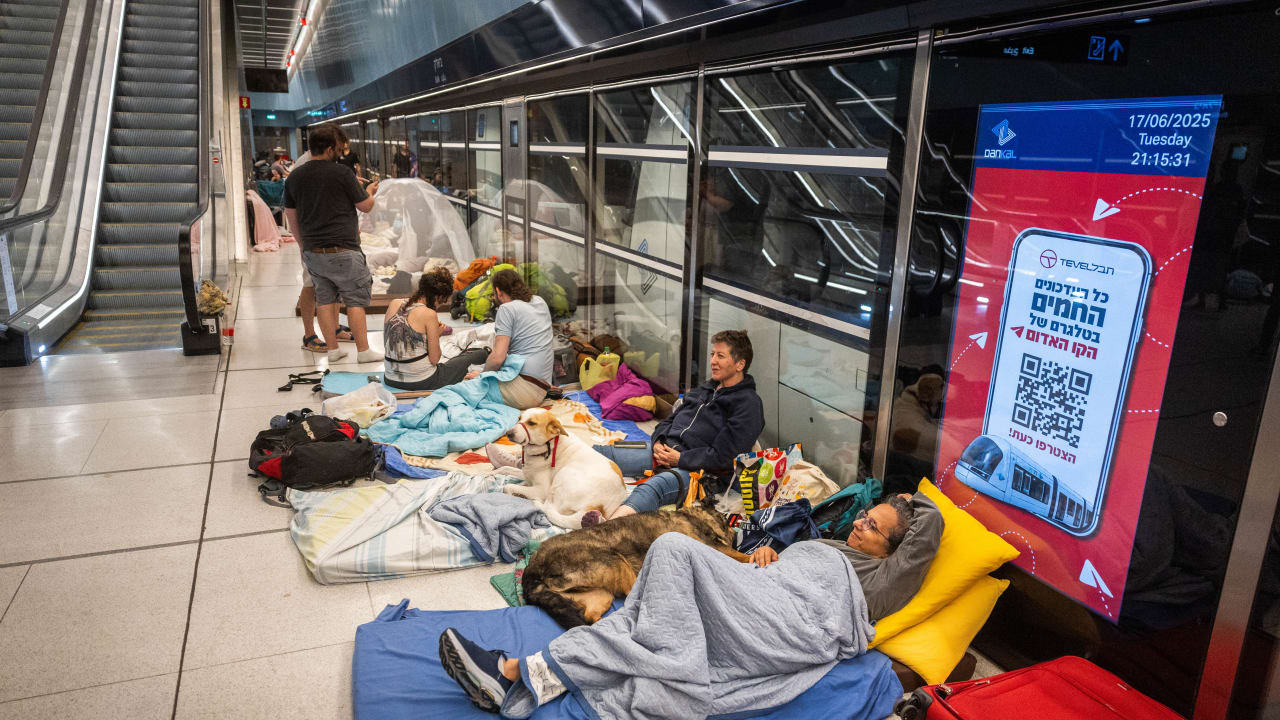
You keep your shoes next to your bed. You never lock your building door, so that strangers caught in the street can take cover. And in the underground shelter, a strange intimacy takes shape. The space is concrete space, not meant to be lived in. But under fire, it becomes something more than protection – a community of the strangest sort.
As the explosions of missiles and interceptors are heard overhead, you begin to truly see the people whom you’d shared an elevator with, in silence. A neighbor is no longer just the guy who nods; he’s a father of two, a leftist, a chain-smoker perhaps. You find out who has snacks, who panics or is stoic, and who insists on tuning up the radio to hear every report.
How Israelis react to Iranian missiles
There’s an elderly couple in their 80s who always insist on sitting side-byside. They don’t say much. They hold hands on the way down and on the way back up. After all their decades of their marriage, they always stay close by together.
A woman arrives with her two dogs. One is visibly anxious. The other settles by your feet, rubbing against your leg, demanding affection with regal authority.
There’s a religious French family who made aliyah years ago. They speak of Netanyahu in heroic terms. In their eyes, he’s infallible. France, they insist, is finished; Europe will soon be rid of its Jews. Their views are often unsettling and not mine, but they are kind.
There’s a prominent international journalist in the mix. He’s scathingly critical of the government – he calls Netanyahu corrupt, and his dysfunctional coalition full of crooks and fanatics – still, he supports the strikes on Iran. The stakes, he says, are too high for politics. One night, he arrived in a blazer – he’d just finished a marathon of TV interviews. Modestly, he didn’t bring it up to the familiar crowd.
And then there’s the former Meretz activist, an Israeli PhD student of art and technology – a particularly Israeli combination. She once protested against the moderate Yitzhak Rabin, she tells me with a half-smile, halfsigh. She’s planning to move to Paris, where she feels her work will be better appreciated. It’s not only politics that push people to leave. Personal goals are just as important.
Two male teenagers always arrive with backpacks. They spend their whole time in the shelter playing computer games. Apparently, teens are the same all over.
Despite these clashing identities – Left, Right, religious, secular, Ashkenazi, Mizrahi, immigrant, native-born – the sirens flatten the social hierarchy.
Everyone is equal under threat. We huddle together, share news, debate the latest updates, or sit in silence. Some people bring snacks, others bring stories. Some are still half asleep, others widely awake. Someone always turns on the radio.
I found myself wondering what all this means. What does it say about a society when it must brace for war with such frequency? How do you build normalcy on top of emergency?
In the end, the experience confirms the cliché about Israel: It is a land of almost unbelievable contradictions with a level of diversity that might completely erode cohesion – and often, clearly does. The politics are brutal, trust is thin, and tempers short.
But when the chips are down, something remarkable happens. The arguments fade – not forever, but for now.
The resilience that surfaces is not loud or heroic. It’s understated, practiced. It shows up in flip-flops and pajamas, with a thermos in one hand and a dog leash in the other. Israel is divided but not fragile. The shelter experience reflects that. Beneath the noise and the cynicism, there remains a capacity to endure, together, under fire.
When the all-clear notification arrives, everyone shuffles out. The youngsters let the older ones go first, even though everyone is slowed down as a result. In a famously impatient society, even in the middle of the night, we somehow find the time.
Someone always says the same words, taking it in turns to say what’s on everybody’s mind: “See you in a few hours! Take care.”
The writer is a researcher and human rights analyst, and a member of the Geneva Parliament. www.joellefiss.ch