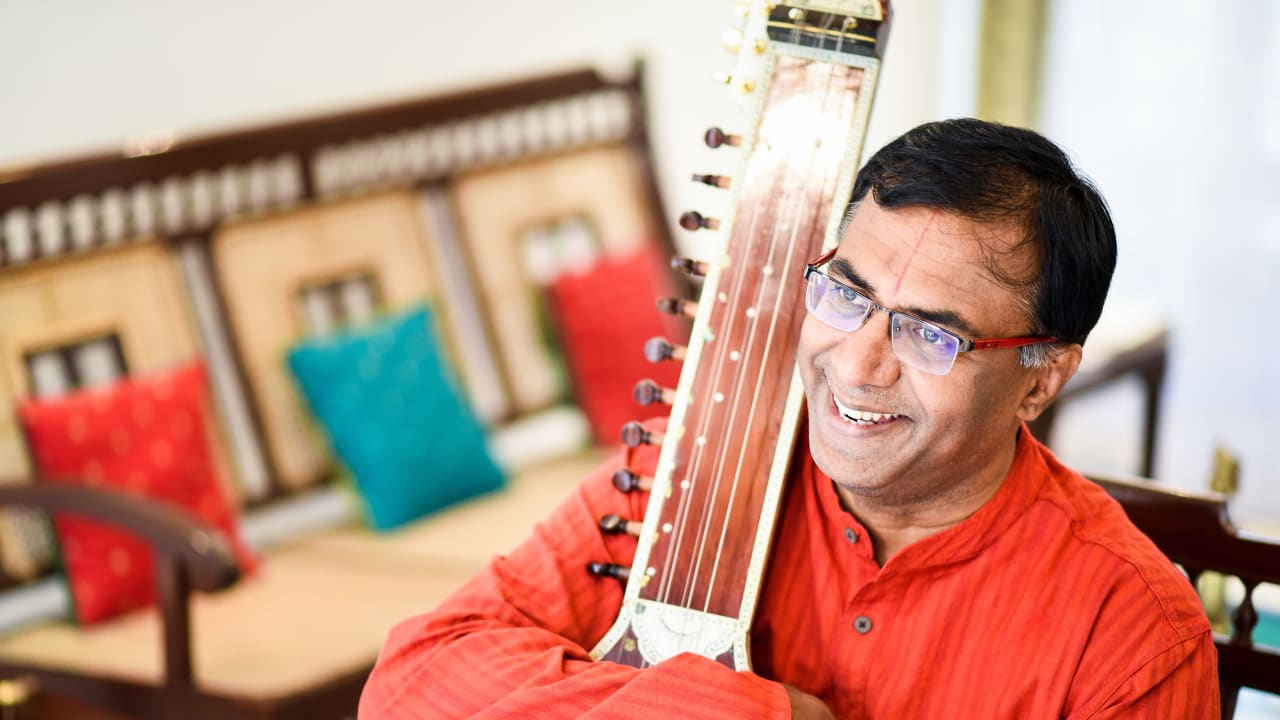

As we are all painfully aware, these are tough times in so many walks of life. That includes the arts and cultural sector, which somehow manages to survive and to spawn quality entertaining fare, despite – since the COVID-19 era and post-Oct. 7 shock waves – the difficulties of bringing foreign artists over here and the strictures imposed by miserly state support.
That certainly applies to smaller outfits such as Confederation House, which is about to hold the 26th edition of the Jerusalem International Oud Festival (November 6-13).
In view of the aforementioned political and fiscal circumstances, one can understand why Confederation House CEO and artistic director Effie Benaya struggled to lure more than one offshore act over here, but Chitravina N. Ravikiran and his trio should provide their November 9 (9 p.m.) audience at the Jerusalem Theatre with their money’s worth, along with a refreshing whiff or two of exotic foreign climes.
The 58-year-old artist plays the chitravina, one of the lesser-known Indian string instruments at least in the West, where most who have any knowledge of music from the Asian subcontinent are primarily familiar with the sitar and tabla.
Ravikiran hails from the Carnatic domain of Indian classical music, from the south of the country. He also keeps his musical options open. Over the past five-plus decades, he has collaborated with artists from a wide variety of genres and styles.

“I have performed with and/or composed for artists of almost all major genres in the world, such as Western classical orchestras, jazz, rock, Middle Eastern, and African,” he notes, expounding on the added value of his chosen field of musical expression. “Every system has phenomenal qualities that I admire. But I can objectively say that Carnatic is the most structured, sophisticated, and balanced melody-centric system I have ever seen.”
A stratified sonic offering
Ravikiran’s Jerusalem Theatre audience can clearly look forward to a stratified sonic offering. “There is equal importance given to melody, rhythm, and lyrics to so many varieties of structured compositions and improvisation, to vocal and instrumental, to musical and mathematical concepts, and its [the Carnatic system’s] theoretical framework is matched by its aesthetic qualities,” he explains.
There was very little chance of Ravikiran following a different career path.
His father, now 84-year-old Chitravina Narasimhan, is a feted musician who plays the same instrument as his son, although he uses the more modern moniker of gottuvadyam.
There have been various musical wunderkinder over the centuries, such as Mozart, who started playing music at the age of three and writing his own scores only two years later. Ravikiran can be included in that rarefied bunch. He says that at the age of two, he could identify and sing close to an astounding 500 melodic and rhythmic works.
There was plainly no way the youngster was going to earn his crust in, say, the legal profession or as a cricketer.
“I was lucky to be born into a family of distinguished musicians and was also nurtured on a diet of music from birth,” he says. “My passion for music has overshadowed everything else, and I never considered any other vocation even in my remotest dreams. I also believe that at the highest levels, the pursuit of music is as sophisticated, demanding, and fulfilling as any other field known to man.”
The youngster imbibed pitches, textures, timbres, and musical rhythms almost as soon as he could talk. Everything he needed to push him in the desired direction, across numerous technical avenues, was right there at home.
“My father is not only a virtuoso musician but also an inspired educator who taught me literally everything to do with music for the first few years. These include over 300 ragas, 175 talas, vocal and instrumental techniques, and a repertoire of nearly 500 compositions,” he recalls. “By the age of five, [I had developed] improvisation skills, analytical skills, taste, and abilities in rhythmic arithmetic, lyrics in various languages, and aesthetics.”
The toddler was provided with a rich tool set to continue his artistic and personal learning curve on his own as he grew up. “My father also gave me discipline, work ethics, a scientific approach, and an ideal mindset required to pursue the highest values of art and life with excellence and integrity,” he states.
Becoming a professional musician may have been a genetic shoo-in for Ravikiran, but he says it wasn’t just a matter of going with the familial flow. “Basic musical abilities can be natural to most normal people [like language]. But to optimize it and express it with both instant appeal and enduring values, one must practice a lot for years. In fact, the greater the talent, the harder one must work for the body to keep pace with the mind,” he points out.
The Indian artist has put in the hours and the requisite elbow grease to hone his skills and stay at the top of his game over the past half century. Mind you, he demonstrated impressive physical prowess from the get-go, participating as a vocalist in three-hour concerts from the age of five.
Ravikiran says that his two primary means of sonic expression – singing and playing the chitravina – make for snug bedfellows. “The chitravina is a slide instrument that has gained a reputation as the closest to the human voice.”
He has taken that natural instrumental-vocal interface and run with it even further. “I have developed several techniques to enable it [the chitravina] to bring out better articulation of lyrics, play longer passages with a single strumming of the strings, etc. At the same time, one also needs to highlight the unique qualities of this instrument.”
The chitravina may be an instrument like no other, but Carnatic music is a very different kettle of fish compared with, say, the sounds produced by the likes of The Beatles, Jimi Hendrix, Eminem, Beethoven, or Joni Mitchell. How does Ravikiran go about imparting the textural and rhythmic subtleties and nuances of Carnatic music to Western ears? How do Western audiences, for example, react to the “breathless slide” technique? That involves the player evoking rapid sonic oscillations by plucking a string with the finger of one hand, and sliding a cylindrically shaped accessory across the string in question with a finger of the other hand. For blues aficionados, that textual description my conjure up images of blues icons Muddy Waters and Howlin’ Wolf, and even Rolling Stones founding member Brian Jones, who generally employed a sawed-off bottleneck. In fact, Ravikiran feels more than a little affinity with the genre, with his bulging recording portfolio including a 1995 outing with now 83-year-old blues headliner Taj Mahal, titled Mumtaz Mahal.
The Indian musician believes there is more common ground between his line of work and the sounds of American and British rock groups and, in fact, other genres and styles of music. He feels that the appreciation of art, including seemingly disparate musical disciplines, is very much down to the way the artists go about their work and proffering it to the listener.
“I have seen firsthand that there are a lot of similarities between even apparently divergent systems when it comes to fundamental excellence, tunefulness, rhythmic feel, virtuosity, and aesthetics. As an instrumentalist, it is easier for me to play for global audiences than [for] vocalists, whose music may appeal more to those familiar with the language and themes of the songs. My ‘breathless slides’ have been very well received by audiences,” he says.

The Taj Mahal synergy is a case in point. “He is a phenomenal artist and human being, and it was extremely inspiring for me to adapt to his style and reproduce it on the spot because we met only 30 minutes before actually recording!”
That also illustrates Ravikiran’s ability to adapt, accommodate, and improvise on the fly. He notes that the meeting point between the two fields of art lies more in the performer’s philosophy and subsequent application than in the modular structure, tempi, or sonic building bricks.
“The common ground between Carnatic music and the blues is only to the extent that both must be soulful, tuneful, and powerful,” he states.
SINCE HE has mixed it with so many artists from almost polar sectors of the musical spectrum, including world music, which by definition involves a certain amount of give-and-take between the various sourced genres, one might have thought that Ravikiran was perfectly happy to give learned ear to musicians from different spheres and dovetail with their lines, thereby ceding some Carnatic ground in the process.
I wondered whether he had listened to pop, rock, and other Western sounds as a youngster, and whether it, to some degree or other, fed into his take on Indian classical music. Given his collaborations with blues, jazz guitarist Larry Coryell, Belgian blues guitarist Roland Van Campenhout, Iranian multi-instrumentalist Hossein Alizadeh, and Chinese pi-pa player Qiu Xia He, to mention but a few in Ravikiran’s global spread, one would have expected that to be the case.
However, it seems that, to begin with, the necessary airwave frequency reach and purchasing logistics were not in place to facilitate that. That and his steadfast allegiance to his musical DNA. “In my early years, I didn’t have access to most music systems in the world. But, over the years, technology improved, and I have widened my horizons.”
Communication means advances notwithstanding, for Ravikiran it has been more about actual human, rather than virtual, intersections that has enabled him to widen his musical horizons. “[It has been] more through my collaborations. While I love excellence in any genre, I strongly believe that the identity of every genre should be maintained intact, and one must not let the characteristics of any other genre influence one’s own, except during mutual explorations.”
That credo found a brief instrumental performance outlet when Ravikiran dabbled with playing slide guitar, albeit with some considered modifications. He says it was a perfectly natural foray. “The chitravina is globally acknowledged as the forerunner to other slide guitars,” he points out, adding some expert credentials to that claim. “I’ve seen that in Guitar Player [US music magazine] and other Western books on slide guitar. And when I got an original Hawaiian guitar, I altered the string arrangement slightly and gave a few concerts, too, just to challenge myself. It was fun!”
Ravikiran soon got back on track and continues to ply his trade across a broad array of areas, and in abundance. He says he has around 1,200 scores to his name and, in addition to his busy performing schedule, keeps himself gainfully engaged as an innovator with his melharmony concept which, he says, “explores new chords and counterpoints based on melodic progression, in contrast to traditional Western classical music.”
He also offers a lifeline to people who, for whatever reason, can’t envisage the sunny side of the street, through his musopathy form of therapy. It addresses the curative effects of “musical sonics on different parts of the brain or body of humans, animals, plants and micro entities in a de-regionalized, de-culturalized, and quantifiably precise manner.”
That sounds like an eminently more wholesome approach than the 1960s counterculture, drug-related idea of “turn on, tune in, drop out,” reducing that to just the second of that mainstream society-challenging triad of measures.
Many of my now senior citizen generation, and the one before us, were introduced to Indian sounds through George Harrison’s contributions to The Beatles’ oeuvre, and also through the game-changing performance by preeminent sitar player Ravi Shankar and tabla player Alla Rakha at the 1967 Monterey International Pop Festival.
While Ravikiran admitted to not, as yet, having watched that particular clip from the video of the milestone event in California, he says that both Indian music giants fed appreciably into his consciousness and fueled his drive to strike for pastures farther afield. “I have been deeply inspired from childhood by both maestros Ravi Shankar and Alla Rakha in my mission to take my music to global audiences. I was quizzed [on his knowledge of the aforementioned hundreds of Indian works] by both these icons in 1969 when I was two, and subsequently both of them were kind enough to invite me to various performances. But I have not got the opportunity to see this particular film but heard them live on many occasions.”
Having caught Shankar in live hypnotic action myself 40 or so years ago, I can certainly vouch for his charisma and mesmerizing hold over his audiences.
Ravikiran says he can’t wait to get to Israel to strut his stuff for us and, hopefully, get some kind of handle on the local lay of the land. “This is my first trip to Israel, but visiting this great land and seeing the Holy City of Jerusalem have been on my wish list since I was a teenager! I am highly looking forward to sharing my music with your highly knowledgeable listeners, and thank the organizers for inviting me!”
Needless to say, the feeling is entirely mutual.
OTHER HIGH points on this year’s Jerusalem International Oud Festival program include a 70th birthday celebratory show with groundbreaking oud player-violinist-vocalist Yair Dalal; an intriguing slot fronted by ethnically inclined pop-rock artist Ehud Banai with 79-year-old local bluesy rock founding father Shalom Hanoch; a reunion of part of pioneering East-West crossover band Bustan Abraham; the Borochov family act; oud master Emad Dalal; the D-ONE Yemenite music project; rock veterans Nikmat Hatraktor; and a first-time festival dance slot called Al-Atlal, based on the eponymous work made famous by Egyptian diva Umm Kulthum.
For tickets and more information: *6226, http://tickets.bimot.co.il and www.confederationhouse.org/en/page_18014