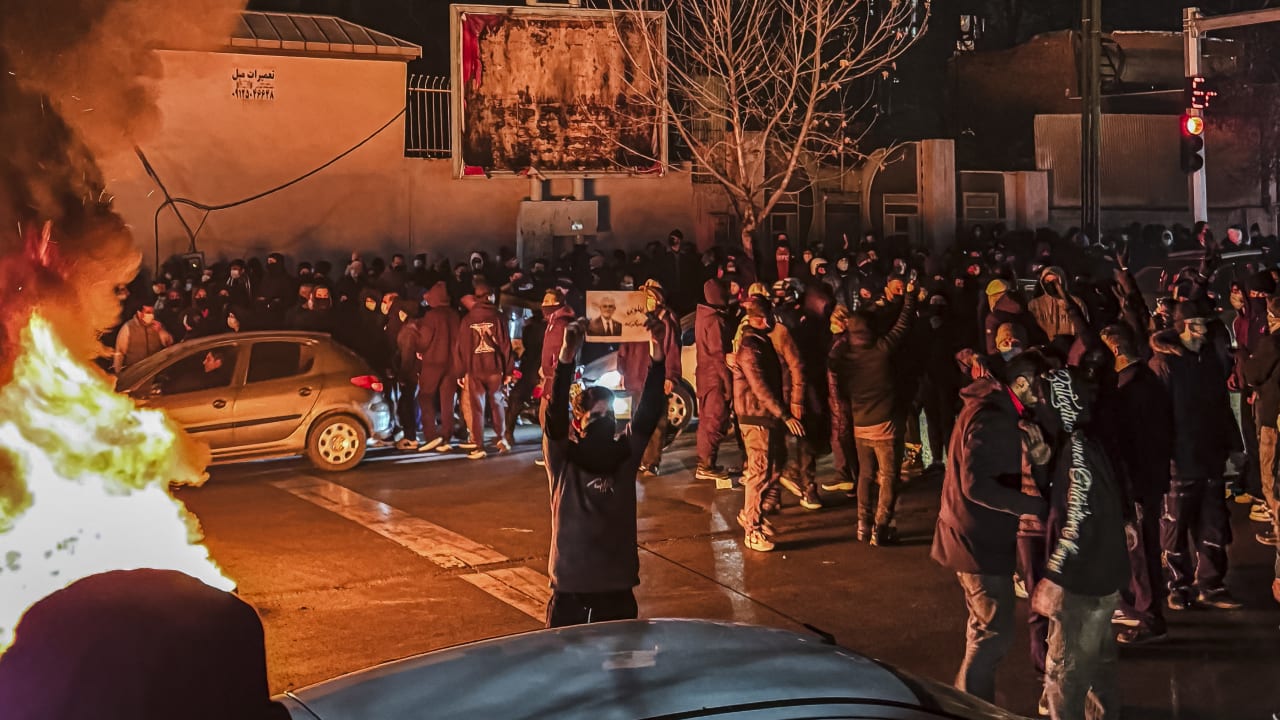
Many have described the current protests inside Iran as a “Berlin Wall” moment, meant to evoke the unforgettable, positive transformation European geopolitics underwent when the wall came down. Instead, for the past few weeks, what has taken place in Iran is better described as a digital Iron Curtain descending across the country.
What little information escapes the digital wall erected by the Islamic Republic comes only in fragments: text-only messages, broken calls lasting mere seconds, testimony passed through intermediaries abroad. Together, they describe a country under de facto martial law, where streets are controlled by guns and communication itself has become a punishable act.
One message, sent from Fardis in Alborz Province and passed to the National Union for Democracy in Iran (NUFDI), captures the scale of what Iranians say they are living through.
“Today, with great difficulty, after almost two weeks, I managed to connect to my landline internet,” the message reads. “Mobile internet is still cut off. I can only send text messages. It is absolutely impossible to send audio or video.
“I experienced the worst, worst, worst days of my life. With the things I saw and experienced, I don’t think I will ever be the same person as before. It is a crime against humanity. Tell the whole world that a crime against humanity has taken place here.”

The writer states that thousands of innocent people have been killed, that children and young people were shot in the streets, and that the internet shutdown has made it impossible to show the true scale of what has occurred.
“The Islamic Republic turned the streets into rivers of blood,” the message says. “No one has been able to show the depth of the crimes, because the regime shut down the internet.”
The account comes from trustworthy sources and aligns with a growing body of testimony emerging from inside Iran, as connectivity briefly flickers on before being cut off again.
One Iranian living in Europe told The Jerusalem Post that he managed to speak to a friend inside the country for five minutes before the call was abruptly terminated.
“What I heard was out of a nightmare,” he said. “Much worse than we are being told and shown.”
By nearly all accounts, Iran is now operating under conditions residents describe as martial law in all but name. Members of the Basij militia patrol Tehran on motorbikes, some reportedly shouting, “Don’t come out! We’ll shoot you!” Police loudspeakers order residents to stay away from windows, an apparent attempt to prevent people from chanting protest slogans from their homes, as exiled Crown Prince Reza Pahlavi has urged.
Videos have shown armed guards patrolling the streets from the backs of trucks, in images reminiscent of scenes from October 7.
There have been multiple reports and videos of Islamic Revolutionary Guards Corps security forces breaking down doors of private properties and beating residents. Civilians inside Iran have stated that IRGC men have been going door-to-door in an effort to locate hidden Starlink devices or satellite dishes used to connect with the outside world.
Universities in Tehran remain closed to prevent student gatherings. A majority of shops and shopping centers are shuttered. Armed security forces dominate city centers. Public gatherings are dispersed within minutes.
Reports have also emerged of Arabic-speaking mercenaries from Iraq, Syria, and Afghanistan reinforcing regime forces in several cities.
The human cost: Arrests, killings, and executions
The human cost is staggering. According to figures cited by Iranian officials themselves, at least 5,000 people have been killed since protests erupted on December 28, including around 500 members of the security forces. Authorities blame “terrorists and armed rioters.” Human rights activists and opposition groups dispute that narrative and say the death toll could be far higher, potentially exceeding 20,000.
At least 24,669 Iranians have been arrested.
A doctor inside Iran described the killings as “genocide under digital darkness” to the British newspaper The Sunday Times. One couple told the paper they were given “ten minutes to cry” when shown the body of their daughter – after being forced to pay a $5,000 “bullet fee” to recover her remains. After paying, they were driven five hours to another town, where her body had been thrown into an old grave.
Numerous families have reported being charged exorbitant sums to retrieve the bodies of loved ones killed by the regime.
Images shared from within Iran during the past week also show injured protesters admitted to hospitals – tubes and catheters still attached, admission tags visible – and then shot point-blank in the head, their bodies lying on the ground. Doctors have also reportedly refused to treat protesters, branding them enemies of the regime.
Beyond live fire, the blackout is the Islamic Republic’s central weapon against the demonstrators. With mobile data cut nationwide and only sporadic landline access available, Iranians are isolated from one another and from the outside world. Evidence cannot be shared; deaths cannot be documented.
Several Iranians contacted by the Post used the same word to describe their condition.
Hostages.
“We are hostages inside our own country,” one message read. “We don’t know what is happening in the next street, let alone the next city.”
In the early days of the protests, before the streets emptied and the internet went dark, Iranians appealed outward for the help they believed they needed.
Handwritten signs addressed to Israeli Prime Minister Benjamin Netanyahu and US President Donald Trump appeared at demonstrations. Video messages circulated online calling on Israel and the United States to intervene. In some cities, streets were symbolically renamed after Trump, reflecting a belief that foreign warnings would translate into protection.
Those appeals were made after explicit statements from abroad warning Tehran against killing protesters and promising consequences if it did.
But the momentum of the demonstrators on the ground has passed, at least for now, as they have been confined to their homes. This has given the regime the one thing it needed to cling to power: time. Time to arrest, time to murder, and time to release to the world a narrative that suits it. They may have told Trump that executions have been halted, but one look at what has taken place inside Iranian hospitals shows that executions are still being carried out.
As the internet shutdown entered its twelfth day on Tuesday, Pahlavi addressed the nation and the regime in a video message broadcast on social media.
“My address is to Ali Khamenei, the leader of the occupying regime of Iran,” the exiled crown prince said. “You are an anti-Iranian criminal. You have neither honor nor humanity. Your hands are stained with the blood of tens of thousands of Iranians.”
“You, your regime, and all your mercenaries will be held accountable for every single drop of blood you have spilled – without exception.”
He urged Iranians not to allow grief and fear to halt the movement.
“Be ready,” he said. “The moment of returning to the streets will come – broader, stronger, more determined than ever: to take Tehran – to reclaim Iran.”
But inside Iran, the present reality is captivity – a people held hostage.
“I am suffocating. We in Iran are 80 million hostages of this regime,” the message to NUFDI concluded. “The world must act now.”
For Israelis, the word “hostages” carries a weight unlike almost any other. For two and a half years, it has barely left our lips or our thoughts.
Innocent Iranians right now are being held hostage by their own government. Help them now.