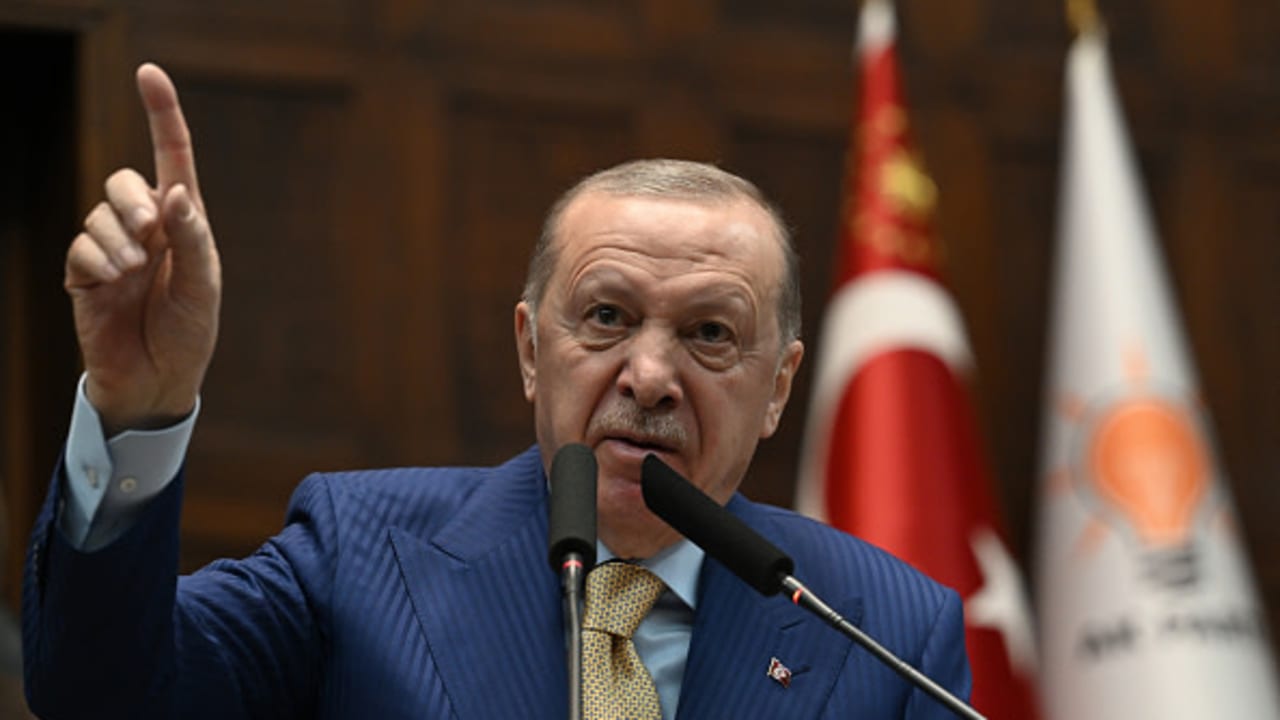
As the smoke cleared over Tehran after the beginning of the Israeli-US strikes, Turkish President Recep Tayyip Erdogan was quick to point the finger. “This all began following Netanyahu’s provocations,” the Turkish leader stated, “we feel deep sorrow and great concern.” He went further, issuing a chilling warning: “God willing, I have no doubt that Israel will pay the price for this.”
The casual observer might imagine that Turkey, fighting as it is with Iran for dominance of the region, would welcome the strike against the Islamic Republic.
However, Hay Eytan Cohen Yanarocak, a leading expert on Turkish affairs at the Jerusalem Institute for Strategy and Security, explains that Turkey has a vested interest in the survival of the current Iranian regime.
“Ankara does not want to see a new ‘surprise’ in the form of regime change,” Yanarocak notes. “They are interested in the continuation of the regime because if a revolution occurs, Turkey’s monopoly as the primary bridge between the West and the Middle East simply disappears.”
Policy expert Jonathan Adiri agrees, suggesting that Turkey prefers a crippled neighbor over a liberated one.
“Turkey wants a non-nuclear, weak Iran,” Adiri says. “They want a sort of ‘weakened virus’ in the region. An Iran that is pro-Western and working with the Americans would become a magnet for foreign investment, which would directly hurt the Turkish economy.”

Perhaps the most potent driver of Erdogan’s anxiety is the Kurdish question. For decades, the Iranian and Turkish regimes have shared a common interest in suppressing Kurdish nationalist aspirations. A destabilized Iran could lead to the emergence of an autonomous or independent Kurdish entity on Turkey’s southern border – a prospect Erdogan finds intolerable.
According to several sources, Erdogan and other senior Turkish officials pressured US President Donald Trump not to give a green light to an Israeli operation that would have resulted in Kurdish fighters in Iran starting a rebellion against the Iranian regime.
Adira points out that Erdogan and Turkey’s Foreign Minister Hakan Fidan drew a red line with Washington regarding the use of Kurdish forces from Iraq to move against Iran.
“Erdogan told his public: ‘Case closed,’ regarding the Kurdish story,” Adiri observes. “He is deathly afraid of that box being reopened. From Ankara’s perspective, the success of a Kurdish-led or Kurdish-supported uprising in Iran would have a domino effect on Kurds in Turkey, Syria, and Iraq.”
A withdrawal of legitimacy for Israel’s very existence
As the geopolitical stakes have risen, so has the temperature of the rhetoric. Erdogan has increasingly abandoned the language of diplomacy in favor of the language of the “resistance.” He recently referred to Prime Minister Benjamin Netanyahu as “Hitler,” and Turkey issued arrest warrants for a slew of Israeli officials.
“[Erdogan] has started referring to Israel not as the ‘State of Israel,’ but as ‘the Zionists,’” Adiri notes. “This is a deliberate shift. It is the language of the fault line shared by Hamas, Hezbollah, and the Iranians. When you stop being a recognized state and start being ‘the Zionist Project,’ it signals a withdrawal of legitimacy for Israel’s very existence.”
Israel has not taken the verbal assaults lying down. In a rare joint rebuke, Netanyahu and Defense Minister Israel Katz lashed out at the Turkish leader’s hypocrisy. They accused Erdogan of “massacring the Kurds” and suggested that his outbursts were born of cowardice, claiming he was “afraid to respond to Iranian fire” that had previously targeted Turkish interests.
Erdogan’s response was swift: “I remind the baby-killers who attack me on social media: The Republic of Turkey is not an ordinary state.”
While Turkey decries Israeli “aggression,” it is quietly shoring up its own strategic depth.
Yanarocak highlights Turkey’s rapid development of the Tayfun ballistic missile system, its burgeoning interest in nuclear energy, and perhaps more. When Turkish Foreign Minister Hakan Fidan was recently asked on television whether Turkey should possess nuclear weapons to counter regional threats, his answer was telling in its brevity: Fidan replied with a smirk when the presenter told him, “You can say ‘No comment.’”
Ankara is watching the destruction of Iran’s conventional military assets and realizing that in a Middle East dominated by Israeli technological and intelligence prowess, traditional power might no longer be enough.
Despite the hostility, some experts warn Israel against declaring Turkey a lost cause. Adiri argues that while Israel must act “powerfully” against Turkish provocations, it should leave the door open for a “reset” based on mutual respect and strength.
“It is a mistake for the opposition or the government to label Turkey as a permanent enemy,” Adiri concludes.
“We must not fear friction, but we must signal that Israel is ready for a new beginning – one from a position of power.”