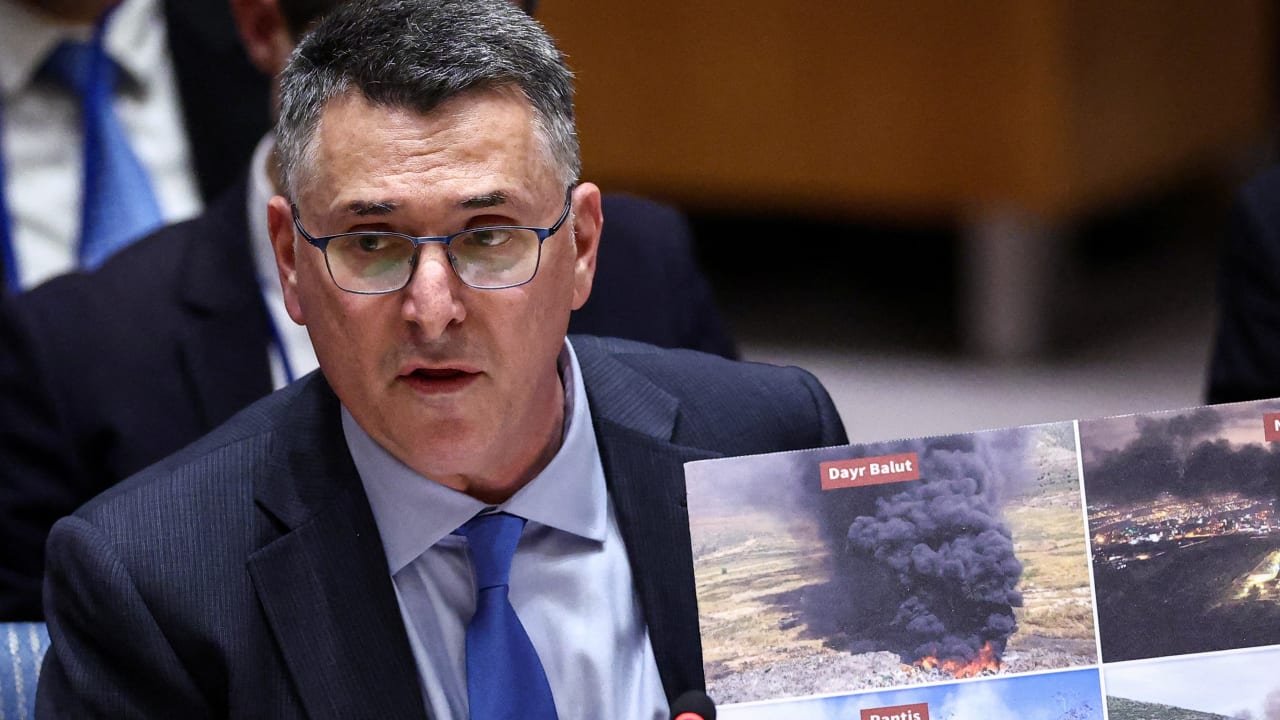
Foreign Minister Gideon Sa’ar on Wednesday called on the United Nations Security Council and the UN Secretary-General to officially designate Hezbollah as a terrorist organization, demand that the Lebanese state disarm the group, and recognize Iran as a “threat to international peace.”
“To date, Hezbollah has launched more than 3,500 rockets, missiles, and UAVs at Israel, including from areas south of the Litani River, endangering millions of Israeli residents and forcing them into bomb shelters,” Sa’ar wrote in a letter addressed to current UNSC President Michael Waltz, shared on X/Twitter.
Waltz, the United States Ambassador to the United Nations, chairs the council until April, when Bahrain is set to rotate into the role.
Sa’ar went on to reference the Tuesday death of 27-year-old Bnei Yehuda resident Nuriel Dubin, who was killed by Hezbollah rocket-fire in northern Israel, and noted that the same communities most affected by the group are those that were forced to evacuate following Hezbollah’s entrance to the Israel-Hamas War on October 8, 2023.
“These blatant attacks constitute a violation of international law, as well as United Nations Security Council resolutions 1701 (2006) and 1559 (2004), and represent a direct continuation of Hezbollah’s disregard for the November 2024 Cessation of Hostilities Understandings,” Sa’ar added.

The foreign minister went on to assert that Israel wouldn’t accept Hezbollah’s attacks and would take military measures, as it has been engaged in, to protect its citizens and degrade the group’s capabilities.
Last week, the IDF said that, in its actions against the group, it had killed nearly 600 Hezbollah operatives, including at least 220 Radwan Force members.
“The failure of the Government of Lebanon to act against Hezbollah’s military infrastructure demonstrates a lack of will, insufficient effort, and inability to effectively address Hezbollah,” Sa’ar wrote. He went on to say that the group’s continued activities in southern Lebanon, despite the Lebanese government's claim of “operational control” of the area, highlight the “gap between rhetoric and reality.”
The minister’s comments echo remarks IDF officers made to Walla earlier in the day, when they asserted that the Lebanese Armed Forces had lied to the IDF about disarming Hezbollah.
“The Lebanese army lied to the IDF. They deceived Israel. They claimed they had enforced the decision to demilitarize southern Lebanon,” one officer said. “They shared intelligence and reports on entire regions, but based on what we found, it's clear that nothing was done.”
The Hezbollah-Iran connection
The foreign minister also underscored Hezbollah’s connection to its patron, the Iranian regime, asserting that it was impossible to separate the terror group’s actions from Iran’s campaign against Israel.
“Iran has transferred to Hezbollah $1.2 billion since the ceasefire. It also plays a direct role in training militants and guiding senior leadership.”
He also blamed the group for using Lebanese civilians as human shields by embedding its operatives and infrastructure in civilian areas.
The accusation mirrored a similar one made that day by IDF Arabic spokesperson Col. (Res.) Avichay Adraee, who asserted that the group had embedded itself in civilian areas of Tyre, from where it had launched around 120 rockets since the start of the renewed conflict between Israel and Hezbollah.
“These actions further underscore the concerns repeatedly raised by Israel over the years regarding Hezbollah’s continued violations and the failure to implement the relevant Security Council resolutions and the 2024 Understandings,” Sa’ar wrote.
Sa’ar concluded by asking for Waltz to distribute the letter as an “official document of the Security Council” and noted that the letter had also been sent to UN Secretary-General Antonio Guterres.