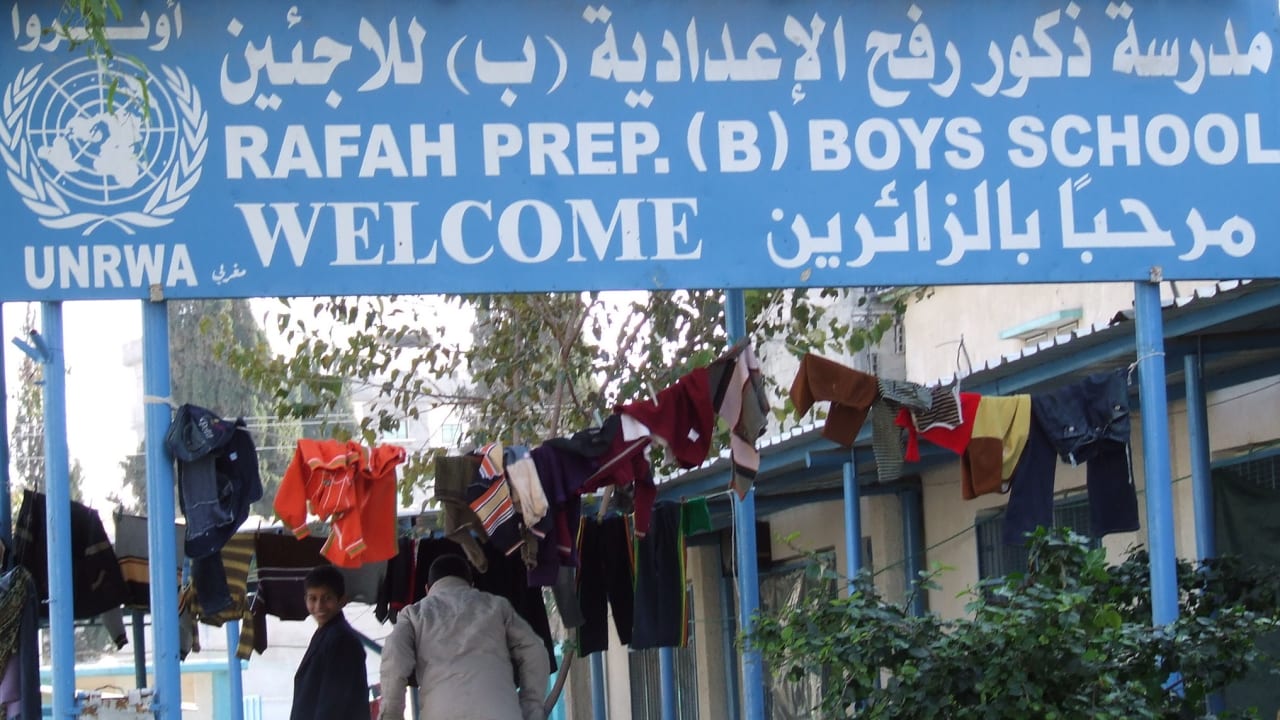
The United Nations Relief and Works Agency confirmed to The Jerusalem Post on Sunday that it fired a Gaza school principal after learning of his involvement in the October 7 massacre.
Both Israel and, later, the US have concluded that Gaza school principal Hafez Mousa Mohammed Mousa was a Hamas member who participated in the attacks.
Just recently, the Office of the Inspector General of the US Agency for International Development carried out an investigation into Mousa's involvement in the October 7 attacks.
On February 27, it was revealed that Mousa is an operative of the Hamas East Jabaliya Battalion and coordinated communications with other suspected Hamas members during the massacre while still serving as an UNRWA school principal. Israel separately revealed that, on the morning of October 7th, Hafez used the same cellphone to perform his duties both as an UNRWA school principal and a Hamas member.
The US subsequently debarred Mousa on a government-wide level, meaning he is prohibited from participating in all United States contracting and grant activities. This investigative result was actually unprecedented, representing the first known debarment by the United States of a terrorist affiliated with a UN agency responsible for humanitarian assistance programming.

UNRWA confirmed to the Post on Sunday that "upon the allegations made against Mr. Mousa by the Israeli authorities, on 16 April 2024," UNRWA immediately placed him on Administrative Leave Without Pay and that "upon completion of the [internal] investigation, his appointment was terminated on 20 August 2024." It did not directly mention Mousa's Hamas membership in the statement.
UNRWA says it's required to interact with Hamas due to enviroment in Gaza
However, UNRWA argued that just because it is active in Gaza does not mean it is in collaboration with Hamas. The organization cited a US National Intelligence Council assessment, which said that while UNRWA has had to interact with them to deliver humanitarian relief, it does not mean the Agency is collaborating with Hamas.
"By definition, humanitarian crises take place in complex environments worldwide. In such environments, interaction by UN agencies and international NGOs with a range of actors is necessary to ensure people get the aid they need. But interaction does not mean collaboration, and attempts to depict it as otherwise are intentionally misleading."
UNRWA told the Post that it has "consistently followed up with the Israeli authorities and requested information and evidence concerning any alleged wrongdoing on the part of its staff," but that "Israel has not responded to UNRWA requests and has not provided any information that could be used to substantiate its claims - claims that continue to be repeated in the public domain."
UNRWA also said it has made multiple requests to the US State Department IG and USAID IG that their evidence of possible UNRWA employee misconduct be shared with the Agency to address these matters in accordance with UNRWA’s accountability framework, including possible action against these employees. The Agency has allegedly received no response.
Israel, however, said that it presented details of Mousa and 17 other UNRWA employees to the UN's OIOS (Office of Internal Oversight Service), but that the OIOS did not provide Israel with the details of its investigation into these cases.
This week, a source familiar with the Office of Inspector General of USAID’s investigation told US media that investigators asked UNRWA for names of employees that it fired for terror ties, but that UNRWA refused to provide that information, or the names of its staff who participated in the Oct. 7 attacks.
In fact, in October 2025, Rep. James Comer, chair of the House Committee on Oversight and Government Reform, testified that UNRWA was obstructing a US inquiry into links between UNRWA staff and Hamas.
“Despite repeated U.S oversight inquiries, UNRWA, either on its own or at the direction of UN Headquarters, has refused to provide necessary documentation related to its staff’s involvement in this atrocity," said Comer.
"For example, although the USAID OIG has requested pertinent documentation related to the termination of several UNRWA employees implicated in the October 7th attack, the UN’s Office of Internal Oversight Services (OIOS), at UNRWA’s request, has redacted valuable information, further obscuring the involvement of current and former UNRWA staff in the attacks," he added.
"This is unacceptable, as the lack of transparency greatly undermines US efforts to assess risk and obstructs the oversight responsibilities of Congress," he concluded.