The United States has yet to secure funding commitments for its Gaza reconstruction plan as potential donors voice concerns that disagreements over Hamas disarmament could lead to the continuation of full-scale war in the enclave, sources told Reuters.
Hamas laying down its weapons is a key requirement under US President Donald Trump's plan to end the Gaza war. It calls for the IDF to withdraw troops as Hamas disarms and for Gaza's reconstruction to be overseen by a "Board of Peace" chaired by the US President.
Trump's plan got a boost this week with the reopening of Gaza's Rafah border crossing with Egypt. But sources close to Hamas say the terrorist group has yet to start talks on disarming, a move that is meant to precede the start of rebuilding Gaza's destroyed cities.
Two sources with direct knowledge of the Board's planning said that countries were hesitant to commit funds to a rebuilding plan unveiled last month by Trump's son-in-law, Jared Kushner, until Hamas disarms.
"Countries want to see the funding will go for reconstruction within demilitarized places, and not to throw the money into another war zone," one of the sources said.

"If we pass that obstacle, then funding will not be an issue."
Seven Western diplomats told Reuters that the funding holdup, which has not been previously reported, was also being driven by a demand by some potential donors for funds to be managed by the United Nations rather than the Board of Peace.
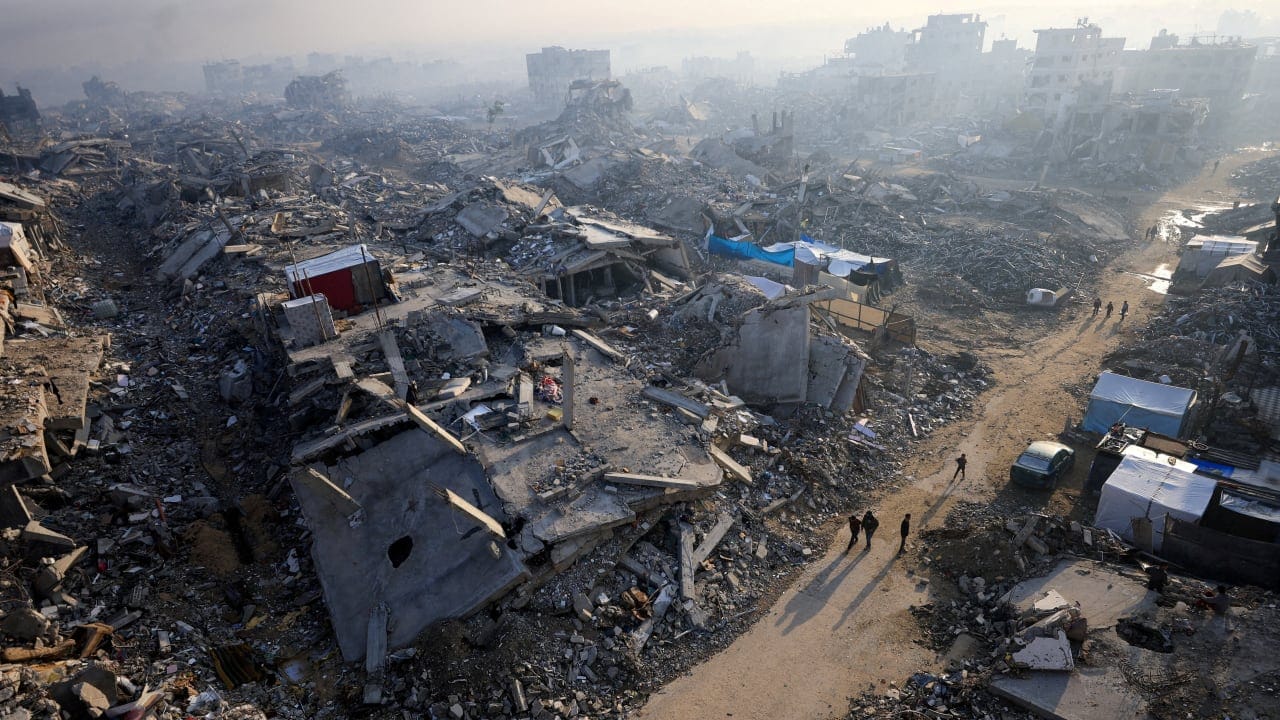
The funding delay leaves Gaza's population in limbo, unable to begin clearing rubble or rebuilding basic infrastructure, and feeds into worries among US allies that a fragile October truce, shaken by repeated Hamas cease-fire breaches, could break down and lead to a resumption of heavy fighting between Israel and Hamas terrorists.
Alongside governments, potential donors could also include private sector contributors, diplomats, and the two sources said. They estimated the potential rebuilding cost to be in the range of $100 billion.
That money would fund a "New Gaza" rebuilt from scratch to include seafront residential towers, data centers, and industrial parks, Kushner said at the World Economic Forum in Davos on January 22.
'New Gaza' to be rebuilt after rubble removal
The plan does not call for compensation for Gazans who saw their homes destroyed. Two of the diplomats said it was unclear how the "New Gaza" plan would address land rights.
Kushner said in Davos that an event would be held in Washington in the coming weeks "where we'll announce a lot of the contributions that will be made ... from the private sector."
But the two sources familiar with the Board's planning said a date for that conference had not yet been set.
"In the meantime, we're not waiting for the event. There is discussion one-on-one," one of the sources said, without identifying specific donor targets.
A senior European diplomat said that no European or Western country had yet committed funds for Gaza's reconstruction.
"We need some serious private money ... The Europeans are not capable of funding it," the senior European diplomat said, citing fiscal constraints and growing domestic opposition within Europe to foreign aid spending.
Wealthy, oil-rich Gulf Arab states have expressed hesitation at financing Gaza's reconstruction without a broader political solution that includes Hamas disarmament.
One source with knowledge of the Board's planning said it would be difficult to secure private-sector financing without at least some progress toward disarmament.
"We came to the conclusion that if you really want to (rebuild) with the full spectrum of financing, you need peace area pricing," the source said, suggesting the cost of financing would be risk-adjusted to the level of security in a given area.
"Now it doesn't mean that we wait for the full process to be done, but we want to see that it's really happening with full cooperation."
One of the first tasks will be clearing an estimated 68 tonnes of rubble and war debris in Gaza. The Board of Peace was in talks with several parties to award potential rubble-clearing contracts, the source and a US official familiar with the matter said.
Several rubble-clearing contracts could be awarded, the source said, adding that the aim is for tenders and the awarding of contracts to eventually be managed by a Palestinian technocratic body overseen by the Board.
Hamas stashes of rockets, arms still being found
After a two-year war that left much of Gaza in ruins and Hamas weakened, the terrorist group possesses rockets, which several Western intelligence sources estimate to number in the hundreds. It is also estimated to possess thousands of light weapons, including rifles.
Senior officials in Israel say they do not believe Hamas will lay down its weapons without the use of force and that the military may be preparing to return to war.
On Tuesday, the IDF announced that it had found a massive cache of weapons hidden within humanitarian aid and wrapped in UNRWA blankets. The stores included around 110 mortar rounds, rockets, and other arms.
The stash was located by IDF forces patrolling Israeli-controlled territory and was one of the most extensive arms finds since the start of the ceasefire.
The first phase of Trump's plan left Hamas in control of a bit under half of Gaza, where the terrorist group polices streets and has reestablished its hold.
Israeli and Hamas-controlled territories are separated by the "Yellow Line," which numerous Hamas terrorists have attempted to cross, an action that constitutes a breach of the ceasefire.
Hamas has agreed to discuss disarmament with other Palestinian factions, but neither Washington nor regional mediators had presented the group with any detailed or concrete disarmament proposal, two Hamas officials told Reuters.
Yonah Jeremy Bob contributed to this report.