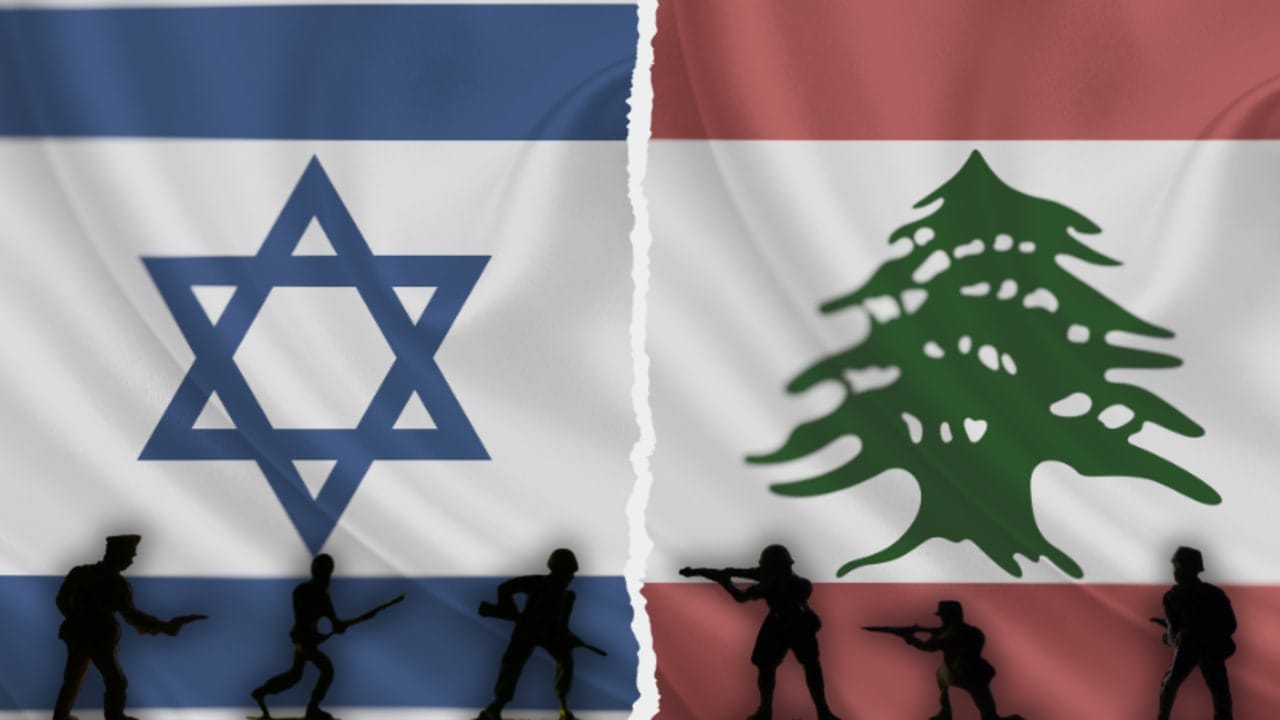
From the steady hum of Israeli airstrikes in southern Lebanon, it would be hard to tell that Beirut and Jerusalem did something last week they haven’t done in decades: They held direct civilian talks.
Not military-to-military, not via intermediaries, not with everyone pretending they weren’t in the same room. Actual talks between civilian officials.
In Naqoura, at the UNIFIL compound overlooking the sea, Lebanese and Israeli envoys sat at one table, discussed potential economic cooperation, and agreed to meet again.
It was extraordinary. And what made it even more extraordinary was that shortly afterward, IAF jets were back over southern Lebanon, hitting what the IDF said were Hezbollah weapons warehouses. Talk about contradictory realities: diplomacy at noon, airstrikes by nightfall.

But beneath that contradiction, change is simmering. Not only in Lebanon, which now finds itself pressed from all directions, but also in Israel, where the national reflex to “let things slide” seems to have gone missing.
Lebanon is on an 'irreversible path,' President Aoun says
Lebanon’s President Joseph Aoun called the decision to expand talks with Israel “irreversible,” and presented it as a way to lower the temperature along the border. No one in Beirut is calling this “normalization,” or even “a pathway toward normalization,” but the very fact that the government overruled Hezbollah’s objections to this meeting tells its own story.
For decades, direct civilian contact with Israel was political poison in Lebanon. This time, the government swallowed hard and did it anyway.
That alone explains Hezbollah’s reaction. Naim Qassem blasted the move as a “blunder.” Hezbollah supporters described it as drilling a hole in the hull of a national ship. What worried them was not the meeting itself but what it symbolized: A government, however timidly, stepping out from underneath Hezbollah’s dark shadow and taking baby steps toward regaining sovereignty. When a child begins to walk, everyone notices – and Hezbollah is noticing the Lebanese government’s tiny moves to regain authority.
Beirut wants Jerusalem and Washington to notice as well.
All this takes place with a looming deadline. The November 2024 ceasefire that ended fighting in the North stipulated that Hezbollah was to withdraw its forces and weapons north of the Litani River, consistent with UNSC resolutions calling for the disarmament of all armed groups in Lebanon; the Lebanese Armed Forces, along with other official state security forces and UNIFIL, were to assume sole control of the area south of the Litani; and Israel was to withdraw its troops behind the Blue Line in a phased manner within approximately 60 days.
One year later, none of those commitments has been fully honored. The disarmament of Hezbollah has not begun; the terrorist organization is – again with Iranian help – rebuilding, and, as a result, Israel has not withdrawn completely behind the border.
The US, which was critical in brokering the ceasefire deal, is unhappy with the pace of disarmament and has set a date: December 31. Disarm by then, or face consequences.
Lebanon’s decision to send a civilian official to engage with Israel was seen as an effort to show movement and push off that deadline. In the meantime, Reuters reported on Monday that the EU was preparing support packages to free up Lebanese forces to focus on Hezbollah.
But, as IDF maneuvers and rhetoric from Jerusalem are showing, Israel is running out of patience, and there is increasing talk of a major military action to speed along Hezbollah’s disarmament.
Israel will take no more partial solutions
This talk of renewed military activity in Lebanon reflects a deep change in Israel’s thinking since the catastrophe of October 7: It no longer trusts in partial solutions.
For years, Israel tolerated Hezbollah’s violations along the border and its buildup of a massive missile arsenal, believing that the organization was deterred and that confronting it militarily would be destabilizing. The Gaza calculus was similar. Contain Hamas, deter Hamas, live with Hamas. Don’t take major preemptive military action that would lead to war.
Then October 7 came and put an end to that logic. A state can absorb only so many illusions before it wakes up.
The evolution is easiest to see in the hostage negotiations. Few believed that under the Trump ceasefire plan, Hamas would return all the hostages, alive and dead.
Even fewer believed Israel would refuse to move to the rehabilitation stage of the Trump plan until every last one of the hostages was returned. Yet that is what is happening. With one exception, the hostages have all come home, and Israel has remained immovable on moving to the next stage until the remains of the final hostage, St.-Sgt.-Maj. Ran Gvili, are returned.
That posture is now visible on the Lebanese front as well. Israel is no longer content with “partial Lebanese sovereignty,” “gradual LAF deployment,” or “phased disarmament.” Those were the euphemisms of the old Middle East, the one Israel tolerated but now seems intent on leaving behind. Today, Jerusalem says openly: If Beirut does not disarm Hezbollah, Israel will.
And this places Lebanon in the position it has been trying to avoid for decades, being forced to choose between confronting Hezbollah and risking internal strife, or not confronting Hezbollah and risking a war with Israel.
Neither option is good; both are dangerous. Lebanese leaders know that sending the Lebanese army into heavily armed homes in the south to disarm them will not end well. But they also know that ignoring the deadline is a huge gamble.
Complicating everything is Hezbollah’s condition. The group is weak, but not weak enough. Its leadership has been decapitated, its elite units decimated. Yet it is already smuggling in new rockets, restoring outposts, and burrowing underground.
Israeli officials accuse the organization of planting “double agents” in the Lebanese army. True or not, the allegation speaks to the same underlying problem: The Lebanese government is still far from having full control of the Lebanese state.
And so Lebanon keeps trying to thread the needle – moving just enough to show the world it is taking steps toward disarmament, but not enough to provoke Hezbollah into a confrontation.
But this time, something is different. The question hanging over Lebanon echoes the one hovering over Gaza: Who is going to disarm the armed groups?
In Gaza, Hamas is both the ruler and the terrorist group that needs to disarm, making disarmament impossible without someone from the outside coming in to do it. In Lebanon, the state and Hezbollah are separate on paper, but the state lacks the capacity and will to enforce its authority.
In both places, the terrorist groups insist their weapons are indispensable as long as Israel remains a threat. And in both, Israel – after the shocks of the past year – is signaling that the old formula of “managing” these realities, living with half-measures and strategic ambiguity, is no longer acceptable.
Which brings us back to Naqoura. One meeting does not make peace, and one civilian envoy does not change Lebanon’s political DNA.
But the moment is revealing.
It shows a Lebanese state edging, however cautiously, toward reclaiming a sliver of sovereignty. It shows an Israel unwilling to look the other way as the clock runs out.
And it shows a region that will need to adjust to an Israel that, after the trauma of October 7 and the ensuing recalibration of its security doctrine, is no longer operating with the same reticence – the same willingness to “let things slide” – that various actors in the region had grown accustomed to.