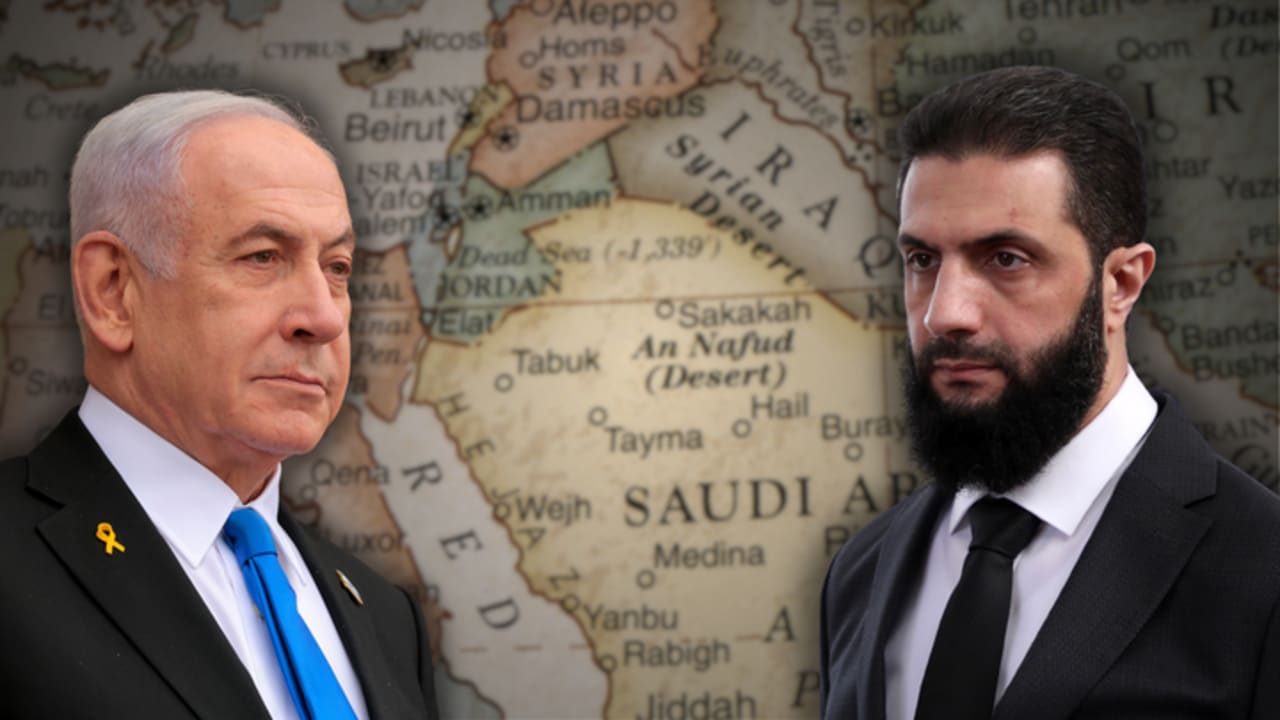
Syrian President Ahmed al-Sharaa claimed that his government is currently negotiating with Israel during an interview with the Washington Post on Tuesday.
“We are engaged in direct negotiations with Israel, and we have gone a good distance on the way to reach an agreement. But to reach a final agreement, Israel should withdraw to their pre-December 8 borders,” Sharaa said.
The Syrian president's reference to December 8 refers to the fall of the Assad regime and the commencement of Israeli strikes in Syria following the ouster.
After Sharaa's forces ousted former Syrian president Bashar Assad, Israel had targeted key military sites in a sweeping effort to obliterate Syrian military capabilities left behind by the regime that could be used to threaten Syria's neighbors, such as Israel. Israel targeted armaments such as chemical weapons, long-range precision attack missiles, and its air force. Additionally, part of Israel's efforts included establishing a physical military presence in southern Syria.
Sharaa's comments to the Washington Post came as the US works to broker a security pact between Syria and Israel. A Syrian official told Agence France-Presse in September that the countries are expected to arrive at several security and military agreements by the end of the year. These agreements would be independent of Syria joining the Abraham Accords, which Sharaa, citing Israel's "occupation" of the Golan Heights, dismissed the possibility of joining at present.

“The United States is with us in these negotiations, and so many international parties support our perspective in this regard. Today, we found that [US President Donald] Trump supports our perspective as well, and he will push as quickly as possible in order to reach a solution for this,” he added.
He also claimed that his government's refusal to respond to the attacks conducted by Israel since he took power is a way of demonstrating that their focus is on “rebuilding Syria.” At the same time, he claimed that Israel has “expansionist ambitions” and that the current defensive buffer “doesn’t serve security concerns.”
“Israel has always claimed that it has concerns about Syria because it is afraid of the threats that the Iranian militias and [Lebanon’s] Hezbollah represent. We are the ones who expelled those forces out of Syria,” Sharaa alleged.
Sharaa was also asked about the possibility of demilitarizing Southern Syria, to which he responded that his government must be the one responsible for maintaining stability across the whole country. “Who would stop rebel groups from attacking Israel from there if there are no Syrian forces?” he asked.
“Israel occupied the Golan Heights in order to protect Israel, and now they are imposing conditions in the south of Syria in order to protect the Golan Heights. So after a few years, maybe they will occupy the center of Syria in order to protect the south of Syria. They will reach Munich on that pathway,” he added.
Minorities in Sharaa’s Syria
When asked about the persecution of minorities in Syria since he took power, Sharaa said, “There are individual interests of certain groups that want to have independence or autonomy. Some of those parties want to find justification for their interests, so they use their denomination or their faith as an umbrella.”
"They talk about an existential threat to their denomination or faith. In Syria, we have been living in coexistence with different religious groups for 1,400 years. We’re still existing, and we still have that diversity.”
Finally, he compared the current situation in Syria with the post-Civil War United States, asking if “things were stable after one year? Or did it take so long, so many years after the war? We are in the stage of rebuilding the state and restoring and rebuilding the law. But I’m not saying that there are no problems in Syria. It’s not the end of the story.”
Seth J. Frantzman and Yonah Jeremy Bob contributed to this report.