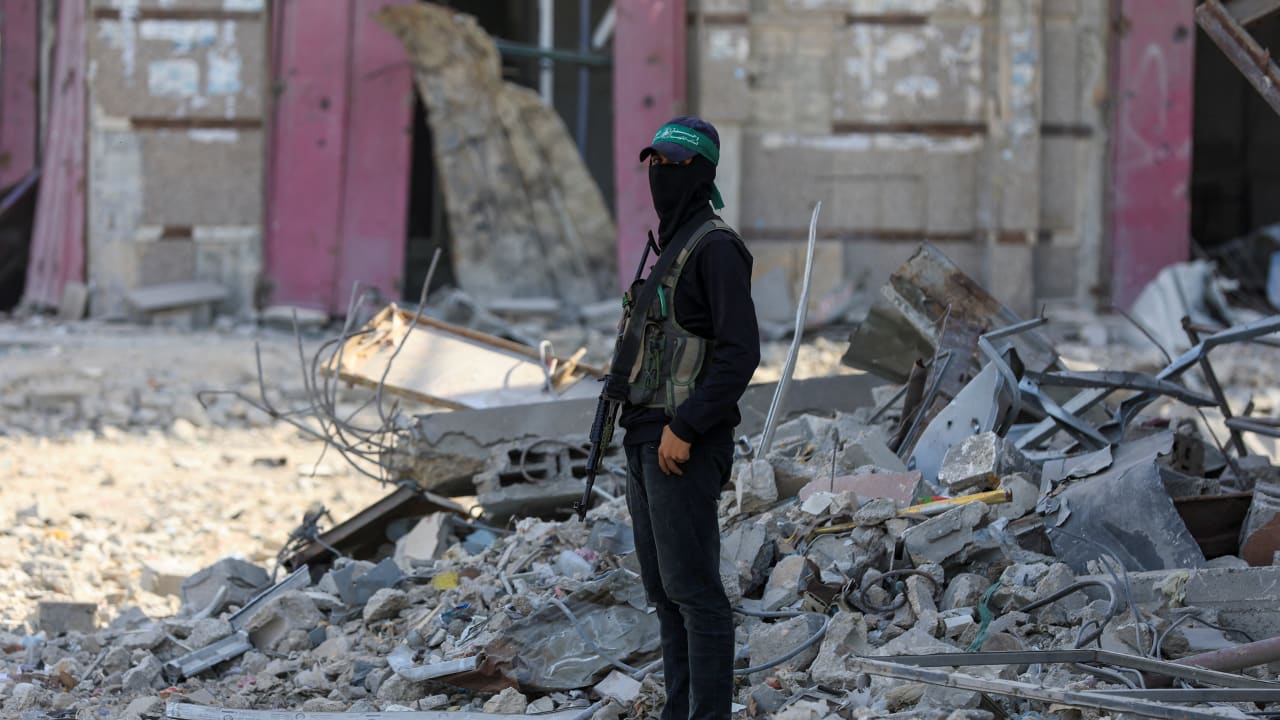
Hamas appears to be trying to trot out its remaining leaders to urge diplomacy as a path to resolving tensions in Gaza. Over the past few days, reports have indicated Turkey’s MIT intelligence agency chief met the head of Hamas’s negotiating team, Khalil Al-Hayya, in Istanbul.
The talks took place on Wednesday and aimed for a “path to be followed in implementing the next phases of the Gaza ceasefire plan, Turkish security sources said,” Reuters reported.
In a related development, Axios reported: “The Trump administration wants to use a crisis over Hamas militants who got ‘stuck’ in tunnels behind Israeli lines in Gaza to develop a model for disarming the group, two US officials with knowledge of the issue tell Axios.”
A Bloomberg report discussed Hamas giving up some of its weapons. Hamas official Moussa Abu Marzouk was quoted as saying Hamas might be willing to relinquish rockets “with ranges beyond the buffer zone.”
The three reports clearly represent a pattern. Hamas is trying to work with Egypt and Turkey to resolve issues in Gaza.

At the same time, it is not always clear if Cairo and Ankara are on the same page. Therefore, Hamas is likely trying to send its emissaries to both countries to try to get the best of both worlds.
Hamas also knows the US is moving toward a UN plan for an international force in Gaza.
“Today, Ambassador Michael Waltz, Representative of the United States to the United Nations, convened the elected members (E10) of the UN Security Council – representatives of Algeria, Denmark, Greece, Guyana, Pakistan, Panama, the Republic of Korea, Sierra Leone, Slovenia, and Somalia,” the US mission to the UN said Wednesday. “Notably, the United States also welcomed Egypt, Qatar, the Kingdom of Saudi Arabia, Turkiye, and the United Arab Emirates to the meeting, demonstrating regional support for the resolution to the UN Security Council on Gaza.”
Meanwhile, the Axios report has important details about the crisis in Rafah.
“Behind the scenes: US officials have been trying to bridge the divide over the last several days,” the report said, adding that “Turkey’s intelligence chief, Ibrahim Kalin, also joined the mediation efforts at the US request, Turkish officials say. During those talks, the Trump administration gave Israel a proposal to resolve the Rafah crisis. It called for Hamas militants in the Rafah tunnels to surrender and hand over their weapons to a third party (Egypt, Qatar or Turkey).”
What are Turkish media outlets saying about the Hamas meetings?
“During the meeting, the Hamas delegation expressed its gratitude to Turkiye, particularly to President Recep Tayyip Erdogan, for the role and efforts as a mediator and guarantor in achieving and monitoring the ceasefire,” Turkey’s Anadolu Agency, a state-run news agency, reported.
Implementing the next phases of the ceasefire plan
“The Hamas delegation also said that they are committed to the ceasefire agreement despite the violations committed by Israel throughout the ceasefire process,” the report said. “The meeting also addressed the steps needed to ensure the ceasefire process operates smoothly and how to overcome existing problems. The parties also discussed the paths to be followed in implementing the next phases of the ceasefire plan.”
The talks are also garnering attention in the Gulf states.
The discussions about Rafah are important because they could pave the way for further talks that enable stabilization in Gaza, Al Ain News, a UAE-based news site, reported.
The concept is to create a permanent mechanism for resolving crises in Gaza. The US has already done a lot of groundwork on this.
US Central Command set up the Civil-Military Coordination Center in Kiryat Gat, for instance. The US push for a UN resolution is an example of “American leadership of the new path,” Al Ain News reported.
Hamas officials, including Hayya and Marzouk, are key players for the next steps as well. The interplay between Egypt and Turkey will help move forward what happens next in Gaza.