
Jordan’s King Abdullah said that no country is going to be willing to deploy its forces in Gaza for peace enforcement as outlined in US President Donald Trump’s Gaza deal in an exclusive interview with the BBC on Monday.
The king said that peacekeeping efforts, rather than enforcement, will be the only acceptable form of foreign intervention in the strip.
Under Trump’s proposal, Arab nations and international partners are expected to provide stabilization forces to train and support Palestinian police forces in Gaza. The plan also calls for Hamas to disarm and relinquish its political control of the area.
However, Abdullah expressed concerns about the feasibility of such an operation, saying that foreign forces are not interested in engaging in direct military intervention in Gaza.
“If we are running around Gaza on patrol with weapons, that’s not a situation that any country would like to get involved in,” the king said. He added that peacekeeping, which would involve supporting local Palestinian police units, is something Jordan and Egypt are willing to assist with.
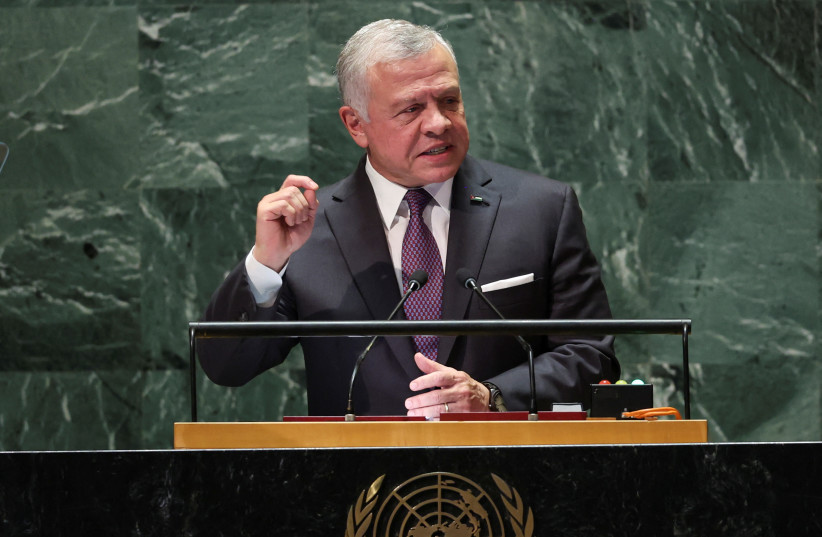
Abdullah also said that Jordan will not be sending its own forces into the Gaza Strip, citing the country’s close political and demographic ties to the region.
More than half of Jordan’s population is of Palestinian descent, and the kingdom has long hosted Palestinian refugees. The king noted that Jordan’s role will be limited to providing training for Palestinian security forces, rather than a direct form of military involvement.
When asked whether Hamas could be trusted to comply with the peace plan’s terms, Abdullah said he was unsure, but pointed to Egypt and Qatar, which have close ties with the group, as hopeful signs of cooperation.
“If we don’t solve this problem, if we don’t find a future for Israelis and Palestinians and a relationship between the Arab and Muslim world and Israel, we’re doomed,” the king told the BBC.
Humanitarian efforts and evacuations from Gaza
Abdullah also discussed Jordan’s ongoing humanitarian efforts in Gaza. Over 5,000 Gazans, including 253 children, have been evacuated to Jordan for medical treatment, according to the BBC.
Despite the slow pace of evacuations, which the World Health Organization has described as “excruciatingly slow,” Abdullah said that these efforts, which involve security checks by Israel and host countries, were significant.
In February, Jordan’s king met with Trump to request assistance in evacuating seriously ill Palestinian children from Gaza, leading to the evacuation of hundreds.
While many Gazans are still awaiting evacuation, Abdullah said that Jordan’s focus will continue to be on providing humanitarian aid.
Queen Rania criticizes international inaction, praises Trump’s role in ceasefire
In a separate interview, Queen Rania of Jordan criticized the international community for failing to take more decisive action to end the ongoing conflict in Gaza. Drawing from her Palestinian heritage, she described the suffering of Palestinian families over the past two years and called for greater international involvement.
While critical of the lack of global action, Rania praised Trump for applying pressure on Israel to agree to a ceasefire with Hamas. She noted that this marked a departure from previous US administrations, which Rania said had not held Israel accountable for its actions in Gaza.
“Trump was the first president in a long time to actually apply pressure on Israel,” Rania said. “Before, when they crossed lines, the US president would maybe just say a few words of rebuke. President Trump actually got [Prime Minister Benjamin] Netanyahu to agree to a ceasefire.”
Rania also addressed the prospects for a lasting peace between Israelis and Palestinians, saying that there are deep divisions, but there is still hope that a solution could be found with international support.
“I truly believe that Palestinians and Israelis can exist side by side,” the queen said. “But in the current atmosphere, there’s too much animosity, anger, grief, and hatred for the two peoples to forge peace on their own.”
Despite the challenges, Rania said, it was important to maintain hope: “Choosing hope was not easy, but it’s the only path that doesn’t deny Palestinians or betray their struggle.”