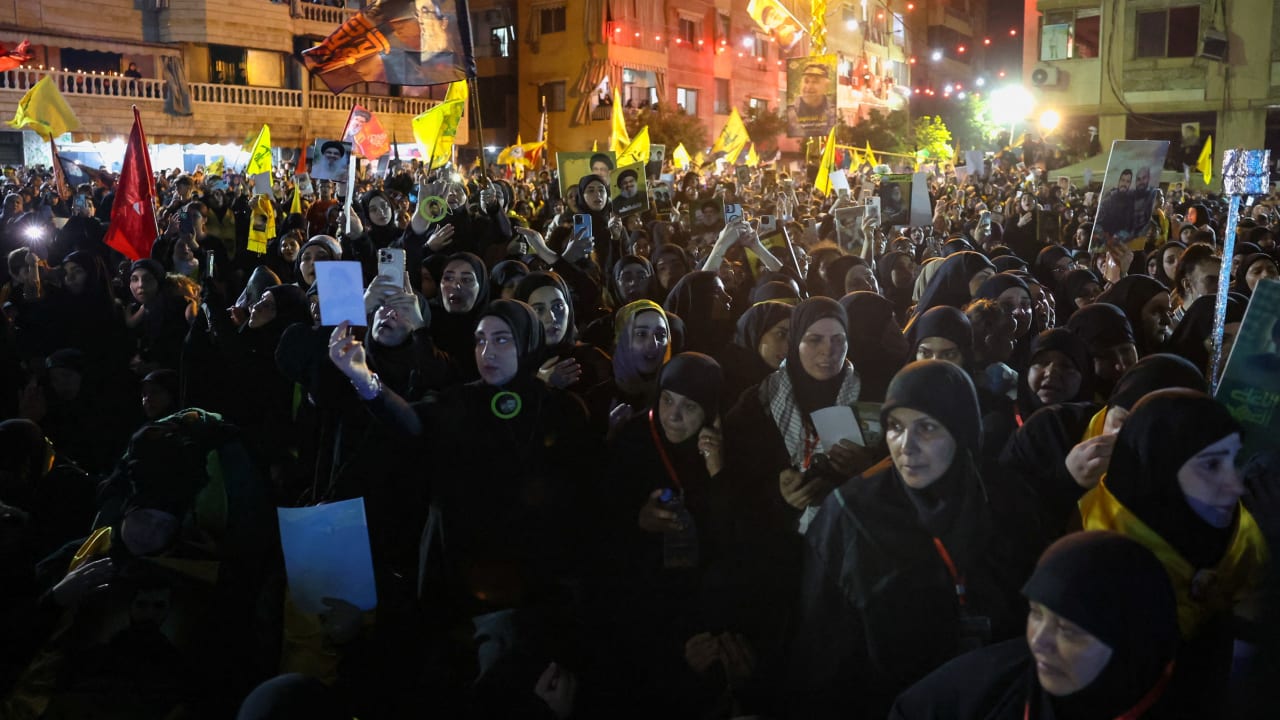
The Lebanese government was put on notice last week after images of Hezbollah’s late leaders were projected onto a natural landmark off the coast.
The Raouche Rocks, also known as Pigeon Rocks, are an important natural landmark in Beirut.
Hezbollah projected images of Hezbollah leader Hassan Nasrallah and his successor, Hashem Safieddine, who were killed by Israel last year.
Hezbollah still lurking in the background
The goal of projecting the images was to show Lebanon that Hezbollah is still powerful, and that it lurks in the background. This has cast a shadow over Lebanese politics, as Lebanon’s government continues to weigh demands to disarm the Iranian-backed terrorist group.
The Lebanese government has vowed to rein in Hezbollah after the Raouche Rocks display, Saudi-based newspaper Arab News reported.

“The Lebanese government pledged swift legal action after Hezbollah brazenly defied an official ban, projecting images of its late leaders onto Beirut’s landmark Raouche Rock, a public display that has reignited fierce debate over state authority and deepened political tensions across the country,” the report said.
Lebanese Prime Minister Nawaf Salam condemned the incident. He made it appear like a bureaucratic incident, saying Hezbollah had breached its “permit” for an event.
“Ministers stressed the government’s commitment to Lebanon’s stability and social cohesion, vowing to counter divisive rhetoric and halt hate campaigns that threaten national integrity,” Arab News reported.
The incident illustrates how Hezbollah continues to play a role in Lebanon. It has been weakened since the war with Israel and a ceasefire in November 2024.
The IDF continues to carry out airstrikes on Hezbollah operatives. Nevertheless, the terrorist group appears to want to wait and hope that it can pass through this period of weakness.
There is no doubt that Salam and Lebanese President Joseph Aoun consider the Raouche incident to be important. They know Hezbollah wants to make a comeback. It has sought to keep its weapons and also continue to have influence in various parts of Lebanon.
Lebanese Justice Minister Adel Nassar said he was looking into the incident. Samir Geagea, leader of the Lebanese Forces political party, opposes Hezbollah and praised the government’s reaction.
There appears to be a growing consensus in Lebanon against Hezbollah’s antics. More voices are willing to condemn the group.
Meanwhile Aoun called for the first anniversary of the killing of Hezbollah’s two secretaries-general, Nasrallah and Safieddine, to be “an occasion to rally around the project of a single, strong, and just state.”
THIS CLEARLY appears to be a shot across Hezbollah’s bow. Aoun wants to show that he and Salam will continue to try to solidify the state.
This eventually will mean confrontation with Hezbollah. So far, however, the Lebanese government has not been willing to confront and disarm the group.
Hezbollah “represents a solid barrier against the Israeli entity,” according to Iranian Supreme National Security Council Secretary Ali Larijani, Beirut-based, pro-Hezbollah newspaper Al Akhbar reported.
All these comments are being made now because it is the anniversary of Israel’s strikes on Hezbollah that brought the group to its knees between September and November 2024.
During a press conference following his meeting with Lebanese Parliament Speaker Nabih Berri in Beirut on Saturday, Larijani said: “Hezbollah is a genuine movement in Lebanon and the Islamic world, and what matters to it is the well-being of the Lebanese people.”
“The resistance represents a significant asset for the Islamic nation, and there is no doubt that the martyr Sayyed Hassan Nasrallah has a distinguished role in this field,” he said. “He recognized the danger of Israel decades ago, devised and implemented plans to confront this enemy, and launched this massive movement that includes this large number of young mujahideen.”
Iran's challenges
Iran is facing many challenges in the region. Its nuclear program is in the spotlight, and it now faces the possible return of snapback sanctions from several European countries. As such, Tehran knows it will have trouble funding Hezbollah or rearming it.
Hezbollah has lost part of its missile arsenal due to the war last year. It continues to lose commanders to IAF airstrikes. As such, Iran is hinting that it can’t come to the group’s aid.
Will this mean Iran cuts its losses and ditches Hezbollah? That’s unlikely, but it means Hezbollah is now isolated and on the back burner in Tehran’s regional policy.
Iran may prefer to try to shore up its role in Iraq and also continue reaching out to Qatar, Turkey, Russia, and China.
Hezbollah can project images onto landmarks in Lebanon, but that might be the current extent of its power. Nevertheless, it continues to cast a shadow over Lebanon.