Trump’s most important statement about Israel
Asharq Al-Awsat, London, September 5
For more stories from The Media Line go to themedialine.org
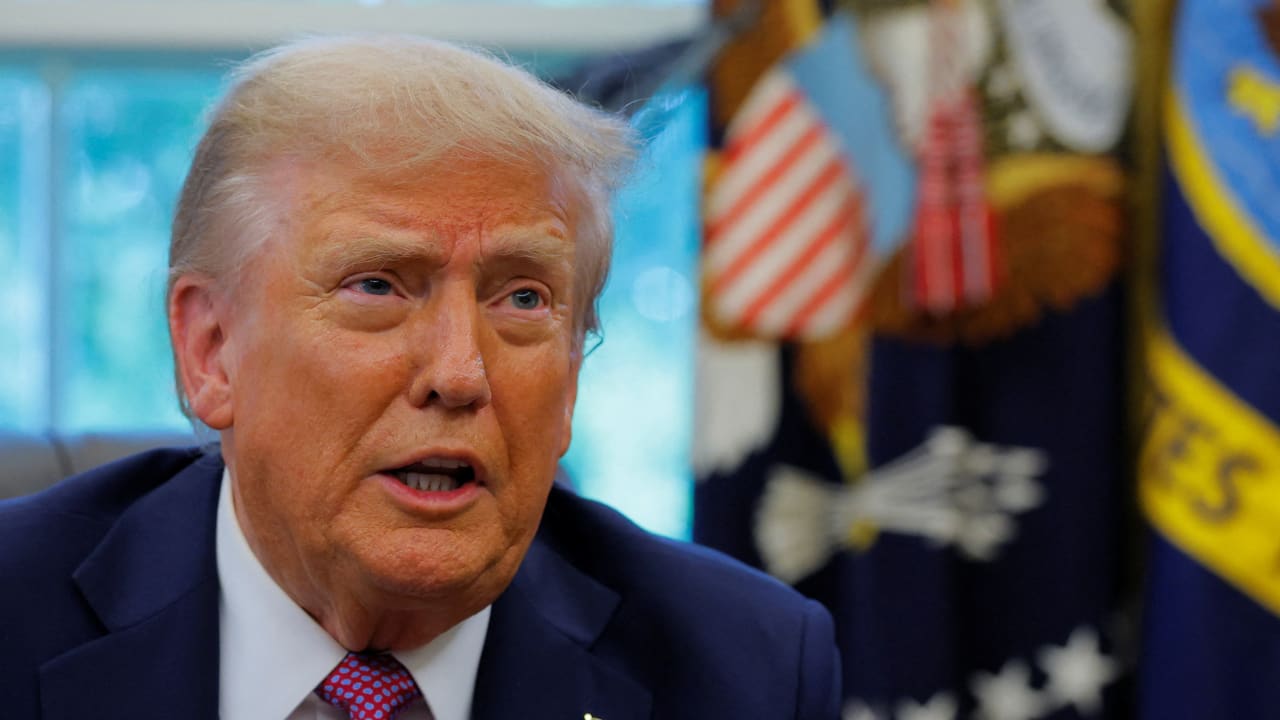
The most consequential political stance and perhaps the most influential statement by any Western leader in recent memory regarding Israel came from US President Donald Trump last Friday in an interview with the Daily Caller, held in the Oval Office.
We are all witnessing what can only be described as the chronicle of a death foretold – borrowing the phrasing from Gabriel García Márquez’s great Colombian novel – unfolding in Gaza, and the world can no longer tolerate the recklessness of Prime Minister Benjamin Netanyahu and the radical figures who flank him in government: Itamar Ben-Gvir and Bezalel Smotrich. These men gorge on the toxic diet of religious fanaticism, garnished with the pungent seasoning of Israeli chauvinistic authoritarianism in its most extreme nationalist form.
Europe and much of the West are firmly opposed to Hamas, Islamic Jihad, the Popular Front for the Liberation of Palestine, and the spectrum of Palestinian extremist groups. Yet opposition to these organizations does not justify starving, killing, and uprooting an entire civilian population. The majority of Gaza’s residents were never aligned with Hamas or Islamic Jihad in recent years; rather, they have been trapped under a de-facto tyranny, much as western Iraq, eastern Syria, and other regions once endured the brutal control of the Islamic State group, al-Nusra Front, or other militias that thrived on violence and excommunication.
Returning to Trump’s “historic” remarks, the president openly declared in last week’s interview that the once-formidable influence of the Israeli lobby in Congress “has diminished over the years,” adding that he is “aware” of Republicans who identify with “America First” and who question the wisdom and utility of unconditional US support for Israel. Trump went further, saying: “If you go back 20 years, I mean, I will tell you, Israel had the strongest lobby in Congress, of any entity, company, institution, or country that I have ever seen. Israel was the strongest. Today, they don’t have a lobby like that. It’s amazing.”
He closed his argument with a warning that sounded more like a command than a suggestion, coming as it did from a man who styles himself as America’s strongman: “They’re going to have to end this war in Gaza.... They may win the war, but they’re not winning the public relations world, you know, and that’s hurting them.... Israel was the most powerful lobby 15 years ago, and now it’s hurting, especially in Congress.”

For Netanyahu and his two incendiary allies, Ben-Gvir and Smotrich, this pronouncement is a dark sign and a grim omen for what lies ahead, not only for their coalition but also for their zealous base. If continued American backing is what they count on to preserve Israel’s exceptionalism – the privilege to act as it pleases, to dismiss international law, and to scorn the most basic human values – then that foundation is now under threat. If Trump, the man who rarely spares Israel his praise, acknowledges that he has never before seen such a steep decline in its standing within America, that admission carries weight.
True, this has not yet been translated into tangible policies, but policy is ultimately the reflection of shifting power dynamics, and among the most decisive of these are public opinion and the moral battle – the battle over image, over narrative, and over which story captures the world’s conscience. This moment is undeniably pivotal, even if its consequences are not immediately visible. – Mishari Al-Dhaidi
Trump’s approach to the future of Gaza
Al-Ittihad, UAE, September 4
The US administration appears to believe it can advance the Gaza issue and impose new security arrangements by recalibrating its political and strategic assessments, whether through an economic vision that invokes the language of a “Riviera project” or by doubling down on a strategy that bolsters the Israeli government and even encourages its military campaign in Gaza City.
Yet there has been no responsible American initiative toward a ceasefire or a return to negotiations. On the contrary, the opposite has unfolded: US envoy Steve Witkoff has shown reluctance to openly engage in stopping the war, despite having his own plan, while the administration has simultaneously announced punitive measures against Palestinian Authority leaders, including the refusal of entry visas to President Mahmoud Abbas and senior officials to attend the UN General Assembly in September.
This session carries weighty symbolism, as it coincides with France’s recognition of the Palestinian state, supported by 10 other European countries – a development that could reverberate across Europe in ways both Israel and the US fear. The joint American-Israeli plan is clear: undermine the Palestinian Authority, delegitimize its standing internationally, and weaken its foundations in the West Bank. This strategy is visible in efforts to encourage the separation of Palestinian villages and cities, to divide the West Bank into fragmented cantons, and in the persistent rhetoric of annexation.
The West Bank, in other words, is not insulated from the same destructive designs currently playing out in Gaza. Security arrangements, too, are slated to be enforced by brute force, with military operations in Gaza City targeting control of up to 80% of its territory. These measures reflect Israeli anxieties about the durability of Palestinian resistance and the political risks of a conflict that could spiral into zero-sum scenarios. In parallel, US backing for these policies threatens to accelerate demographic shifts on the ground and reconstruct legitimacy around local tribal structures, particularly in anticipation of a post-Abbas political reality.
This further confirms Washington’s role in besieging the Palestinian Authority while reinforcing Israel’s political and security agenda. In practice, American institutions appear intent on deepening the advanced model of US-Israeli relations, preparing to offer incentives that encourage Israel to persist with its designs in both the West Bank and Gaza. This trajectory highlights a troubling reality: real discussion of a ceasefire has evaporated, while the prevailing discourse frames Gaza not as a site of mass starvation or genocide but as the unfortunate outcome of Hamas’s actions.
The result is a media and political narrative that reinforces Israel’s right to “self-defense” and dismisses proposals like Witkoff’s in favor of uncritical alignment with Israeli priorities. What follows is a set of constants that cannot be ignored: any American arrangements forged in partnership with Israel are designed to endure so long as the Gaza crisis remains unresolved, even in the event of a full military occupation of the Strip. Israeli plans even envision direct US participation in governing Gaza – potentially through the appointment of an American governor of Palestinian origin and the establishment of a joint administration until power can be transferred elsewhere.
Such an experiment could drag on indefinitely, with Israel retaining ultimate control over internal security and governance. The central problem is that the US administration lacks a coherent and sustainable vision for Gaza or the West Bank. Addressing these issues requires deliberate strategy, long-term planning, and a nuanced understanding of the history of conflict in the Middle East; qualities absent from today’s reactive policymaking. Empty rhetoric and symbolic statements will not alter realities on the ground. What remains constant is that Washington will continue to anchor its policies in support of Israel, providing it every opportunity to entrench its agenda in Gaza, the West Bank, and beyond. – Tarek Fahmy
Israeli school curricula and the cultivation of hatred
Al-Masry Al-Youm, Egypt, September 6
School curricula are among the most powerful instruments for shaping collective consciousness. They do more than transmit information; they help instill values and attitudes that determine how students perceive themselves and others. In Israel, a wealth of studies has shown that textbooks have played a direct role in constructing a negative image of Arabs and Muslims, repeatedly portraying them as eternal enemies and existential threats with whom coexistence is impossible.
This model of education fosters a culture of exclusion from an early age and helps explain recurring assaults not only on Muslims but also on churches, monasteries, and Christian clergy, such as the incidents in Jerusalem and Hebron where monks were spat on, insulted, and attacked by settlers. The outcome is generations raised to normalize hostility and accept occupation as routine practice.
A landmark study, “The Arab Image in Hebrew School Textbooks,” conducted by Daniel Bar-Tal, one of Israel’s leading social psychologists, reviewed 124 history, geography, and language textbooks and found Arabs consistently depicted as primitive, violent, deceitful, and untrustworthy. In her book Palestine in Israeli School Books, Nurit Peled-Elhanan, professor at the Hebrew University of Jerusalem, concludes that Palestinians are reduced to caricatures: miserable refugees, backward peasants, or terrorists, while violence against them is rationalized as essential to the preservation of the Jewish state.
She writes that she found no depictions of Arabs as normal people and insists that this absence is no accident but a deliberate policy reflecting “structural racism.” Textbooks label Arabs as “groups of a savage nation” or describe a caravan as a “bloodthirsty caravan,” while villages are depicted as “nests of murderers.” A recurring metaphor in history books casts Israel as “a small lamb in a sea of 70 wolves,” reinforcing the notion of Arabs as an omnipresent existential danger. The bias is not confined to written text but extends into illustrations and children’s literature.
A study by Adir Cohen, head of the Department of Education at Yezreel Valley College, examined more than 500 children’s books and found that 60% portrayed Arabs as violent, 52% as evil, 37% as liars, 31% as greedy, and 27% as treacherous. Arabs are also likened to animals – ”snakes,” “beasts,” “bloodthirsty” – and are drawn in grotesque, demeaning forms.
Historical and geographical narratives are similarly skewed. The Nakba is presented in history books as an unavoidable event, while the Deir Yassin massacre is described as having helped “evacuate villages,” thereby facilitating the founding of the state. Maps erase Palestine altogether, replacing it with biblical names, prioritizing Jewish settlements, and sidelining Arab villages. Nowhere is this bias more entrenched than in ultra-Orthodox schools, where the curriculum fixates on the Jewish religious self and erases any recognition of the other.
This exclusion is tied to a deeper ideological system rooted in the notion of “God’s chosen people,” which elevates Jews while relegating others – gentiles or goyim – to inferior status. Such thinking is reinforced not only in traditional religious texts but also in controversial contemporary works like The King’s Torah by Rabbi Yitzhak Shapira, which explicitly permits killing non-Jews, including children, if they are perceived as future threats. Despite the uproar, the book was not banned, and its author continues to be treated as a religious authority among certain settler groups.
Similarly, Rabbi Dov Lior, the former rabbi of Kiryat Arba, declared that killing non-Jews is sanctioned by the Torah and defended the Israeli army’s crimes as “land cleansing.” Rabbi Eliyahu Rishi [sic; apparently Rabbi Mordechai Eliyahu, the former Sephardi chief rabbi] described Arabs as “animals” and argued that killing a thousand innocent Arabs is less serious than killing one Jew, while Rabbi Shlomo Aviner claimed that pregnant Palestinian women might give birth to “terrorists” and therefore could be killed. These rulings, shocking as they are, reflect a worldview in which non-Jews are perceived as existential threats who must be eliminated before they can even exist.
This worldview is not confined to the religious fringe; it has seeped into the political establishment, embodied by current government ministers such as Itamar Ben-Gvir, national security minister, and Bezalel Smotrich, finance minister and leader of the Religious Zionist Party, both products of this extremist ideology. Taken together, this evidence shows that Israeli curricula are not mere educational resources, but ideological instruments designed to cultivate fear, enmity, and the normalization of conflict. They cast Arabs, Muslims, and Christians as enemies or inferiors, presenting confrontation as inevitable and reconciliation as impossible.
Schools thus become factories for reproducing a political and cultural discourse of exclusion and justification for continued occupation. And just as Western governments demand that other nations revise their curricula to purge antisemitic tropes, logic and fairness dictate that the same scrutiny be applied to Israeli textbooks, which openly incite hatred not only toward Muslims but toward Christians as well. – Amr Helmy
Translated by Asaf Zilberfarb. All assertions, opinions, facts, and information presented in these articles are the sole responsibility of their respective authors and are not necessarily those of The Media Line, which assumes no responsibility for their content.