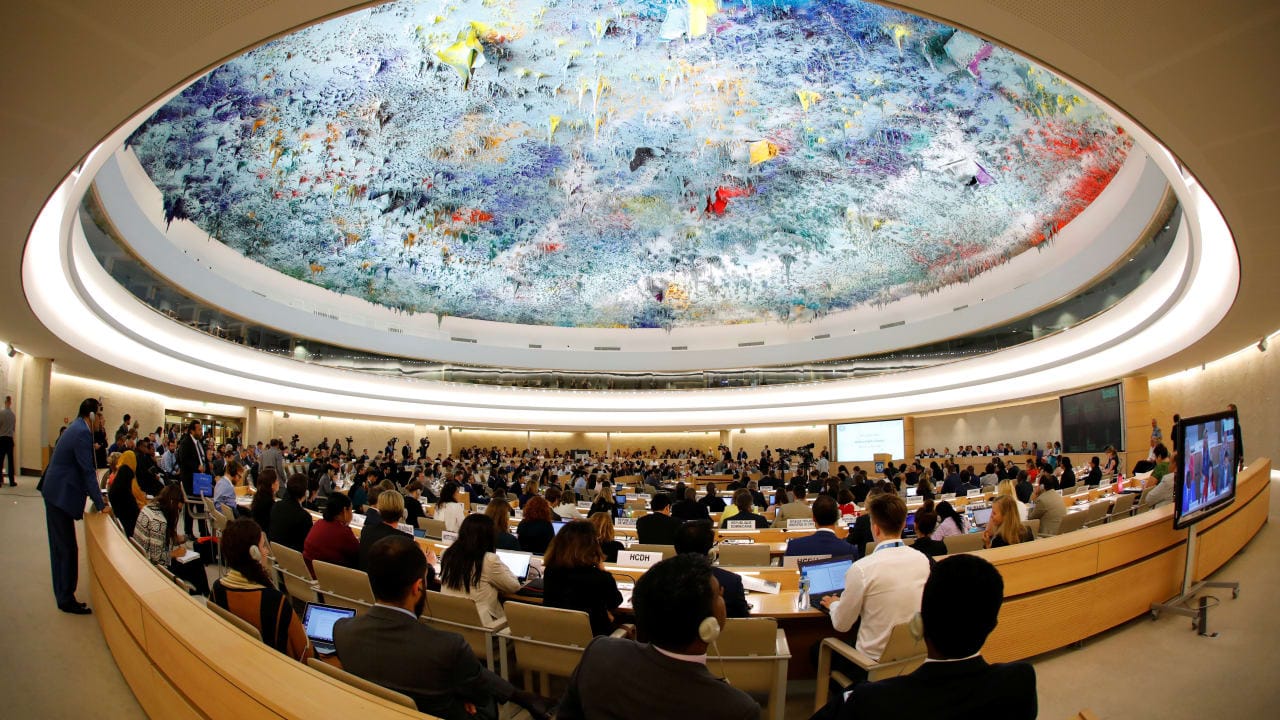
Jewish refugees from 11 Middle Eastern countries lost an estimated $263 billion in assets due to persecution, ethnic cleansing, and violence, researchers explained at a Monday United Nations side event for the opening sessions of the United Nations Human Rights Council (UNHRC).
The reports on 10 Arab polities and Iran, created by Justice for Jews from Arab Countries (JJAC), were presented at the “Seeking Truth, Justice and Reconciliation: Jewish Refugees from the Middle East” panel. The event, a joint initiative with B’nai B’rith International, hopes to promote understanding of the scope of loss endured by Middle Eastern Jews in the largely unaddressed 20th-century refugee crisis.
The report details how systematic state oppression, pogroms, and expulsions depopulated the nearly million Jews of Aden, Algeria, Egypt, Iran, Iraq, Lebanon, Libya, Morocco, Syria, Tunisia, and Yemen down to almost 12,000. The Jewish refugees had their assets forfeited, expropriated, and destroyed, or had to use them to pay ransoms, with the JJAC report scouring 22 archives in six countries over several years to understand the extent of the financial damages.
Yet with no records in some countries and inaccessible archives in others, testimonial data and statistical breakdowns of the socioeconomic status of Jewish families in Egypt, Syria, Iran, and Iraq were used to determine estimated financial damages. The three Arab countries were used as benchmarks to extrapolate estimated financial losses in seven other countries for “illustrative purposes” to demonstrate the degree of loss. While the researchers said that the reports should not be considered definitive, taking into account interest, the financial damages suffered by Middle Eastern Jewish refugees in the 20th century were estimated to be $262,796,251,664 in current US dollars.
JJAC co-president Rabbi Eli Abadie said in a statement on Sunday that “The scale of loss suffered by Jewish communities throughout the region is staggering and has been largely ignored in international discourse on Middle Eastern refugees.”
The Jewish communities of those countries, after enduring centuries-long oppression as second-class citizens under the system of Dhimmitude, as detailed in the report by JJAC, began to gain rights and economic freedoms in the 19th century under Ottoman reforms or Colonial rule. Yet, the trend in these countries was that as Jews began to be identified with colonial powers, violence and pogroms against them intensified, expanding into renewed state oppression and persecution, as fledgling Arab states saw them as paragons of the old orders and a fifth column for the nascent Jewish state.
Egypt has a long history of subjugating the Jewish people
In Egypt, racial and religious citizenship laws were introduced in the 1920s that excluded Jews, the JJAC report explained.
Immediately after World War II, there were riots in several Egyptian cities, resulting in the burning down of a synagogue, hospital, and retirement home. Ten Jews were murdered in the Balfour Declaration anniversary riots, and another 350 people were wounded.
In 1949, the assets of Jews were foreclosed. The 1950s saw further riots destroying property and the stripping of Jews of their passports, said the report, and in the 1960s, they were denied their ownership of financial and commercial institutions without receiving compensation. As a result, it is estimated that there are a little more than three Jews in Egypt today, the remnant of the 75,000-strong 1948 community.
Cairo-born historian Levana Zamir, who immigrated to Israel after her family was deported, is set to give testimony of her experience to the UNHRC.
“Officers who came to search our house in the middle of the night found nothing, but they vandalized some of our property. The next day, the head nun at my school was waiting for me at the entrance and told me that they had taken my uncle, who lived right above us,” Zamir said.
“Not long after, tensions increased, and people who had been close to us preferred to keep their distance. One night, my father was informed that he could meet his brother on a boat, and so we found ourselves on our way to a refugee camp in France, deported and humiliated.”
Iraq's history of cruelty against Jewish people
Iraq serves as one of the bloodiest examples of the persecution of Middle Eastern Jews. The 1941 Farhud pogrom by pro-Nazi forces saw Jews murdered and raped, and their belongings looted.
In the 1950s, Jewish assets were frozen, and those who wished to leave the country had to forfeit their citizenship. By 2025, the Iraqi Jewish population had dwindled from 135,000 to an estimated five.
In one of the most ancient Jewish communities in the Middle East, Jews were subject in the early 1900s to severe dhimmitude that included the forcible conversion of orphaned Jewish children.
The report recalled that Yemeni Jews were targeted in anti-Zionist riots in the 1947 Aden Pogrom, which killed dozens and destroyed Jewish properties. By 1950, only a few hundred Jews remained in Aden, with an additional 3,500 in Yemen. The JJAC estimated that today there is only one Jew in Yemen.
JJAC co-president Sylvain Abitbol said that in a period of historic reconciliation, it was time to face what happened to Middle Eastern Jews with honesty.
“Only through truth, justice, and mutual recognition can the peoples of the region move toward a future of dignity and lasting peace,” Abitbol said in a Sunday statement.