

On March 24, Dr. Saeed Shamaghdari, a professor at Iran’s Science and Industry University, was killed alongside two of his children in a strike on his home in northern Tehran.
He was not a nuclear scientist. He was not a weapons designer in any publicly documented sense. He was an engineer at a university – the same kind of engineer the Islamic Republic spent decades recruiting, grooming, and instrumentalizing in the name of what it called the “jihad of knowledge.” Local officials referred to him as one who sacrificed his life for the “indigenization of the missile industry.”
State doctrine
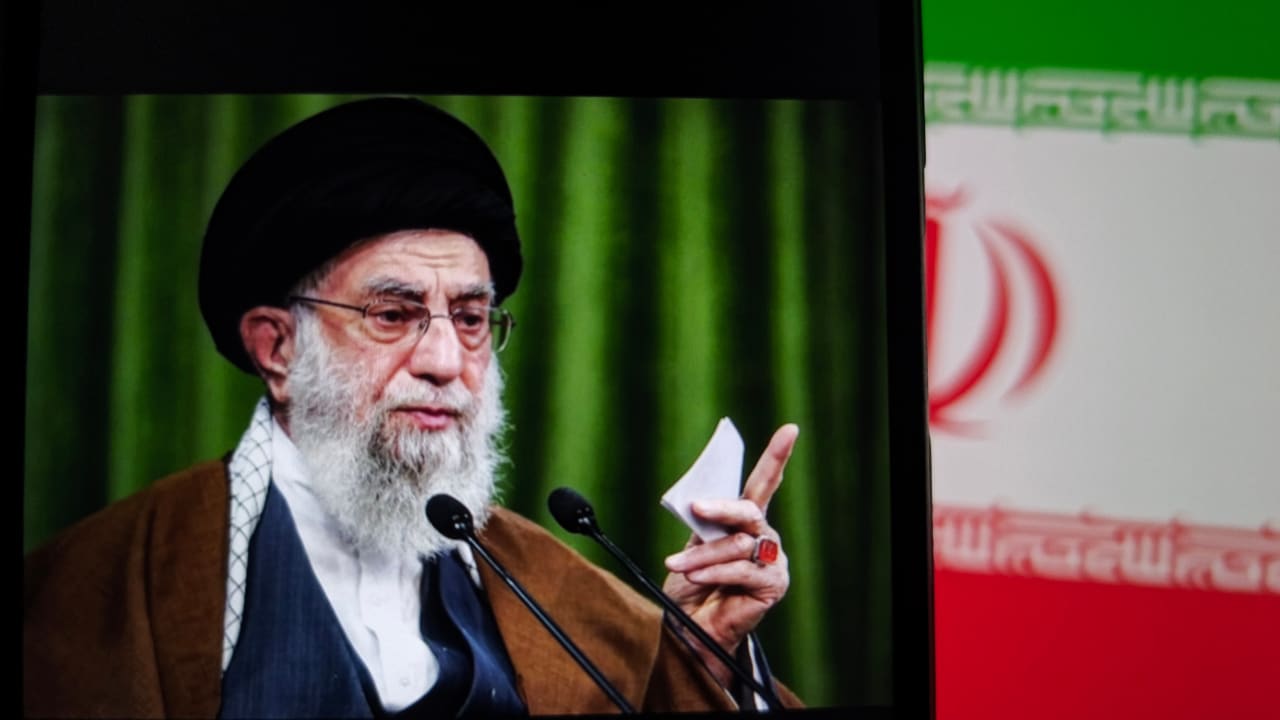
The jihad of knowledge is a state doctrine, introduced by the late Supreme Leader Ayatollah Ali Khamenei, who was assassinated by Israel and the US in the opening strike of the current war.
For more than a decade, the phrase was among the most frequently used terms in Khamenei’s speeches, when he addressed various audiences. He saw the knowledge-based sector as the key element of the Islamic Republic’s resistance.
Khamenei’s vision, translated into state policies, made knowledge production an ambitious strategy aimed at serving the state and projecting power – domestically and internationally.
The sectors this doctrine concentrated on were not medicine, education, or food and water security – all of which are extremely critical for the country’s future.
Instead, the largest categories of knowledge-based companies in Iran, which over the past decades received generous government support, are in electronic hardware, software development, machinery, and equipment, all of which are used in the state’s cyber, nuclear, aerospace, drone, and missile programs. This science was developed inside a system that demanded ideological loyalty as the price of admission.
Purge and produce
The Islamic Republic’s jihad of knowledge has framed the state’s focus on developing forms of knowledge that can safeguard the longevity of the Islamic Revolutionary government at home and abroad.
It has been complemented by a systematic purification of the higher education system that involves heavy-handed purges of university staff and students for lack of ideological and political loyalty, and the revision of curricula across all disciplines to ensure compliance with state ideology.
The Islamic Republic did not simply use universities. It redesigned them. Professors who spoke out faced interrogation and prosecution. The state drew a sharp distinction not between the competent and the incompetent, but between what it saw as the “useful loyalist” and the “threat.” Those who served the state were allowed to stay. Those who refused, or questioned, or simply thought freely, were silenced, removed, or prosecuted.
Millions of Iran’s engineers, physicists, and mathematicians scattered across the world, building futures from exile, mourning a country that expelled them for thinking. Those who remained silent purchased security, and ideological compliance purchased prestige and money.

Legitimate targets
Iran’s Science Ministry has reported that at least 21 universities have been damaged in strikes since the war began. Among them are Iran University of Science and Technology, an engineering-focused institution founded in 1929 as the country’s first dedicated to training engineers; Shahid Beheshti University; and Sharif University.
These institutions were where the jihad of knowledge took its most concrete form. Researchers in these institutions worked on state-funded projects that required circumventing sanctions, reverse engineering, and covert collaboration with Western academic institutions.
Their output was not measured by the number of citations and articles published in peer-reviewed journals, but by their dedication in advancing missile guidance systems, drone fleets, nuclear centrifuges, and cyber espionage operations.
These institutions now lie in rubble. The very organizations that worked hard to protect the state, and advance its power aspirations, are now considered legitimate military targets. They were parts of a machine that was built to protect the regime, but could not protect the people who served it.
Caught between violence
This is the final accounting of the jihad of knowledge: a system that weaponized science could not protect its scientists.
The regime inherited most of these universities from the Shah era. These institutions were built before the Islamic Revolution under a modernization program that aspired to advance science and education.
The Islamic Republic conscripted them into a state project that is not designed to serve Iran, but rather the revolution’s survival and its own capacity to project power.
It is precisely that conscription that turned them into targets. These universities were purged, the scientists were instrumentalized, and the knowledge they produced was weaponized. Their underlying ideology was enough to protect them.
The ultimate losers of this jihad of knowledge are the Iranian people. Expelled by the millions for thinking freely, surveilled and suppressed by the technologies the Islamic Republic’s loyal scientists were conscripted to build, the Iranian people are now watching the oldest institutions of their country’s intellectual life reduced to rubble in a war their government’s choices made inevitable.
A state that made knowledge the servant of power has left its people without the one thing knowledge was supposed to build: a future worth living in.
Sara Bazoobandi is a member of MENA2050 and a non-resident researcher at the Institute for Security Politics and Kiel University, Germany.