
Last year, Eretz Nehederet – Israel’s version of Saturday Night Live – aired a sketch about an Israeli couple vacationing in Prague. Nervous about being recognized as Israeli, the wife urges her husband to lie about their nationality: “Jacob, we’re from Malta,” she hisses as they enter a restaurant. But unbeknownst to her, the Czechs apparently hate the Maltese. The diners form an angry mob, a diplomatic incident erupts, and the couple realize they would have been better off just saying they were from Israel.
Israelis concealing their identity abroad is not a new phenomenon, but in the aftermath of Hamas’s October 7 attack two years ago, the stakes have shifted dramatically.
Global condemnation of Israel’s military campaign surged, and as the war dragged on and the humanitarian crisis in Gaza deepened, anti-Israel sentiment reached a fever pitch.
Israelis traveling overseas increasingly found themselves on the frontlines of that hostility, with reports of harassment, canceled bookings, and even physical confrontations becoming near-daily occurrences.
The experience of “traveling while Israeli” now begins long before the boarding pass is scanned, with safety assessments, internal debates, and contingency plans.
Which countries feel safe? Major cities or quiet towns? Speak Hebrew or stick to English? Travel on the Israeli passport or the other one? What do we tell the kids – and what do we tell strangers?

The Jerusalem Report spoke with dozens of Israelis about recent experiences abroad: vacations, family visits, business travel, and the like. Some went solo, others with partners, children, extended family, or tour groups.
While many described smooth, uneventful journeys, others recalled a wide range of encounters: from warm welcomes and curious questions to canceled Airbnbs, tense taxi rides, and, in one alarming case, a woman reported being attacked in Greece by men who tore off her chai necklace and pulled her hair in front of her children.
Some travelers we spoke to refused to hide who they are. As one man who flies regularly for work put it, “I am Israeli and have absolutely nothing to apologize for.”
But many described at least a moment, if not several, of hesitation.
Concerns ranged from practical – accents, passports, language – to the deeply personal, touching on issues of identity, politics, and personal conviction. Some felt a duty to present a different narrative; others simply wanted to avoid conflict. Several reflected on fear itself: how they carry it, and what surrendering to it would mean.
“If their intention was to keep me away,” one woman said, “I wasn’t willing to give them that satisfaction.”
In this climate of pre-travel anxiety, the Eretz Nehederet sketch has become a part of the national conversation. “Jacob, we’re from Malta” is used as shorthand not just for the absurdity of hiding one’s nationality but also for the quiet script many Israelis now rehearse before going abroad.
The following are three snapshots of Israelis who traveled in the past year, each navigating that script in their own way.
Passengers: Sarah Cytryn and Gabi Mitchell
- Destination: Crete, Greece
- Date of travel: August 2025
- Passports: Israeli and American
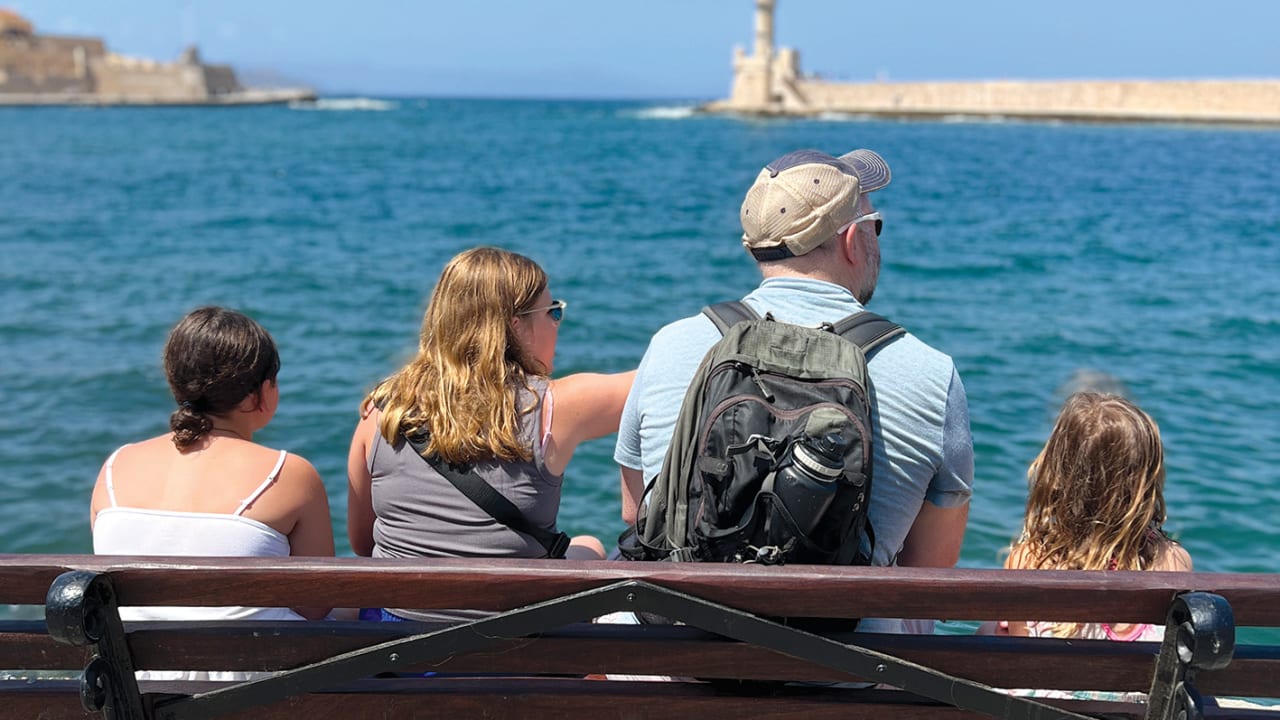
- Travel companions: their three daughters and Mitchell’s mother
For Sarah Cytryn and Gabi Mitchell, the last two years, which included six months of reserve duty for Mitchell at the start of the war, had taken a heavy toll.
“I don’t care where or how or when, but we need to go away as a family,” Mitchell told his wife. “We need to breathe. I need to breathe.”
They booked a week in Crete for the end of the summer.
As the trip approached, Cytryn, who works in tourism, grew increasingly anxious. Stories of Israelis being harassed abroad, especially in Greece, were everywhere.
“I was literally shaking,” she recalled. “I wanted to cancel. I was crying myself to sleep.”
But Mitchell, a policy analyst and seasoned business traveler, wasn’t worried.
“These kinds of incidents happen randomly,” he reasoned. “You’re either in the wrong place at the wrong time or you’re not. You can’t cancel your plans over something you don’t have much control over.”
“Did it help me that he wasn’t scared?” Cytryn said. “No. I hated him for it.”

If Mitchell found comfort in the randomness, for Cytryn it only fueled her anxiety. “It’s what makes us such a good team,” Mitchell joked.
With so much beyond her control, Cytryn focused on what she could shape.
“I wanted to plan out exactly what would happen. We’ll go to this restaurant, we’ll tell them this story. We’ll say we are from New York. I told the kids not to speak Hebrew and made sure not to pack anything with Hebrew writing or Jewish symbols.”
Their eldest wasn’t thrilled with the new directives. “Why do we have to lie?” she wanted to know. “If the world hates us this much, why are we even going?”
“I didn’t really have good answers for her,” Cytryn admitted.
Once in Crete, her fear began to subside. The Airbnb host was kind, locals were warm and welcoming, and even the careful plans to conceal their identity began to fade.
“The girls were saying ‘New York’ like we practiced, and I would slip and say ‘Israel,’” she said. “And it was totally fine.”
Only in the city of Chania did they encounter hostility – in the form of anti-Israel graffiti and stickers lining the streets.
“It’s funny because I actually agree with a lot of the criticism,” Cytryn reflected. “But seeing all of the graffiti everywhere felt like this blanket hatred of all Israelis. It made me feel so uncomfortable and sad.”
Mitchell was also disturbed, not just by the volume of the anti-Israel material but by how much of it was in Hebrew, some of it aimed directly at soldiers. What bothered him most wasn’t the content, though.
“It just looks really ugly,” he said. “Where’s the mayor of Chania to say, ‘We don’t want this. This isn’t reflective of our politics or our policies. And it’s bad for business.’”
While the graffiti went unnoticed by their younger daughters, the eldest saw it but didn’t fully understand the messaging.
“She wanted to know why there was a picture of Bibi in the middle of this Greek town,” Cytryn said.
“That’s something we’ll really need to think about going forward,” Mitchell said. “As they get older, we’ll need to figure out how to have these conversations in a healthy way.”
On this, the couple are aligned. “We don’t want them to take it personally. And we don’t want them to feel like the whole world hates them,” Cytryn added. “But we also want them to understand what’s happening outside their little bubble.”
Passenger: Gemma Morgan
- Destinations: Melbourne, Australia, and Sinai, Egypt
- Dates of travel: July 2024 and October 2025
- Passports: Israeli and Australian
- Travel companions: ex-partner and two children in Australia; a friend in Egypt
Of the two trips Gemma Morgan took recently, only one was to a country under Israel’s highest terror alert. And it was not the one she was worried about.
“I was more scared to go to Australia than Egypt,” she said. “From my parents and their community, I knew that Australian Jews had really been affected by the anti-Israel protests there and also experienced very real acts of violence. People are naturally feeling sadness and anger and, of course, fear.”
It’s her perspective on that last emotion that shaped the discussions Morgan said she “had with herself” before she left for the month-long trip.
“I have somewhat of a unique relationship to fear,” she explained. “I don’t see it as something negative or dangerous, just something to be curious about.”

She described visualizing different scenarios that might unfold.
“I actually pictured us on public transportation. Would we speak Hebrew? Would someone yell at us? What would happen if we were in danger?”
Trust in her ex-partner and a shared commitment to engaging peacefully helped Morgan release her fears before boarding the plane.
“By and large, we didn’t encounter any sort of real danger or threats, but I also think so much of this is about how you decide to handle it,” she said. “It would have been easy to perceive certain comments as attacks and get defensive. But I had worked through so much of that before I went that I was able to just move on.”
Despite the official travel warning, her four-day trip to Sinai this fall didn’t require the same level of preparation.
“It was absolutely amazing. Peaceful and restorative,” Morgan said.
Sinai’s tourism industry, reliant on Israeli visitors, has been hit hard since the government raised its threat level two years ago, but many, including Morgan’s travel partner, have continued to go there.
“My friend wasn’t worried about it, so neither was I,” she said.
While she’s always aware of the risks of traveling as a woman in an Arab country, Morgan said being Israeli wasn’t one of them.
“Actually, the opposite is true. You can feel how much they want us there,” Morgan said. “They try to speak Hebrew, they ask about life in Israel. One of the employees even sang songs with us.”
Passenger: Hila Parnes Raz
- Destination: Dolomites, Italy
- Date of travel: July 2025
- Passport: Israeli
- Travel companions: a friend
“We didn’t really have a game plan before we left,” said Hila Parnes Raz of the week she spent trekking through the Dolomites with a friend. “Italy wasn’t as bad as it’s gotten now, but neither of us is really the type to worry, anyway.”
Nevertheless, on their first day, when a shop owner asked where they were from, both instinctively answered “Greece.” The lie immediately felt absurd.
“We have Israeli accents,” Parnes Raz laughed. “And anyway, he was perfectly nice – as were most people we met. It just felt silly.“

Having decided to be honest, she was pleasantly surprised by the reactions.
“Plenty of people weren’t really all that interested,” she recalled. “I met one woman who didn’t even know where Israel was. But we also talked to people who knew a lot and were very open to what we had to say.”
Parnes Raz said she found herself explaining how much dissent there was in Israel, “that we take to the streets every weekend, rallying for the hostages and protesting against our government.”
It was a role she embraced. “At the end of the day, I love Israel and I love being Israeli. And if I get the opportunity to change even one person’s perception, to show them that there are people who are vehemently opposed to what is happening, that makes me happy.”
Other than one moment that was “more bizarre than scary” – a man waving a giant Palestinian flag as he walked past them on a quiet street – the trip went smoothly.
The only real source of anxiety, Parnes Raz said, was handing over her Israeli passport at the hotel.
“It’s definitely something I think about,” she said. “I don’t have the option to enter as another nationality, and that definitely affects where I’m willing to travel.”
Still, the journey offered a welcome respite from an exhausting period of grief, fear, and protest back home.
“Of course it’s annoying to have to take into consideration what it means to travel as an Israeli,” Parnes Raz admitted. “But it’s worth it. Traveling is a breath of fresh air, an opportunity to disconnect from everything we’ve experienced over the past two years.”■