

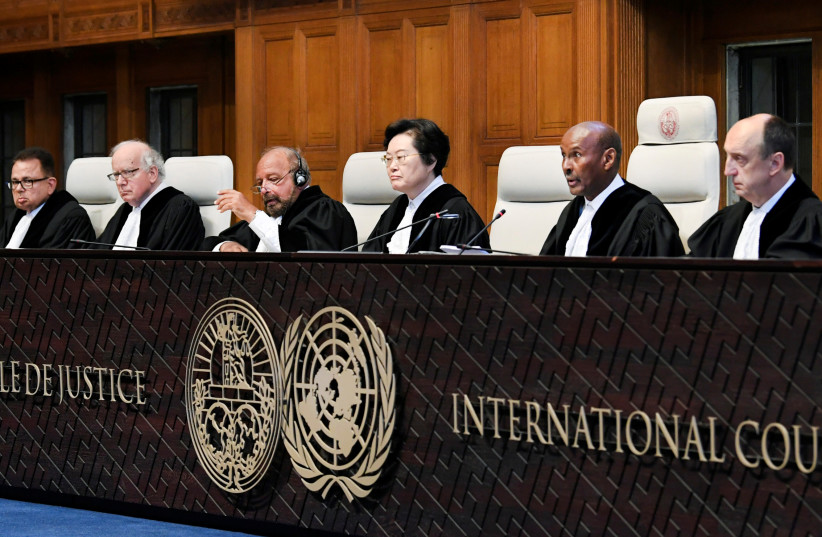
On a hazy summer morning in The Hague, on July 19, 2024, the halls of the International Court of Justice (ICJ) were filled with tension, as the court was ready to present its advisory opinion on the legality of the policies and practices of Israel in territories it maintains under military control.
The proceedings continued decades of international legal discourse around the intractable Israeli-Palestinian conflict but ultimately boiled down to a discussion on one of the most sensitive issues in Israel: the legality of settlements.
The ICJ adopted the view that the Israeli presence in the West Bank – and east Jerusalem – is unlawful and that Israel is obligated to bring the occupation of the territory to an end.
While advisory opinions of the court are not binding, they can make an impact in reality.
Two decades ago, the ICJ dealt with the legality of the construction of the security barrier being built in the West Bank; its view on this endeavor fueled anti-Israeli campaigns and attempts to promote boycotts and sanctions. This time around, the mandate of the court was bolder; it looked at the overall legality of Israel’s military control, and its significance increased as it was adopted during the Israel-Hamas War.

Unclear status
Israel captured the West Bank, east Jerusalem, Gaza, the Sinai Peninsula, and the Golan Heights during the 1967 Six Day War. Sinai was returned to Egypt as part of the 1979 peace treaty, the Golan Heights was formally annexed in 1981, and Israel unilaterally removed all its presence in Gaza in 2005.
The status of the West Bank is less clear, and Israel’s sovereignty over east Jerusalem was never fully recognized internationally. As such, the ICJ ruled that Israeli communities established there are illegal.
First, the ICJ found that Israel’s actions indicate a desire for annexation rather than a temporary administration, in violation of the prohibition on conquest in the UN Charter.
Second, the ICJ asserted that the settlements infringe on the Palestinians’ right to self-determination.
Third, the court referred to Article 49(6) of the Fourth Geneva Convention, which bars the transfer of the civilian population in an occupied territory. Given that, the court found that Israeli control is an illegal measure that must cease, and that the international community should avoid helping Israel in maintaining the occupation.
Israel’s arguments
While Israel chose not to present its opinion before the ICJ – and the outcome indeed disregarded the Israeli perspective – traditionally, Israel has claimed that the seizure of the territories from Jordan in 1967 did not displace a recognized sovereign, since Jordan’s annexation of the territory after 1948 was accepted by just a handful of states.
Secondly, Israel claims that this article of the Geneva Convention was never intended to forbid voluntary civilian settlement, like that of Israeli nationals who choose to live in the West Bank and east Jerusalem. Instead, Israel argues that it was aimed at preventing forced deportations – an interpretation rejected by international bodies, who view the settlements as a governmental project rather than a voluntary one.
A third claim by Israel is that the Oslo Accords left the fate of the territories unresolved, to be decided by negotiation.
Finally, Israel claims that the West Bank is the cradle of Jewish civilization; hence, to declare Jewish presence in these places as illegal is to erase a history stretching back millennia. Indeed, the Knesset’s Constitution, Law and Justice Committee approved a bill proposing that any legislation relating to the area will use the term “Judea and Samaria” rather than “the West Bank,” since doing so “expresses the legislator’s recognition of the Jewish people’s historical right to its land.”
A UN resolution
Naturally, once Israel decided not to take part in the ICJ proceedings, all these claims were moot. The international community embraced the perspective suggested by the ICJ, and the United Nations General Assembly adopted Resolution ES-10/24 on September 18, 2024, “welcoming” the opinion, by a majority of 124 states.
The UN resolution holds the view that Israeli settlements are designed to lead to the annexation of east Jerusalem and large parts of the West Bank, contrary to the prohibition of non-acquisition of territory by force. It also states that Israel has an obligation to bring an end to its military and civilian presence.
In addition, the resolution affirmed the Palestinians’ right to self-determination while rejecting claims for entitlement to Israeli sovereignty over these territories.
Shadow of illegality
In a practical sense, the ICJ view could influence future diplomatic or legal decisions by countries relating to Israel – and the settlements – during one of the most turbulent periods the Jewish state has experienced since its establishment.
Governments will use it as a rhetorical tool to justify measures against Israel, while the private sector will consider it as part of their risk assessments before investing in or cooperating with Israeli companies. Civil society groups, too, will use it in their slogans to mobilize people and promote boycotts, divestments, and protests.
The Israeli government and public are no strangers to criticism. Since October 7, 2023, we have witnessed what one can call a perfect storm of ICJ proceedings initiated by South Africa. The International Criminal Court (ICC) investigations have led to the issuing of arrest warrants against Israeli officials; legal and diplomatic attempts to limit military exports to Israel; and attempts to prosecute Israeli soldiers based on universal jurisdiction.
There have also been calls to boycott Israel in international forums such as the Eurovision Song Contest, and mass protests have shaken the streets of capitals around the world.
Some initiatives are fueled by antisemitism – and international bodies warrant criticism for their selective treatment toward Israel – but we cannot overlook the fact that this trend has the potential to impact Israel’s diplomatic relations, its security, and its economy.
Quite tragically, Israel began a war of self-defense after October 7, and the most atrocious terrorist attack it suffered in its history, but soon found itself facing criticism and legal actions that threaten to tarnish its international standing.
Future of the settlements
So, what does the future hold for the settlements? The Israeli government is not staying passive, and it seems that the international pressure is only motivating it to further anchor its hold over the West Bank.
Practically, there is more investment and support for Israeli settlements, and there are increasing indications of the possibility of official annexation of parts of the West Bank.
In addition, Israel has doubled down on bilateral diplomacy, with a focus on the United States, as well as India, Greece, and some states in Eastern Europe and Asia.
However, if it wants to avoid further pressure on its economy or possible legal threats, Israel must continue to take part in the battle of narratives and try to show a more nuanced story than the one portrayed by international bodies.
Israel cannot erase the ICJ’s advisory opinion, but it will need to deal with its effects, contest its message, and pave the way for a future that allows Israel’s economy and society to continue blossoming, further promoting its goodwill and ingenuity. ■
Tal Mimran teaches law & technology at the Hebrew University, serves as a faculty member at Zefat Academic College, and as a senior research fellow at Tachlith Institute. He consults for policymakers, tech companies, and UN agencies on international law and the intersection between law and technology.