
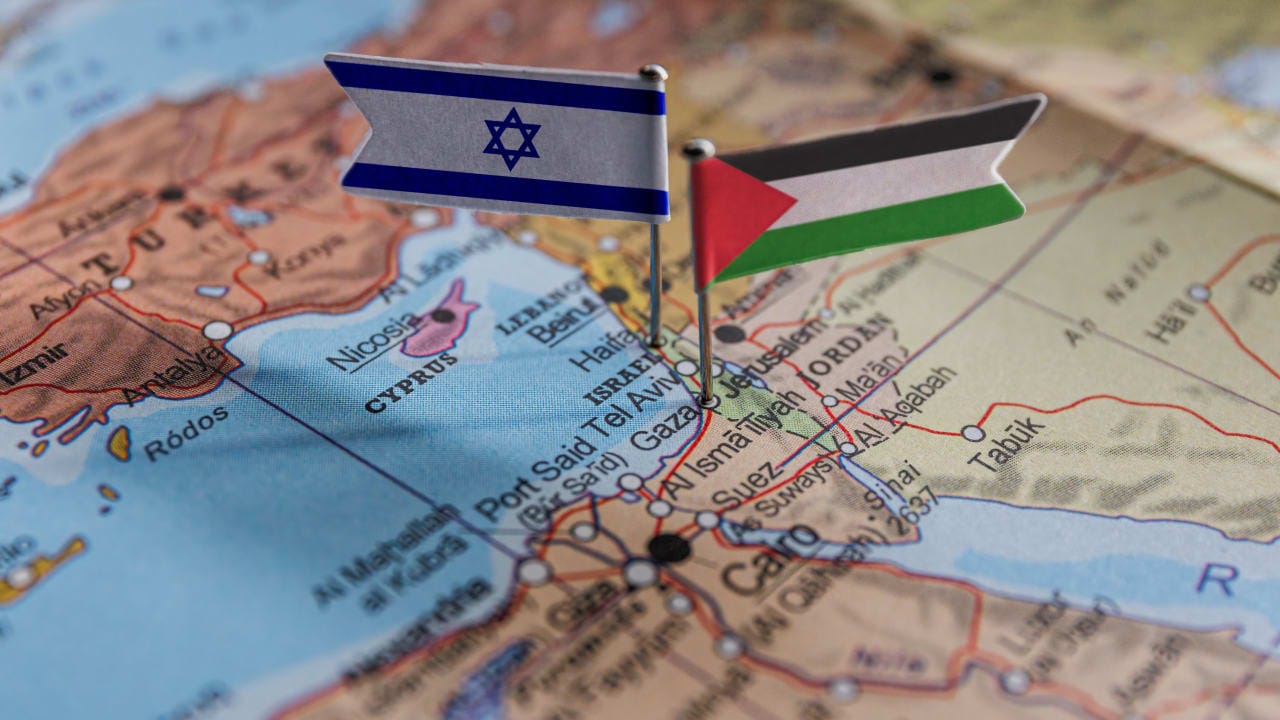
Discussion of a “one-state solution” to the Israeli-Palestinian conflict has returned with the publication of a new book co-authored by Robert Malley, a former Middle East adviser to Democratic US presidents; and Hussein Agha, a Palestinian peace negotiator.
Malley and Agha are the latest in a long line of critics of Israel, arguing that the goal of creating two states – Israel and Palestine – which has underpinned international peace efforts since the signing of the Oslo Accords in 1993, is no longer achievable due to Israeli settlement policy.
“The era of the peace process, of the two-state solution, has vanished,” they declare in Tomorrow Is Yesterday: Life, Death, and the Pursuit of Peace in Israel/Palestine.
Impossible to separate
Polls suggest that around 22% of Palestinians but less than 10% of Israeli Jews favor the idea of bringing Israelis and Palestinians together in a single state. But support for such an outcome is not confined to Israel’s critics. Prominent Israeli voices, on both the Right and the Left of the political spectrum, are in favor – but with vastly different aspirations for what such a unified country would look like.
“The lives of both national communities are so interwoven that it looks almost impossible to dissect the two of them anymore,” Avraham Burg, a former Labor speaker of the Knesset, told The Jerusalem Report.

“The real deliberation today in Israel is not between one state and two states; it’s a deliberation and polemic about what kind of one state it will be,” continued Burg, who now combines political activism with writing and university teaching around the world.
He argues that ensuring full equality, human rights, and civic freedoms for all those living “between the river and the sea” in a single state or a close confederation of national communities, similar to the US or even the UK, is also the best way to provide long-term peace and security for both Israelis and Palestinians.
Not viable
Others dismiss the idea as impractical and failing to address the national identity of either side.
“The idea of a binational Israeli-Palestinian state will not work in the Middle East. It is a region where there are no democratic traditions,” said David Makovsky, a former executive editor of The Jerusalem Post, who is now director of the Koret Project on Arab-Israel Relations at the Washington Institute. “Is the story of Iraq, Syria, Lebanon, and Libya what we should be prescribing for the future of Israelis and Palestinians?”
Prominent right-wing Israeli voices also endorse the idea of a one-state solution – but with strict limits on the rights of Palestinians.
“Israel must assume full sovereignty over its biblical homeland to secure peace, prosperity, and dignity for all its inhabitants,” One Jewish State asserts on its website. The nonprofit organization, which advances the case for Israeli sovereignty over Judea and Samaria, was created by David Friedman, President Donald Trump’s first US ambassador to Israel.
“Palestinians in the region would be granted permanent residency status in the State of Israel, along with Israeli travel documents, enabling them to live and move freely within Israel and abroad,” Friedman said. “However, they would not have the right to vote in Israeli national elections, similar to the status of Puerto Rico’s residents in the United States.”
Israeli Finance Minister Bezalel Smotrich has long proposed annexing the West Bank without granting citizenship or voting rights to the Palestinian residents. As the war in Gaza has dragged on, Smotrich has become a leading advocate of the annexation of the embattled Gaza Strip and the relocation of its Palestinian residents.
“If we must choose between democratic and Jewish, I have no doubt what I would choose,” Smotrich said in 2015. “There are models of democracy in the world that do not grant citizenship.”
In September, responding to the imminent recognition of the state of Palestine by France, the UK, and other democratic countries, Smotrich and Yesha Council head Israel Ganz called for Israel to immediately annex and apply sovereignty to 82% of the West Bank to forestall a two-state solution.
“We can never allow an existential threat to establish itself among us, and after decades of hesitation it is time to state this clearly and act accordingly,” Smotrich and Ganz said.
Historical solution
The idea of a single, democratic state that would unite Jews and Arabs in the Holy Land was first proposed in the 1920s by the Brit Shalom movement led by Judah Magnes and Martin Buber. However, it was rejected by both Zionists and Palestinians because it failed to recognize their respective national aspirations.
The notion was revived by the Palestine National Council, the decision-making body of the Palestine Liberation Organization (PLO), which in 1971 endorsed the aim of creating a “secular democratic state” in what had become Israel, the West Bank, and Gaza. But PLO policy developed instead toward endorsing a Palestinian state in the West Bank and Gaza alongside Israel.
In 1999, when Prime Minister Benjamin Netanyahu’s first government collapsed following the failure of the Wye peace talks, Edward Said, a Columbia professor and Palestinian National Council member, who had long queried the two-state strategy, pronounced it dead.
“It is time to question whether the entire process begun in Oslo in 1993 is the right instrument for bringing peace between Palestinians and Israelis,” Said wrote in a notable New York Times essay. “It is my view that the peace process has, in fact, put off the real reconciliation that must occur if the hundred-year war between Zionism and the Palestinian people is to end. Oslo set the stage for separation, but real peace can come only with a binational Israeli-Palestinian state.”
Two states
While a flurry of books and essays continues to endorse Said’s arguments, many prominent peace advocates, both Israeli and Palestinian, view two states as the only option.
“I believe there is no solution but the two-state solution. None. A Palestinian state within the 1967 borders alongside Israel,” Knesset member Ayman Odeh, leader of Hadash, told online +972 Magazine in 2021.
“According to all polls, from 2000 to the present day, about 50% of the population supports two states, and everyone knows roughly what the borders are. That’s the right thing, not getting ahead of ourselves to one state,” he said.
In February 2025, Gershon Baskin, a prominent left-wing Israeli activist who has been actively using his contacts with Hamas to secure a hostage deal, created an Alliance for Two States with Palestinian activist Samer Sinijlawi, despite the ongoing war in Gaza and rocket attacks from Yemen and Iran.
“Recognition of Palestine is not a reward to Hamas terror and crimes; it is, in fact, a gift to Israel because it sets the path clearly forward for how to end this conflict,” Baskin said.
In the quest for peace, something needs to change, Burg told The Report.
“American Jews do not have bombs, do not have an air force, do not even have Prime Minister Netanyahu, and they are better protected than the Israelis,” Burg said. “Israel, which was established to protect the lives of the Jews, is the most dangerous place in the world for them. So something isn’t working. We need to replace the operating system.”■