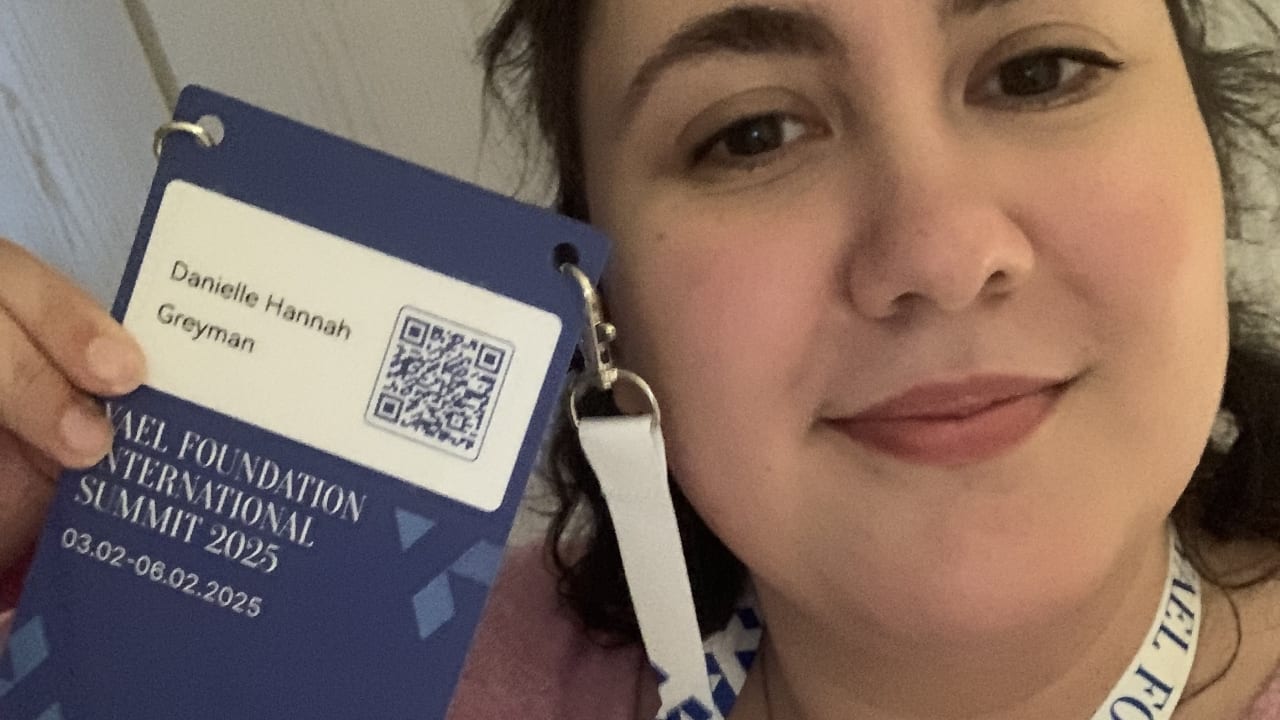
Danielle Greyman-Kennard, or Chava as she is known to her friends and co-workers, has had one incredible story.
As a student at the University of Leeds, she was working to finish her bachelor’s degree in sociology. In doing so, she wrote a paper on Hamas’s crimes against Palestinians and the UN’s alleged complicity.
But her lecturer gave her a failing mark because she didn’t write about any of Israel’s own alleged crimes, with feedback that was distinctly prejudiced against the Jewish state.
That incident, publicized in several publications including The Jerusalem Post, began Chava’s legal battle against the university and instilled within her a passion to prove her haters wrong.
Having worked at the Post for several years now, Chava is known for her determination and fearlessness to stand up for what’s right – something that has served her well in journalism. As one of our most experienced members on the Breaking News Desk, she is one of the most well-rounded writers we have, capable of churning out articles on just about any topic one can imagine.
That versatility has led to her being assigned to be the head of our OMG (Oh My God!) desk, where we write about the most outlandish and absurd stories that happen in the news.
Indeed, Chava has managed to do exactly that. Whether it’s Middle East affairs, femicide rates, or domesticating raccoons, she hasn’t just proven that she can write about any one thing – she can write about everything.
But there is another side to her, too. The side that takes care of rescue animals and volunteers at cat shelters. Indeed, for anyone who knows her long enough, one cannot think of Chava without also thinking of her beloved and oft-dramatic animal companions.
In Jerusalem sat down with her to talk about her life and work.
What brought you to Israel? What challenges have you faced since making aliyah?
I think I had the messiest aliyah possible. I am a textbook example of what not to do.
I came to Israel on a volunteer program after facing some traumatic instances of antisemitism that shook my trust in institutions. I arrived in the middle of the night with two bags and did some awful program that was so problematic that all but two people in my city left early.
I didn’t know anyone in the country and built a support system from scratch. I eventually found my legs, and this past year I have been thriving. Without proper planning or research, I definitely suffered at the beginning by living in neighborhoods which didn’t suit my needs – places with poor public transportation, without ulpan or proper olim services and cities without many English speakers. Now I’m living in Ramat Gan, and life has been a thousand times better.
What do you miss the most about life outside Israel?
I miss the food in England. It’s not that England is known for good food, but I lived in very cosmopolitan cities. I miss Korean BBQ, accessible Chinese food, and monster munch crisps.
I miss my family too, though I’m hopeful they’ll make aliyah in the coming years when they accept that Britain is lost.
What made you want to live in some of the smaller cities in the country rather than Tel Aviv or Jerusalem?
I wish I had a good reason. I was without roots, had done zero research, and trusted another person to make decisions for both of us – which was a stupid mistake I can only attribute to having been 21. I made some amazing friends in those places, learned some things about people I would have never interacted with otherwise, and got the non-olah [new immigrant] experience. I missed out on a lot of things, but I will always have a special place in my heart for Rosh Ha’ayin. Less so Ganei Tikva, though I still have some wonderful friends there.
What made you want to work in journalism?
I never actually wanted to be a journalist. My passion was sociology, and I wanted to work in academia. But when it was made clear there’s no future for Jews in that field (despite Jews having built it!), I had to pivot. Finding myself in Israel with fairly weak Hebrew at the beginning, I had to fall back on what I knew – which was writing. I’m glad I found this path, even if it was more out of necessity than intention, because I constantly find myself challenged, learning new things and developing a deeper understanding of issues I never would have even known about had I not been at the Post.
What brought you to the ‘Post’?
In my infamous essay about Hamas’s crimes against Palestinians, I actually cited The Jerusalem Post. I thought it was somewhat funny that the source I had been criticized for using (as a way to justify failing me for not blaming Israel for every issue in the world) would be the future that my former lecturer tried to deny me.
What are some of the favorite moments in your career thus far?
I remember working with Darcie Grunblatt during one of her first overnight shifts. I messaged her saying, ‘Don’t worry, nothing happens overnight. We just need to make it through the first few hours, and then everything will be quiet.’
Nearing the end of our shift, when we were both ready to finally sign off and go to sleep, Ismail Haniyeh was assassinated. It went from 0 to 100 in a minute flat: suddenly, full steam ahead.
Another time, an article I co-wrote with Eyal Green was taken by some Spanish site without permission. They clearly used some poor translation equipment because his name became Eyal Verdé after that shift.
Less funny, I have had so many meaningful interactions as a result of this job. Lately, I’ve been speaking to members of the Druze community in Israel and Syria, and it’s such a tremendous privilege to be trusted to cover an incredibly painful topic for them.
What’s something about your job that most people don’t realize?
People don’t realize the news is 24/7, so journalists have to be, too.
On a slightly heavier note, when people get burnt from the state of the world, they turn off the news. For us, we don’t have that luxury. A dark and gloomy conversation for you is just a workday for us.
What advice do you have for anyone interested in working in journalism?
Talk to strangers. Talk to people about their lives. Get comfortable with communication. Everyone has a story, and you’ll be surprised how often a stranger on a bus will have some important piece of information. Talk to people you disagree with; talk to people you have nothing in common with.
Tell me about your many animals.
Right now I only have a cat and a dog. Charlie, my gorgeous ginger cat I found in Rosh Ha’ayin, has had a difficult year with health issues. She had a cancer scare recently, though it turned out to be the result of a greedy vet trying to make some extra money at her expense. I had scheduled my cat’s euthanasia, spent NIS 1,000 feeding her only brisket and high-quality meats, and then it turned out she was fine. I’m glad she’s fine, despite the emotional turmoil I went through and put my co-workers through. Drama queen.
My dog, Donny, is my foster fail baby and has been repeatedly described as an ‘agent of chaos’ – though I maintain he deserves an official position as the Post’s chief good boy. He is not very smart but is so genuinely loving. He gives Charlie baths when her arthritis is too painful. When he was attacked at the park, his ear tore as he tried to run back to me – he never even bit back. Despite being a German shepherd mix, traditionally a guard dog, he hides behind me when he’s scared. We are still working on his separation anxiety.
What is it like volunteering for an animal shelter?
Rosh Ha’ayin has no municipal funds dedicated to helping street animals, and that was the biggest shock I had when living there. So many pets were just abandoned outside, few cats were spayed/neutered, and at first there seemed to be no care for the animals. I found this increasingly difficult to cope with when living there, until I met an amazing group of people who go above and beyond. They fundraise for treatments, wake up at 4 a.m. to go out and feed all the cats, and campaign every chance they get. It’s also thanks to my involvement in the organization that my colleague Shir Perets was able to adopt her beloved cat named Bear.
For anyone looking to adopt a pet or get involved in some very gratifying work, visit: www.facebook.com/share/14RsFNRNxUJ/?mibextid=wwXIfr