

Being a religious Jew often comes with certain expectations and understandings. Among these, for many people, is that a Jewish man will get married to a Jewish woman and have children. Heterosexuality is often seen by many Jews as being the only acceptable sexual identity, and many Orthodox Jews consider members of the LGBTQ+ community to be sinful as a result.
Nadav Schwartz is challenging this assumption.
A religious Jew who has been out as a gay man for 15 years now, Schwartz is a passionate activist who fights for the reconciliation of religious and queer identities.
Whether it is trying to educate Orthodox Jews about the queer community, providing resources for religious Jews struggling with their sexuality, or bringing support for families with queer relatives, his message is clear: You can be a member of the LGBTQ+ community and still live a religious and halachic life.
And when he isn’t doing that, he also does stand-up comedy.
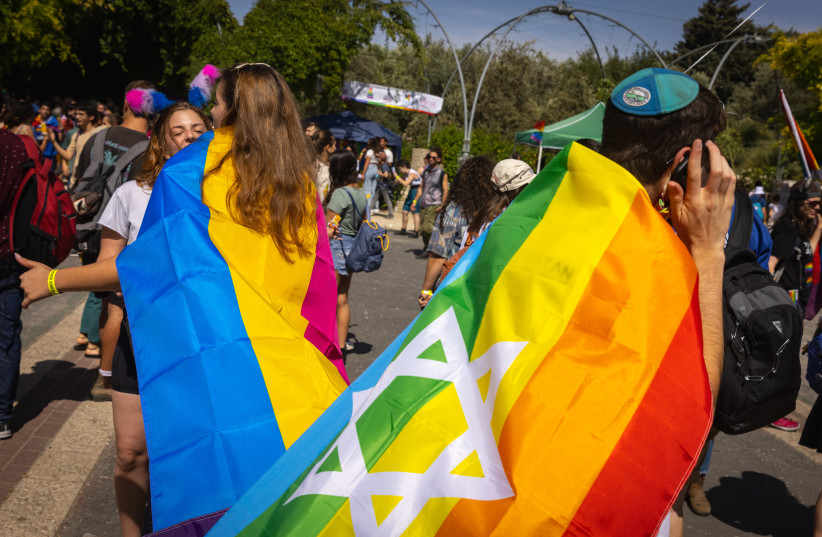
As Pride Month continues, In Jerusalem sat down with Schwartz to discuss his life, activism, and the struggles of reconciling religiosity and queer sexual identity.
How did you come out as gay?
In short, I went to conversion therapy at the age of 18, and I got married to a woman at the age of 26. We got divorced after four months. And in general, this was the time I had to start researching what it means to be gay and religious.
I came out at the age of 27, and it’s been 15 years now.
What does it mean to be gay and religious?
That is a very good question. I think, in general, it means that you’re always being questioned about your identity on both sides and from all directions, meaning the religious world questions me about being religious and gay, and the LGBTQ+ community questions me about being gay and being religious.
On a personal level, though, I have a story to illustrate it. I took a pasuk [phrase] from the Torah, and I framed it in my living room because I believe God wrote a pasuk for me: Ish asher yishkav et zachar mishkevei isha, toeiva asu shnei’hem. [“A man who lies with a male as one would with a woman, both have committed an abomination” (Leviticus 20:13).]
That’s the verse that is cited as condemning homosexuality. Why does it resonate with you?
I think it’s the foundation for everything.
I give lectures on being gay and religious. There are isurim [prohibitions] on everybody, and I always talk about the fact that no matter what identity someone defines themselves as, there are questions of what you’re allowed to do and what you’re not allowed to do.
Even straight couples have different halachot of what they’re allowed to do in terms of sex, but it doesn’t mean you’re not allowed to be straight. You just need to be aware of what you’re not allowed to do.
And we support straight people – that’s how more gay babies are born.
For me, I think it’s a fascinating situation because Halacha knows how to deal with things. Unfortunately, we do not yet have brave rabbis who are ready to take that halachic quest head-on and really try to find ways to deal with it.
I studied at Yeshivat Hakotel, and one of the rabbis gave us an example that I always use: a Shabbat elevator. When they created the elevator and asked if it could be used on Shabbat, the answer was no. But Jews wanted to get home on Shabbat, so they changed the question. They didn’t ask, Are you allowed to use the elevator on Shabbat?’ Instead, they asked, How can you use the elevator on Shabbat?’
So if you ask, ‘What are gays allowed to do?’ you’ll get typical answers. But if you ask, ‘How can I help LGBTQ+ people live a halachic life?’ then you’ll get more interesting answers.
I have spoken with different rabbis about things that are very LGBTQ+ specific. The problem is that nobody is willing to be outspoken about it because they are afraid of what will happen if they do.
What interesting answers?
One interesting question we had was regarding Yom Kippur and taking the medication PrEP, a preventative medicine against HIV.
Here’s the problem with PrEP. It needs to be taken every 24 hours with food. If you stop taking it, then you have to start over, and you shouldn’t have sex for seven days after you start taking it again.
If people know in advance, they can slowly change the time they take their medication to still be able to fast; but in this case, that wasn’t an option. So, would they be allowed to take PrEP on Yom Kippur?
The answer was no because stopping for seven days is not considered a significant hefsek [stoppage], according to Halacha. But the point is that the issue wasn’t about whether being LGBTQ+ is acceptable but rather about the halachot of taking medicine with food on a fast day.
We also had rabbis who had to look into mixed relationships (a Jew and a non-Jew). Family acceptance is also a big thing – how to get families to accept their LGBTQ+ kids.
Have you had issues being in a relationship with a man while also being religious?
It’s very hard to find someone who is gay and religious. I once did the math to find how many gay men live in Israel around my age and level of religiosity. Five people fit my agenda, and one of them is me.
I once spoke to a shadchanit [matchmaker] to create a shidduch [matchmaking] project, and she taught me something smart. She said there’s what we want and what we need. What I want is a guy who is religious, but what I need is a guy who understands my language – someone who isn’t necessarily religious but is willing to understand it.
Do you often feel unwelcome in religious spaces?
The truth is I feel welcome; I don’t feel excommunicated. Obviously, not everywhere and not at all times, but I built my own bubble of people I want to be with, and that is where I am and where I feel most comfortable. Interestingly enough, families of queers don’t have that because they have their friends, spouses, and families around it, so for them it’s sometimes harder.
One of my roles is head of Kehila, which is for religious members of the LGBTQ+ community and their parents to have discussions. They don’t have the same support groups that we have.
What sort of activism do you do?
I have Kehila, which is my biggest project nowadays. I also made a card game for LGBTQ+ dating, which is just a game with conversation starters. It has questions that everybody can answer, like ‘What kind of family do you want?’
Some questions specifically target LGBTQ+ people, like ‘Would you hang an LGBTQ+ flag on your house?’ ‘Would you feel comfortable walking hand in hand in public?’
My inspiration for the card game was that people from all groups have trouble with conversations. I feel that sometimes, people just need a nudge. After I made it, people came to me and said that they played the game at family gatherings and with friends. I made it for dating, but apparently everyone could benefit from help with having deeper conversations.
I also have the Pride Library, which is the largest LGBTQ+ Hebrew book collection in Israel. I have a website with all the books [www.pride-library.co.il/], some very rare ones, about all sorts of identities. You can find them all online, and the library is in my house.
I have books from the 1970s and 1960s, and I even have one book that was printed in 1943, five years before the establishment of Israel. It [the library] has been running for 10 years already.
My inspiration was that as a religious boy, I read many books. As I was coming out, I was looking for books that would be relevant to my life. I bought books about being gay and religious, and then I found more. And I got another book and another. It soon became a shelf, and then more shelves. Then, one day, a bookstore owner said he put aside a box of LGBTQ+ books, and I said I’d take them all.
Now we’re almost at 900 books.
I also have events for men who are attracted to men, which includes people who are trans, bisexual, gay, and asexual – the entire male spectrum. I do it in Jerusalem because I believe the change will come from Jerusalem. The last event I did got more than 160 men from all over the country just talking and being nice to one another. Some are religious, some are not. It’s just a nice mixture of people.

What does Pride Month mean for you?
It’s actually something I’m conflicted about. There’s something good about awareness and celebrating, but I’m also gay every other month of the year. I don’t want people to forget that. People who are celebrating can do so all their lives, and they should be accepted all year long. It’s like Mother’s Day – it’s important to have a day of appreciation, but a mother is a mother every other day of the year, too.
What do you think about the future of LGBTQ+ rights in Israel?
I sometimes ask this in my lectures. In Israel, it was illegal to have same-sex relations until the late 1980s. And I ask, what would have happened if they never changed it? If they proposed to change it in 2025, would the Knesset have been able to pass that bill?
Then I see the people smiling in their chairs and moving uncomfortably because I don’t think in the current situation that we can make a social change for LGBTQ+ individuals through the government. All the changes we’ve made are in the Supreme Court.
Now, are we [Israel] progressive? Yes, we are progressive compared to other places, and one of the most important people in the Knesset, Speaker Amir Ohana, is gay. But will the Knesset do anything for our community?
When someone targets LGBTQ+ people in Israel, it’s not considered a hate crime. When Yishai Schlissel stabbed people during Pride [the Jerusalem March for Pride and Tolerance of 2015, where Schlissel stabbed six people – wounding five and killing 16-year-old Shira Banki], they couldn’t charge him with a hate crime, even though it is a hate crime [he was convicted of murder and multiple counts of attempted murder and aggravated assault].
This is what worries me: We have a demographic in Israel that the Knesset is not willing to help.
What about marriage?
So, Israel does recognize marriages that are performed abroad. And one gets almost all the rights. Ironically, what I’m not allowed to do in Israel is sign a piece of paper. The government tried (unsuccessfully) to block the Utah marriages, but personally, I don’t feel that is my fight because if I cannot fight it for everybody, it’s not fair. It’s not fair that I could have the right to get married, while other people won’t.
For example, because in Israel there’s no civil marriage, a Jew and a non-Jew can’t get married, and two atheists can’t get married. I think there should be opportunities for everyone to get married. So it’s not about being LGBTQ+; it’s about taking care of individuals.
And you’re doing stand-up comedy?
Yes, I am doing stand-up. I think being religious is funny, and we should be able to laugh at things.
How did you get into stand-up?
It was a big mistake. I was supposed to give a lecture, and by mistake they wrote that it was a stand-up show, so I thought, ‘Okay, I’ll do stand-up.’ And so I prepared and got into it.
My lectures are always good anyway because I always try to make them somewhat funny and interesting, but there’s a line.
Like yesterday, I had a speaking engagement, and some religious people in the area said they wouldn’t attend. I made jokes, and I was wondering, ‘Would I have made those same jokes if those religious people were in the room?’
Stand-up comedy is the hardest art form because you always have to connect with your audience. You have to see where the limit is and how far you can push the envelope.
Any advice for anyone religious and gay?
Take your time. There’s no rush. Do it on your own terms, make sure you’re comfortable, and have a support group. Coming out is not a goal; it’s a means to an end. The goal is to feel comfortable with yourself and to feel good, and coming out is a way to do that.
So take your time, find a support group, start small, and find your peers – people like you who can share their stories.