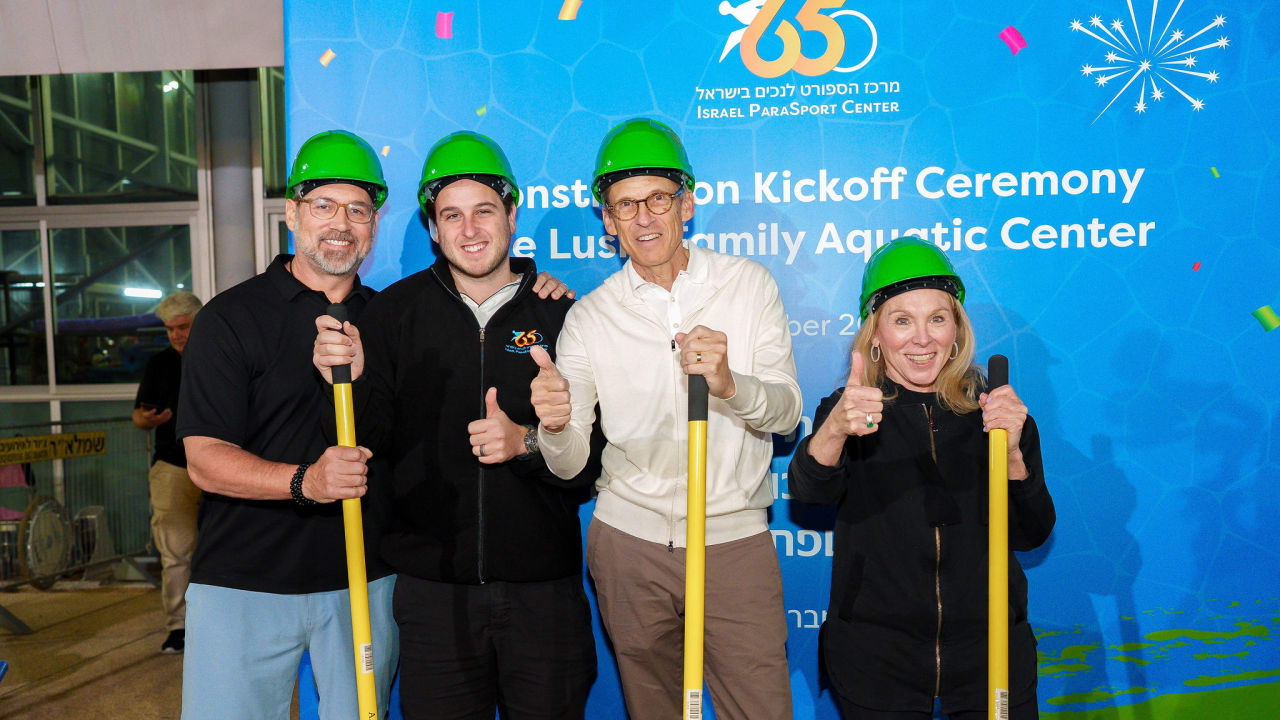
Last week, I had the honour of attending the 65th anniversary ceremony of the Israel ParaSport Center in Ramat Gan.
The center, established in 1960 by the disability charity ILAN, is a home away from home, a lifeline, and a source of strength for so many children and adults with disabilities.
Some of Israel's best Paralympic athletes have trained at the center, and it continues to be the base for multiple Paralympic teams and players (basketball, tennis and rugby in particular).
The center, known in Israel as the Spewack center, is there for everyone who needs it, at all levels, and for all disabilities.
Initially, there was only a basketball court, but the opening of the pools became one of the most important attractions and also a central point for the center's community.

Luski family funds new aquatic center for ParaSport
The main pool is not a hive of activity (even to the detriment of the ceremony, which started 30 minutes late because the kids did not want to leave the pool).
It hosts many swim competitions, parties and of course training sessions. There is also a hydrotherapy pool fully equipped for disabled individuals.
Always in pursuit of the best facilities and technology, the center's leadership has long been dreaming of a new aquatic center. About six years ago, US National Philanthropic Chair Jon Michaelon asked the head of Israel ParaSport Center, Boaz Kramer, "If you could do one thing, if money wasn't an issue, what would you do?"
Kramer responded that he dreamt of redoing the six-decade-old pools. Initial fundraising efforts were made, but needs increased significantly after October 7, and planning was put on hold.
However, the dream has now been made possible thanks to the generous contributions of the Luski family and the hard work of Jennifer Flink (CEO in the US), who were all present at the ceremony.
The Luski family's relationship with the center spans three generations, starting with Abe and Rose Luski, who donated to the center for decades, including sponsoring the previous hydrotherapy pool. The second generation, David Luski, and numerous Luski family members, including children and cousins, have now taken over the reins.
"When you talk about L'dor V'dor, from generation to generation, the Luski family is an exact example of that," said Michaelon. "From the grandparents, the parents, the kids, the grandkids."
David Luski told the audience that he hopes the new Luski Aquatic Center will enable many members of the community to participate in the activities and become confident members of society.
He told me that the Luski family is "so excited to be a part of this great opportunity to expand the sports center and to continue to support the great things that are being done here in the state of Israel."
He added that the ceremony was the most memorable part of his trip to Israel: "This particular moment right now. Having all the generations together."
The Luskis then buried a time capsule at the location where the new aquatic center will be constructed. The time capsule was filled with letters and notes written by US friends of the center to the present and future athletes with disabilities.
Empowering people with disabilities
The ceremony carried much deeper meaning for me: outside of my extremely busy job at The Jerusalem Post, I train as a wheelchair tennis player at the center alongside some of the world's best players, and my wonderful coach, Asi Stokol.
The center came into my life right when I needed it, without even knowing I needed it. Having, for the last eight years, toed the line between looking able-bodied but having a disability (after a femoral tumour), I've struggled with not being physically able to do normal sports, but at the same time being desperate to participate.
When Boaz Kramer asked me to try out wheelchair tennis, I scoffed. After much persuasion (he is very persuasive), I agreed to give it a try, and after a single session, I was hooked. It has become the greatest love and passion I could ever hope for.
But Spivak is much, much more than that. When I say it is a community, I mean it in the purest sense of the word. It represents life. The choice to live and to thrive, despite what is thrown at you.
It is impossible not to feel invigorated there. From children born with disabilities, to wounded veterans, to those disabled after accidents or illnesses, the center is a home for everyone. A home without judgment, a home where disabilities are not a defining characteristic, and most of all, a family.
After the ceremony, a lot of us, athletes, family members, trainers, the delegation from the US and their kids, headed to a bar to celebrate.
There, I sat and listened to some of the most amazing stories of empowerment, and of how the center raised them at a time when they almost didn't want to keep fighting. It will be a joy to watch the next generation enjoy the freedom that comes with not being limited by disabilities, and the pools will be a huge factor in that.
65 years later, Israel remains lucky to have the Israel ParaSport Center. May it continue to thrive.