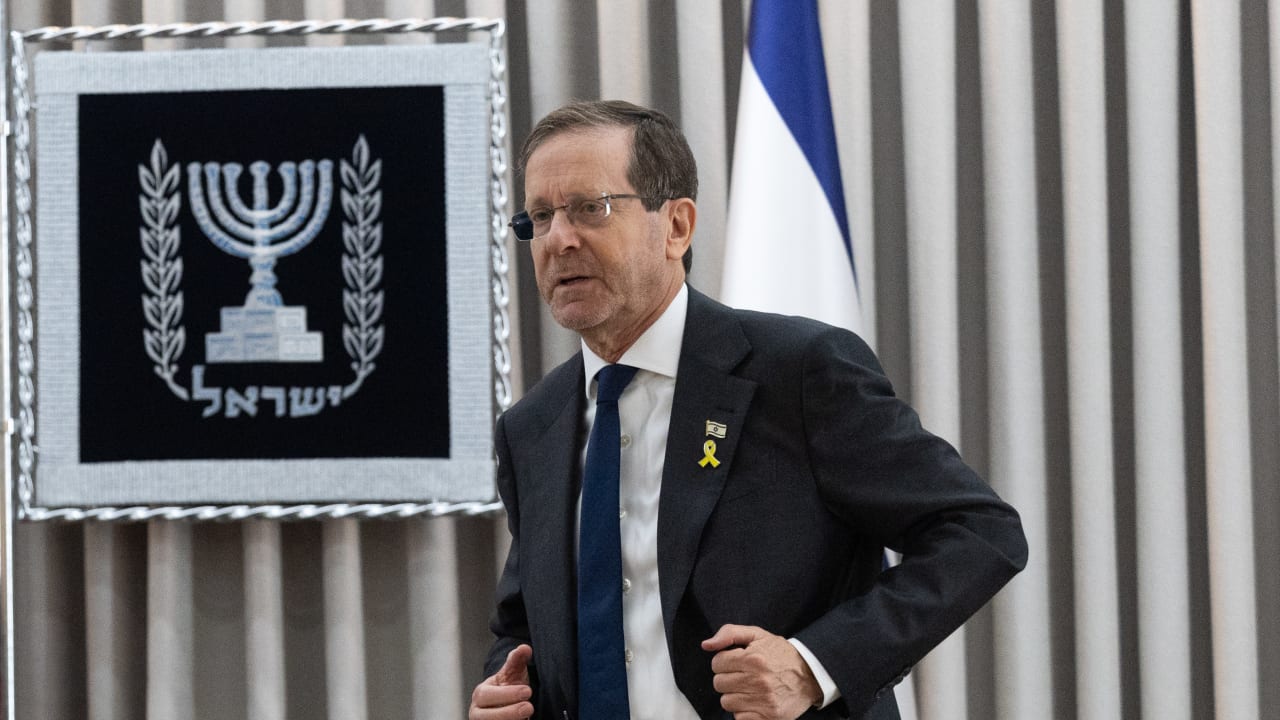
President Isaac Herzog demanded on Wednesday that Eliad Shraga, chairman of the Movement for Quality Government in Israel (MQG), immediately correct what the president describes as false and gravely defamatory remarks linking him to a purported secret pardon arrangement with Prime Minister Benjamin Netanyahu.
In a letter published on Thursday, Herzog, through his attorneys, accused Shraga of “statements that were grave beyond measure and wholly false,” following MQG’s public reaction to a Channel 12 investigation earlier this week.
That investigation, published on Tuesday, revealed the existence of a purported 2019 legal memorandum written by attorney Eyal Rozovsky, who was allegedly examining – hypothetically – the legal feasibility of granting Netanyahu a presidential pardon prior to conviction.
According to the report, the document was allegedly commissioned by someone “close to Herzog,” who at that time was not yet president. This report could not be independently confirmed.

Herzog demands retraction from MQG
The President’s Residence swiftly and unequivocally denied any connection between Herzog and the memorandum. Officials told reporters that Herzog had no knowledge of the document until the media contacted his office this week.
Despite the denial, Shraga declared on Channel 12 that the report amounted to a “political earthquake” and evidence of a “corrupt deal: immunity in exchange for the presidency.”
He further argued that the alleged circumstances required immediate criminal investigation and that any handling of Netanyahu’s current pardon request must be halted.
Within hours, the MQG formally petitioned Attorney-General Gali Baharav-Miara and State Attorney Amit Eisman to open a criminal probe.
But the confrontation deepened further on Thursday, when the MQG submitted a second, independent petition to the attorney-general and state attorney, this time demanding the immediate opening of a criminal investigation into suspicions that Herzog himself had been subjected to extortion attempts.
That petition cited a report in Haaretz alleging that businessman Moti Sander – described as a longtime associate of Herzog – conveyed messages suggesting that if Herzog granted Netanyahu a pardon, Sander would release sensitive information that could embarrass the president.
The MQG said that, if accurate, the conduct may amount to extortion by threats and warrants urgent law enforcement intervention. The organization also reiterated its demand to freeze all internal handling of Netanyahu’s pardon request until the matter is resolved.
This emerging picture, the MQG said, raises “grave concerns.” It added that it is “intolerable” for the president of Israel to face pressure from individuals said to hold sensitive material related to him.
Turning back to the Shraga-Herzog affair, in the initial response letter, the attorneys representing the president wrote that Shraga’s statements, made “with the authority of [Shraga’s] legal expertise” and broadcast to millions, launched a public campaign portraying Herzog as corrupt, criminal, and unfit for office.
Shraga made his remarks without first verifying even the basic fact of whether Herzog had known of the 2019 memo, they further wrote.
“It was incumbent upon you to examine whether the president was aware of the memorandum before offering sweeping and inflammatory conclusions,” the letter read.
“The news outlet, backed by your professional authority, initiated a public assault that presents the president as corrupt, as a criminal, and as someone deserving an investigatory warning,” it added.
The letter stated that Shraga’s allegations were “infinitely grave and endlessly false,” and insisted that Shraga coordinate an agreed-upon corrective statement with Herzog to try to mitigate the damage caused.
The Movement for Quality Government is one of Israel’s most prominent civil society watchdogs. For more than 30 years, the MQG has filed dozens of petitions to the High Court of Justice, challenged government appointments, and led high-profile anti-corruption campaigns.
Shraga, its longtime chair, is known for fiery public rhetoric and has made statements that aim to position the MQG as the state’s unofficial “anti-corruption prosecution” – a strategy that has drawn both praise and criticism.
During the 2023-2024 judicial reform crisis, the MQG was a leading organizer of demonstrations and legal challenges.
This latest scuffle comes mere days after Netanyahu’s legal team submitted a formal pardon request to Herzog. The request argued for “national unity” and the desire to stabilize the political system – an ask made while Netanyahu’s criminal trial, currently in its cross-examination stage, continues. The trial began five years ago.
Under Israeli law, the president has broad but not unlimited pardon powers. A pre-conviction pardon is legally possible but highly unusual, and would almost certainly undergo intense public and judicial scrutiny. The resurfacing of the 2019 memorandum, though never acted upon, has therefore intensified political sensitivities around the current pardon process.
Neither the MQG nor Shraga has yet issued the correction Herzog is demanding, and the attorney-general has not yet responded publicly to either of the MQG’s petitions.